
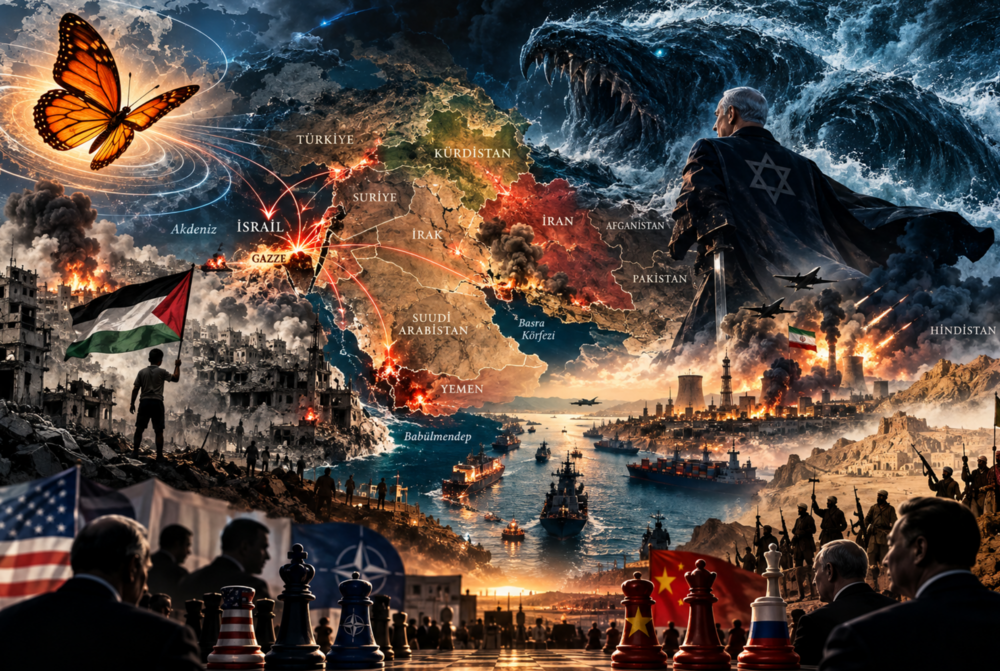
THE WAR ON THE BUTTERFLY'S WING IN WEST ASIA
On October 7, 2023, the terrorist attack launched by Hamas from the Gaza Strip into southern Israel set political fault lines in motion, triggering active dynamics of war across a vast geography extending through Lebanon, Syria, Iraq, Kurdistan, Iran, Saudi Arabia, Yemen, Pakistan, Afghanistan, and even India.
Recall Edward N. Lorenz's Chaos Theory, which suggests that seemingly insignificant movements in a system's initial conditions can produce enormous, unpredictable consequences, and his discussion of whether a butterfly flapping its wings in the Amazon rainforest might contribute to a tornado in Texas, halfway across the world. Metaphorically speaking, Lorenz's butterfly flapped its wings in Gaza, and half the world was plunged into something resembling chaos.
Besides inflicting severe pain on Israel, the attack caused the sudden collapse of Israel's entire Southern Command, the deaths of approximately 1,200 civilian citizens, injuries, and the capture of hundreds of hostages. The shock confronted Israel with the problem of its very survival that has haunted it since its founding. But the butterfly had already flapped its wings; instead of contending with butterflies each time, setting the forest ablaze presented itself as a radical solution to Netanyahu, who had proclaimed himself a second Ben-Gurion. It was time, then, to awaken Leviathan, the sea monster of chaos described in the Bible.
Leviathan is also the title of the book published by Thomas Hobbes in England in 1651. Profoundly influential in Western philosophy and political thought, this book sought to formulate a theory of absolute political power by removing the authority of the Holy Roman papal order from the state system of Europe generally and from civil-war-torn England in particular. For Hobbes, this power was the secular political state. The biblical sea monster Leviathan became, in Hobbes's work, a symbol of the state: a power independent of religion and holding the exclusive monopoly on the use of force. England, in this account, needed such absolute power to eliminate the authority of the Roman papacy and its domestic extensions, which threatened to tear it apart. The state therefore had to become Leviathan. Leviathan's sword was to be the power of the state. Power was right, right belonged to the state, and in England this meant the modern bourgeois state. Whether one agrees or objects, Hobbes theorized the state of a new age emerging against medieval political structures at a historical turning point.
An aside: The Latin phrase homo homini lupus, or “man is a wolf to man,” expresses Hobbes's view that if human beings remained in their original state of nature, everyone would become an enemy to everyone else. Hobbes adopted a perspective grounded in human progress, and such progress plainly did not entail encouraging humanity to remain in primitive communal society. His point was that without progress, people would devour one another. Yet Hobbes's theories, like evolutionary theory, have been distorted. It is not easy to dismiss his argument that remaining in a primitive condition would make everyone an enemy to everyone else. There is no guarantee that, if society were frozen in such a condition, humans would not become wolves to one another. In this sense, Hobbes was a progressive thinker who rejected a return to the past through the law of the wolf. The continuing existence of political movements that idealize a return to ancient times and invoke Neolithic nostalgia makes it necessary to revisit Hobbes.
Today, just as in seventeenth-century England, Leviathan—the symbol of modern state power wielding a sword—has been set in motion in the hands of the Israeli state as a regional war monster after October 7. Acting on the principle that “might makes right,” Leviathan continues to operate Lorenz's butterfly effect across the expanse from Gaza to India.
Israel, long threatened with being “wiped off the map” by the Islamic Republic of Iran, ultimately turned Hamas's October 7 terrorist attack into a pretext for directly targeting Iran. On June 13, 2025, with US support, it launched the devastating conflict that entered history as the “Twelve-Day War.” The war, later named Operation Rising Lion, continued with US involvement, the destruction of Iranian nuclear facilities, and strikes against specific targets. While the United States amassed the largest warships in the region, Iran developed an initiative through the Houthis in Yemen and took control of the strategic Bab el-Mandeb Strait. A new front opened on the butterfly's wing. The closure of Bab el-Mandeb and the Persian Gulf would carry the risk of triggering new global crises affecting the entire world.
A second aside: Yemen is a poor Arab country bordering wealthy Saudi Arabia. Throughout history, its people have been fighters willing to make sacrifices, and they were among the leaders of resistance against the Ottomans. These were lands where the Ottoman armies besieged by Imam Yahya's forces were defeated under the slogan “Not a handful of wheat shall pass.” In Yemen, almost every locality has a designation called Makbarat al-Atrak (“the Turkish cemetery”). Nearly 300,000 Ottoman soldiers, or according to some sources as many as one million, lost their lives in Yemen. Tragically, the leaders of Yemen’s Arabs, too, were hanged before the walls of Diyarbakır, just like Sheikh Said and his spiritual guides.
The opening of the Saudi–Yemeni war front will unleash dynamics that further intensify tensions between the US–Western alliance and the Eurasian alignment of China and Russia. As we have stated in earlier analyses, this war is a manifestation of the struggle for global hegemony between these two blocs. It is worth recalling that while the world was once divided into the Soviet and NATO camps, in Western Asia the Soviet Union positioned itself along the Shiite current and NATO along the Sunni current, with each side periodically attempting to disrupt the balance through Iraq and Egypt. It would not be inaccurate, within this framework, to regard Nasserism, Gaddafi's Green Socialism, and Baathism as ideological currents occupying a space between these two poles. Kemalism has a similar character. Of course, the global powers did not create these two currents; their existence goes back much further. Shiism emerged as a barrier against Islam's expansionist transformation during the era of the caliphal conquests. In essence, it can be summarized as a reflection of the historical struggle between Zoroastrian peoples and Islamic Semitic peoples. Imperial powers seeking hegemony in Western Asia have always had to establish themselves within one of these two currents; doing so in both simultaneously was not possible then and appears unlikely today. Like the tectonic movement of continents, these two political lines push against each other.
In light of this history, the Sunni camp centered on Saudi Arabia continues to regard Iran as a vital threat. It was decided, on the basis of the Abraham Accords, to take action under Israeli–US leadership against an increasingly powerful Iran. Beyond being an Iran–Israel war, this conflict has now almost become a war between Shiite and Sunni Muslim countries and forces. The Shiite shield led by Iran and the Sunni Islamic shield led by Saudi Arabia stand face to face along the Yemen war axis. The confrontation between the Sunni Shield and the Shiite Shield has become clearly visible in Western Asia. The announced “Mecca Alliance” of Saudi Arabia, Turkey, and Pakistan, with Egypt to be included, signals preparations to move against Iran's Shiite shield. Some assessments describe this development as the establishment of a “Middle Eastern NATO” under US control. Also under discussion are arguments that US strategic planners intend to delegate regional security to guarantor states—Turkey, Israel, and Saudi Arabia—and withdraw American military forces from Western Asia. According to the purported plan, various commentators suggest that the Levant would be assigned to Israel's guardianship, the Gulf region to Saudi Arabia, and Rojava, Bashur, Rojhilat, Armenia, and Azerbaijan to Turkey.
Keeping these scenarios in mind, it has become necessary to briefly examine the condition of the Sunni and Shiite Shields, address the situation of the Kurds from this perspective, and offer a projection for Kurdish political thinking. On that basis, I would like to highlight the following:
Iran: First, as the country at the center of the war, Iran has suffered severe damage without collapsing; yet although it has not collapsed, it has lost a significant share of its power. Its deterrence has weakened. The network it built as far as Gaza, which it called the “axis of resistance,” has been militarily defeated in the case of Hamas. Lebanese Hezbollah has been weakened, although its capacity has not been destroyed. Iran has been defeated in Syria, and efforts are underway to encircle pro-Iranian forces in Iraq. The front on which Iran has succeeded is Yemen, where it has placed Saudi Arabia under threat. Despite being battered, if the war continues at this level, Iran may learn during the fighting, improve its ability to survive, and strengthen its capacity for resistance. Friedrich Nietzsche's metaphor, “What does not kill me makes me stronger,” may find a wartime expression in Iran's case; that would hardly contradict the nature of the situation.
Saudi Arabia: Saudi Arabia has been defeated in Yemen and, fearing an invasion by Houthi forces, is seeking protection by assembling mercenary armies. Incredible as it may sound to many, Saudi Arabia does not have an army in the conventional sense. Fearing a coup from within, the royal family designed a nominal army and effectively transformed it into a police organization in military form. This is not unlike turning a predatory carnivore into a herbivore. That transformation has trapped Saudi Arabia in a snare of its own making during this war. Even the air force in which it invested is functionally weak, since many of its pilots were recruited from abroad, especially Pakistan. Perhaps most importantly, Saudi Arabia lacks a political society acting with the spirit of a united nation. All this shows how fragile the country remains without the United States. If the US does not put its weight behind it, whether the Mecca Alliance and assembled mercenaries can adequately protect Saudi Arabia requires careful analysis.
Israel: In terms of its current regional policies and long-term strategy, Israel may be the only state that would desire the establishment of an independent Kurdistan as a matter of its own security. But it cannot accomplish this through its own power. It would need to persuade the United States and Europe, which is far from easy. Although the Iranian and Shiite axis poses a major threat in the near term, the Sunni Arab axis is, in essence, a more existential threat for Israel. A Kurdish state in the region is almost an essential part of Israel's struggle for survival.
The Kurds: Because a large majority of Kurds in all four parts are Sunni, they naturally fall within the Sunni axis; political actors are also steering them in that direction as a matter of choice. In Bakur, efforts to enter this axis through Turkey proceed via the “Terror-Free Turkey / Peace Process” associated with the now-dissolved PKK, while in Rojava they proceed through integration. In Bashur, the PUK has also begun moving away from Iran, aligning itself with Turkey and acting in coordination with it. In the Iraqi presidential election and the election for governor of Kirkuk, the PUK allied with Turkey, making this preference evident on the ground. The KDP, meanwhile, has historically maintained a tradition of friendly relations with Turkey. These three principal currents are the actors currently determining the Kurds' direction, and they have openly displayed a tendency to position themselves within the Sunni axis under Turkey's protection. The question, then, is this: What does the Sunni axis promise the Kurds in terms of national rights? Although it supported a common state between Iraqi Sunni Arabs and Kurds against an Iran strengthened in Iraq during the Maliki government, today it does not even encourage the granting of any national rights to the Kurds in Rojava. Turkey already holds the most rigid position on this question and appears unlikely to show flexibility. Iran, for its part, is now a colonial state struggling to manage its own problems and, for many reasons, lacks much of the scope and means to draw Kurds in all four parts into its axis.
In conclusion: This is the present situation in Kurdistan from the Kurdish perspective. Yet there is no reason to assume it will remain so in the medium or long term. If the Kurds, one of Western Asia's most ancient peoples, wish to exist on the world stage as a nation, they must overthrow colonialism, establish their own nation-state, and reunify their divided homeland. Because if a nation has no state, it is condemned to extinction. To achieve this, it is necessary to move beyond the parties that block Kurdish politics across the four parts of Kurdistan and in the diaspora, effectively holding the Kurds hostage. In fact, the existing mainstream Kurdish parties are worn down, exhausted, and in many respects decayed. However powerful they may appear from outside, they fundamentally lack the firm and determined national will required to address the challenges of the age. There is a need for revolutionary leadership that strategically places independence and the reunification of all four parts at the center of its program and aims at national and social liberation. For Kurdistan's socialists and all national liberation movements, this is a task that cannot be postponed. Only such leadership could unite and mobilize the entire people, apart from a handful of national traitors.
In the present climate of confrontation in Western Asia, there is still no leadership on the ground with the clarity and determination to turn the Kurds' sense of national unity into political will for independence. Rather than asserting themselves in the regional equation, existing actors appear resigned to the favor of being placed under another power's protection. Yet if Kurdish political thinking knew how to assert itself, it would be evident that the Sunni Shield could not succeed without the Kurds, nor could Iran be brought to its knees without them. The path of both axes runs through Kurdistan. If the Kurds cannot find a way to make themselves valuable as an independent actor between these two powers, they will, like all appendages—and as is currently happening in Rojava—leave themselves at the mercy of those who dominate them. I believe it is time for all of us to read Hobbes.
15 October 2026