
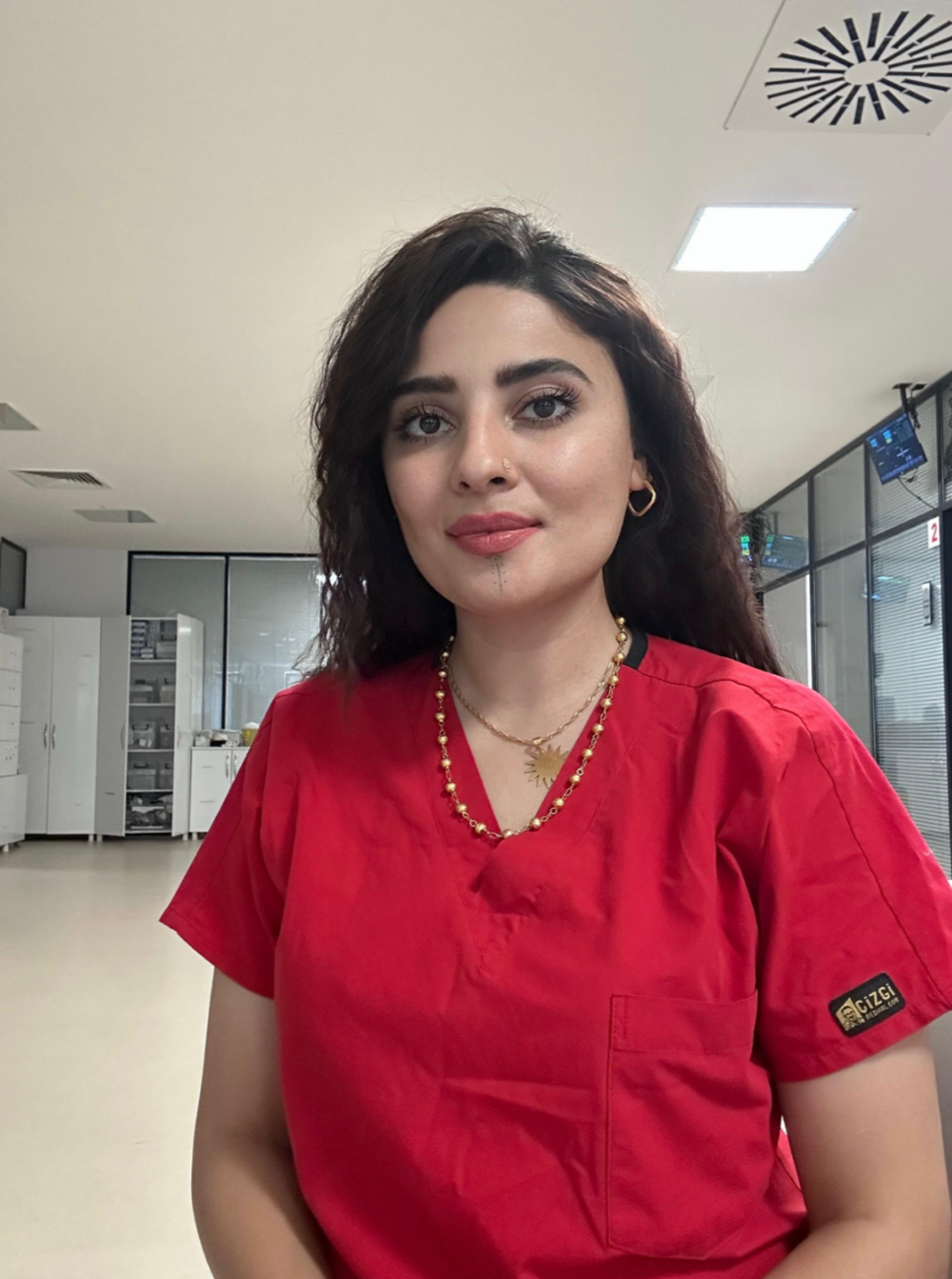
Mother of Bavê Teyar, the Midwife Who Condemned the Brutality in Aleppo, Receives Prison Sentence
Midwife Melike Ayten, who works at a state hospital in Mardin, was sentenced to one year and eight months in prison for “propaganda of an organization” because of posts on her X account. Among the posts in the file are a prayer written after the Kurdish comedian Bavê Teyar, a reaction to a woman’s body being thrown from a building in Aleppo, and a photograph taken with the official flag of the Kurdistan Region.
The Mardin 2nd Heavy Penal Court announced its judgment on Melike Ayten during the second hearing held on 10 September 2026. Ayten, who was on duty at the hospital that day as a midwife, could not attend the hearing; her statement had been taken at the first hearing. Her lawyer’s request for postponement was rejected on the grounds of “reasonable time” and “target period,” the prosecutor delivered his indictment in the same session and the verdict was rendered. The record notes, “The defendant was not present, so a final statement could not be taken.”
Ayten has been employed as a midwife at Mardin Education and Research Hospital since 2019. The case against her is based on an “Open Source Research Report” prepared by the Mardin Provincial Gendarmerie Command in January 2026.
Posts considered criminal
The first piece of evidence listed in the report is a farewell message dated 19 January 2025.
Cuma Xelîl, a comedian and theatre artist from Qamişlu (Kamışlı), known among the public as Bavê Teyar, was seriously injured in an air strike on a convoy of civilians at the Tişrin Dam on 18 January 2025 and died the following day.
Since 1989, Bavê Teyar had been performing theatre and sketches, and producing short films known to both children and adults.
Ayten's message consisted of a farewell and a prayer: “May Allah, the Merciful and Compassionate, make your place green and fertile.”
The gendarmerie report, however, labeled Bavê Teyar as a “member of an armed organization” without providing any basis.
Most of the other posts in the file relate to the attacks on Aleppo’s (Halep) Sheikh Maqsoud and Eshrefiye neighborhoods in January 2026. In clashes that began on 6 January, forces linked to the Syrian transitional government entered Kurdish neighborhoods. According to reports from Reuters, BBC, Al Jazeera, AFP and AP, dozens of civilians were killed and more than 140,000 people were forced to abandon their homes. A video released on 10 January showed armed men throwing the body of a woman from the Kurdish security forces (Asayish) off a building. The Syrian Network for Human Rights (SNHR) verified that the footage is authentic and called for an independent investigation.
Ayten reposted the video together with a post from another user who had written, “What brutality! Damn you and your seven fathers!” The record attributed those words to Ayten. The court classified this condemnation of the violence as “propaganda.”
The list also includes Rudaw's report on an exhibition opened in a Qamishli art gallery that focuses on mothers' dreams, as well as a video of Rojava University graduates visiting a cemetery. In a photo shared on December 17, 2025, on the official Flag Day of the Kurdistan Region, Ayten is shown carrying the Kurdistan Region flag that was given to her during the Newroz celebration in Akrê (Akre) in March 2025. The indictment describes this flag as the “official flag of Northern Iraq.” The same flag had been photographed on February 26, 2017, alongside Turkish and Iraqi flags when President Erdoğan received Masoud Barzani in Istanbul.
"A City in America" translation
The file was prepared carelessly. Although all the posts were taken from the X account, the indictment states that the crime was committed on the social networking site called Facebook. A post dated January 2026 appears in the record and the judgment as dated “11/01/2016.” The Arabic heading “meşahid,” used by Rojava University and meaning “images,” was translated in the record as “Mushahid is a city located in the United States of America.”
In her testimony, Ayten explicitly said that the account belonged to her, claimed she was unaware that the individuals in her posts were members of an organization, and said: “I definitely did not make my posts to praise any organization.” She added that her purpose was to express the grief she felt in the face of mothers, women and baby deaths.
How was the sentence calculated?
The court sentenced under article 7/2 of the Anti‑Terror Law to one year in prison. Because the crime was committed “through the press and publishing,” the term was increased to one year and six months, and because the posts were made on different dates, the “chain crime” provision was applied, raising it to two years. With a good‑conduct reduction, the sentence became one year and eight months. The court postponed the announcement of the judgment (HAGB). This does not amount to an acquittal: Ayten will be under supervision for five years. If, during that period, she is tried again for an intentional offense—e.g., because of a new post—the one‑year‑and‑eight‑month sentence will be enforced. The 2,000‑TL translation cost for translating the Kurdish posts was also charged to Ayten. As a public official, Ayten could also face a disciplinary investigation for the same posts.
Contrary to Supreme Court decisions
The Constitutional Court, in its 2019 rulings on Ayşe Çelik and Academics for Peace (Zübeyde Füsun Üstel et al., 2019), held that propaganda for a terrorist organization can only be constituted by statements that legitimize, praise, or encourage violence. In its 2021 ruling on Ömer Faruk Gergerlioğlu, the Court stated that sharing a news item does not mean endorsing the statements contained in it. The European Court of Human Rights, in its 2021 Üçdağ v. Turkey judgment, considered a conviction under Article 7/2 to be a violation of freedom of expression because the content and context of the social‑media post had not been examined.
That analysis was not carried out in Melike Ayten’s case. Praying for a deceased artist, condemning an attack on a woman’s corpse, sharing a news item about an exhibition, and having a photograph taken with a flag that Turkey displayed in an official ceremony were all deemed “terrorist propaganda.” Ayten will lodge an appeal with the Diyarbakır Regional Court of First Instance.
This decision, which convicted a health worker for sharing the grief of civilians killed in Syria, criminalizes the mourning of Kurds and is unacceptable. The ruling must be overturned, and Melike Ayten should be acquitted.