
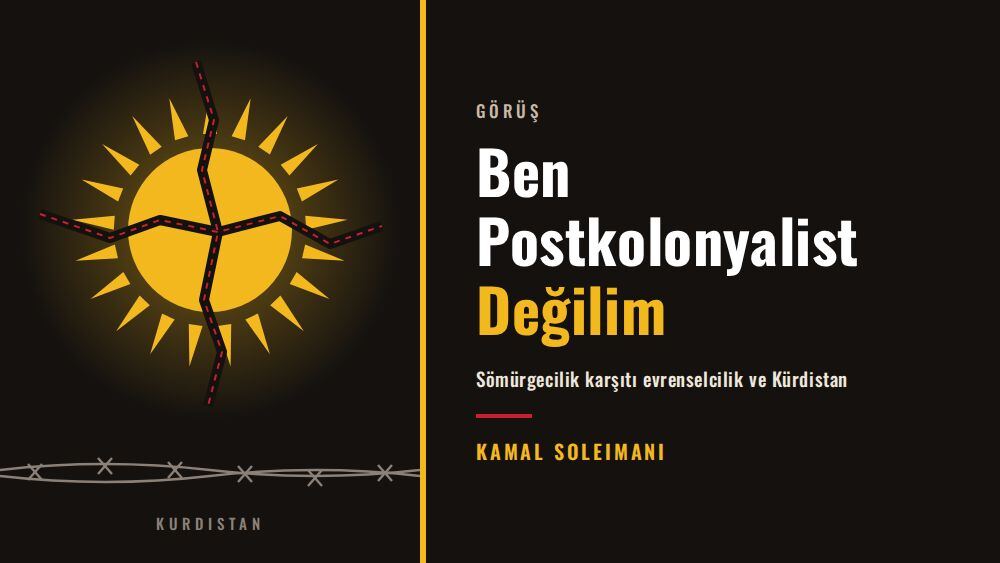
I Am Not a Postcolonialist
Reading Kurdistan not as “post”-colonial but as an ongoing colonial condition: the case for anti-colonial universalism
I have spoken many times about the difference between opposing colonialism—that is, anti-colonialism—and postcolonialism. Even so, I am constantly asked questions about postcolonialism. First, I see postcolonialism as a body of readings, perspectives, research and analytical tools. Postcolonialism is not a theory. Second, although I cannot set out all of my criticisms of postcolonialism here, I will address some of its shortcomings in the context of the Kurdish national question.
Postcolonial studies can contribute to understanding the Kurdish question. But when they are made the principal framework for understanding Kurdistan, they fall short and create serious problems. My position is not postcolonial in the proper sense of the word; it is anti-colonial. This distinction is not wordplay; it concerns Kurdistan's historical time, its material reality and its political claims.
The concept of the "postcolonial" has been ambiguous and vague from the start. In its narrow sense it can refer to the period after the end of formal European colonial rule. In its broad sense it covers critical approaches that examine the continuing cultural, epistemic and political effects of colonial domination. In this broad sense, postcolonial studies offer useful analytical tools. They have taught us to question official archives, to examine the politics of representation, to expose the false claims to universality of imperial knowledge, and to investigate how domination operates through language, education, literature, security discourse and racial hierarchies. These questions matter for Kurdish studies (Said 1978, 1981).
But we cannot understand Kurdistan merely as a place living through the aftermath or legacy of colonialism. Kurdistan is not "post"-colonial in the sense that colonial rule has ended and only its traces remain. Kurdish society still lives under active, physical, administrative, military, linguistic, economic and epistemic forms of colonial domination. The states that rule Kurdistan did not merely inherit the colonial structures of a past era; they continue to reproduce those structures today.
These states deny Kurdish sovereignty, restrict the Kurdish language and Kurdish education, divide Kurdistan, turn Kurdish politics into a security issue, plunder its resources, alter its demographic make-up, criminalise collective demands and often refuse even to recognise the political existence of the Kurds. This is not the indirect legacy of a colonial system that has come to an end. It is a condition of ongoing colonialism.
That is why Abdul-Rahman Ghassemlou's early observation, which described the situation of the Kurds as "a classic case of colonialism", still retains its conceptual force (Ghassemlou 1965). It was not rhetorical exaggeration. Kurdistan is divided among several states; its lands have been fragmented and governed through different national assimilation projects. The Kurds have been subjected to collective violence, forced displacement, cultural destruction, racialisation and political denial. The Anfal Campaign and the chemical attack on Halabja were not isolated atrocities but parts of a wider anti-Kurdish structure of power. Thousands of Kurdish civilians were killed in the 1988 attack on Halabja; Human Rights Watch estimated the death toll at between 3,200 and 5,000 (Human Rights Watch 1993). Nor can the political and religious mobilisation for violence against the Kurds carried out by the Iranian state—including Khomeini's 1979 fatwa and its consequences—be seen merely as an internal conflict. That mobilisation was part of a colonial order that coded the political existence of the Kurds as rebellion, blasphemy, sedition or a threat to national and religious unity (Soleimani and Mohammadpour 2020).
The situation of the Kurds is not an ordinary case of colonisation among others. It is a distinctive, multidimensional colonial system that operates within the borders of at least four states through different but interconnected mechanisms: Turkish nationalism and Turkification; Iran's Persian-centred conception of the state and its assimilation policies; Arab nationalism and Baathist destruction; Arabisation and political exclusion in Syria (Ghassemlou 1965; Human Rights Watch 1993; Soleimani and Mohammadpour 2020). Colonial domination in Kurdistan has religious, cultural, political, economic, spatial, environmental, linguistic and racial dimensions. Though its forms change, its basic principle stays the same: Kurdish existence can be folklorised, securitised, managed, assimilated or, under certain conditions, tolerated; but it cannot become an equal source of sovereignty.
This is where the limits of some postcolonial approaches appear. While their vocabulary illuminates epistemic domination, it can also obscure the continuing material power of colonial rule. Dwelling excessively on discourse, hybridity, representation, fluid identities and the instability of categories can make it harder to call military occupation, the partition of land, genocide, the plunder of resources, demographic engineering, language bans and anti-Kurdish state violence by their real names. What the Kurds experience is not only misrepresentation. It is the material usurpation of their land, their political power, their institutional capacity, their education, their security and their collective right to self-determination.
A serious anti-colonial approach must reject the false opposition drawn between discourse and material power. Discourse matters, because it legitimises violence. When anti-Kurdish states label Kurdish politics "terrorism", they are not only trying to discredit it; they are also licensing surveillance, imprisonment, military operations, diplomatic exclusion and the criminalisation of an entire political horizon. But the struggle does not end at the level of language. Kurdish sovereignty, statehood, land, education, institutions and collective security are material questions; they cannot be reduced to discourse or to the complexities of identity.
For the same reason I strongly oppose postcolonial scepticism towards the Enlightenment and universal values. The history of the Enlightenment is entangled with European empires, racial hierarchies, notions rooted in civilisational arrogance and the false claim that reason was represented by Europe alone. These histories demand unrelenting criticism. But criticising the Enlightenment must not turn into rejecting critical reason itself. That would mean abandoning the critical mind; outside critical reason, what is left but superstition? This is why even the Islamic Republic of Iran and Erdoğan can use postcolonial arguments, in the name of opposing "Islamophobia" and Orientalism, to shield their own power from criticism.
For the Kurds, universal principles are indispensable: equality before the law; the equal worth of people and of nations; freedom of expression; the accountability of power; the right to self-determination; national sovereignty; the public justification of political claims; education in the mother tongue and the right of a people to determine its own political future. The modern universalist form of these rights developed within the debates of the Enlightenment (Hunt 2007). Anti-colonial politics cannot survive by abandoning these principles and taking refuge in cultural relativism, civilisational essentialism, religious authority or leader-centred claims to truth. The task is not to defend Europe as the embodiment of reason. It is to defend the principle that no state, nation, race, religion, sacred text or charismatic leader holds an absolute monopoly on truth.
My disagreement with some forms of postcolonial studies also has a moral dimension. Anti-imperialism is often reduced to opposing only the West, especially the United States and Europe. This approach sets up a crude binary between "the West" and "the Rest": as if non-Western states and movements were automatically victims of colonialism, or as if colonial domination could originate only in the West. Sadiq Jalal al-Azm's critique of "Orientalism in reverse" helps to name this danger: even when the moral signs are reversed, the essentialist East–West divide can persist (al-Azm 1981).
This binary can also be seen in Kurdish academic debates. The concept Kamran Matin calls "inter-subaltern colonialism" draws attention to how a state occupying a subordinate position in the international order can exercise domination over stateless peoples within its own borders (Matin 2022). My objection is that the term risks placing the Turkish state and the Kurds in the same broad category of subalternity. Turkey is a state with an army, borders, international recognition and NATO membership; the Kurds are a people deprived of the right to statehood and subjected to the rule of that state. Calling this relationship "inter-subaltern" can make Turkish colonial power look like a secondary variant of Western domination.
Mamdani's book Neither Settler nor Native examines how colonial and national projects produced permanent political majorities and minorities in different historical cases (Mamdani 2020). Matin cites Mamdani in his analysis of the mutual constitution of colonial rule and the modern state (Matin 2022). But Mamdani does not examine the Kurds or Kurdistan as a case of minoritisation or colonial state formation. The Kurds appear in the book only in a short footnote referring to complicity in Iraq's Anfal Campaign; they have no place in the main analysis of permanent minorities (Mamdani 2020, 386, n. 7). This omission matters. A book that makes broad claims about colonialism, the nation-state and the production of permanent minorities leaves out a people divided among states and denied political sovereignty, even though that people stands at the centre of these very questions. Matin's recourse to Mamdani makes the problem even more apparent: the concept may help explain how states produce minoritised communities, but the Kurdish case remains outside Mamdani's own analysis.
This binary is historically and morally indefensible. In what is called the "Global South" there are states and movements that have built projects of ethnic supremacy, linguistic assimilation, territorial expansionism and internal colonial rule. The states that rule Kurdistan are clear examples of this. The rule of the Turkish state does not become anti-colonial because Turkey was not formally colonised by a European empire, as Algeria or India were. The Iranian state cannot be exempted from accountability because it chants anti-imperialist slogans. Nor do Arab nationalist regimes become liberators because they oppose Western intervention. A state's relationship with Europe does not erase the crimes it has committed in its relationship with the Kurds.
The Islamic Republic of Iran lays this problem bare. It has long presented itself as an anti-colonial and anti-imperialist power, using the language of resistance to Western hegemony to gain political and moral legitimacy. This propaganda cannot conceal the colonial relationship Iran has established with Kurdistan. For the Kurds, the directly colonial powers are Iran, Turkey, Iraq and Syria. These states differ in their political forms, ideologies and historical trajectories; but all of them have established domination over Kurdistan through partition, denial, assimilation, securitisation, military force, demographic engineering and the suppression and violation of Kurdish political sovereignty (Ghassemlou 1965; Soleimani and Mohammadpour 2020).
That is why I keep my distance from forms of postcolonialism in which "America" becomes the theological name of absolute evil, Khomeini's "Great Satan". Kurdish history cannot be read through such moral simplification. In both Southern Kurdistan (Başûr) and Western Kurdistan (Rojava), the survival of the Kurds has depended to a significant degree on the presence of the United States. This does not make America a benevolent power, nor does it erase its history full of imperial intervention, abandonment and self-interested alliances. It means only that concrete political decisions must be made on the basis of material conditions, not ideological reflexes. For societies facing the threat of genocide, mass deportation or annihilation by regional states and jihadist forces, the military or diplomatic presence of the United States can create a space for survival that would not otherwise exist. An anti-colonial ethics must be able to see this reality without turning into a defence of American power.
The decisive question is not whether a power is "Western" or "non-Western". What matters is what that power does, whom it protects, whom it subjugates, and under what historical conditions it does so. Kurdish politics cannot accept an anti-imperialism that whitewashes the crimes of Iran, Turkey, Iraq and Syria because these states are non-Western. Nor can it accept a postcolonialism that treats the survival of the Kurds as secondary to an abstract hostility towards the United States.
The same problem appears in some postcolonial defences of religious extremism, repressive nationalism and anti-democratic political projects. When anti-colonialism is reduced to defending every power that stands against the West, it loses its moral foundation. It can produce excuses for regimes that oppress women, persecute religious minorities, erase linguistic nations, criminalise opposition or practise collective violence against the Kurds. This is not an anti-colonial ethics; it is geopolitical campism (Matin 2022).
For the same reason I do not regard Edward Said as an intellectual authority. Many aspects of his critique of Orientalism remain important for showing how imperial knowledge represented and governed the non-Western world (Said 1978, 1981). But the Kurdish question also exposes the limits of the frameworks of figures such as Said: these frameworks can remain too attached to the assumptions of Arab nationalism; they can approach Kurdish demands for independence or political autonomy with excessive suspicion; and they can be all too inclined to interpret criticism directed at a repressive non-Western regime in advance through the lens of Western imperialism.
An anti-colonial ethics must transcend geographical boundaries and be consistent everywhere. While condemning the violence of Western imperialism, it cannot belittle, relativise, ignore or deny the anti-Kurdish violence and genocide perpetrated by Arab, Turkish and Persian states or by the Islamic Republic of Iran. Said's 1991 article in the London Review of Books questioned Iraq's responsibility for Halabja and relied on a US Army War College report that blamed Iran (Said 1991). Human Rights Watch's research documented Iraq's responsibility and questioned the evidentiary basis of that report (Human Rights Watch 1991, 1993). Said's approach to Halabja is a striking example of how opposing a Western war can lead to the denial or minimisation of a documented atrocity against the Kurds.
The same point applies to the concept of decoloniality. Decolonial thought offers important insights, particularly through its analyses of the coloniality of power, knowledge, race and language. It helps us understand that formal independence did not end colonial hierarchies. But it must not become a vocabulary that hides active colonial domination behind abstract definitions of "coloniality". In Kurdistan, being colonised is not merely an epistemic structure or a cultural legacy. It is an active political system that operates through armies, prisons, borders, intelligence agencies, legal and school systems, settlement policies, economic plunder and everyday killings such as the shooting of kolbers (Soleimani and Mohammadpour 2020).
The Kurdish question requires a framework capable of analysing a colonialism that is ongoing, spread across more than one state and materially organised. Such a framework must examine the coloniality of knowledge and of sovereignty; representation and land; discourse and genocide; racialisation and the material forces that keep the machinery of Kurdish destruction running every day. It must also place law, military force, education, infrastructure, demography, ecology and the right to build political institutions at the centre of the analysis.
Such a framework must not rest on a simple, blind nationalism that sees the Kurds as always innocent or internally monolithic. Kurdish society, like any other, must be open to criticism with regard to patriarchy, class domination, partisan authoritarianism, religious oppression, linguistic hierarchies and violence. But internal criticism must not be confused with the state-centred denial of the Kurds' national existence. The demand for Kurdish sovereignty is not an irrational relic of nineteenth-century nationalism. It is a human response to the material conditions in which the Kurds have been systematically deprived of security, equality, language, land and political agency. In the political discourse of the Middle East, Kurdish nationalism, claims to national rights and the desire to found a state are again and again deemed illegitimate, while the Palestinian demand for statehood is not condemned on the same grounds.
The question of a Kurdish state is not an embarrassment to be brushed aside by an abstract glorification of statelessness. It is a question of survival, protection, institutional capacity and political equality. There is no guarantee that a Kurdish state—or, more realistically, more than one Kurdish state and autonomous political entity shaped by Kurdistan's differing conditions—would be democratic or just. There is no such guarantee for any state. But the absence of Kurdish sovereignty has not brought freedom. It has created permanent vulnerability to partition, assimilation, massacres, exile and external control.
The most productive way to draw on postcolonial studies is to use them selectively, as analytical tools. Kurdish researchers can draw on them to question archives, uncover the logic of domination behind documents, expose epistemic power, examine racialised discourse and challenge the apparent legitimacy of the "civilising" claims that ruling states use against the Kurds. But Kurdish anti-colonial thought must not accept the postcolonial idea of "afterness"; the approach that reduces colonialism to discourse; scepticism towards sovereignty; the romanticisation of statelessness; or the moral relativism that excuses non-Western domination.
The framework we need is anti-colonial universalism: an approach that recognises the ongoing colonial condition in Kurdistan; that defends the equal political worth of the Kurds and of other nations; that rests on evidence, criticism and moral consistency; and that rejects both Western imperialism and non-Western colonial rule. It defends Kurdish sovereignty not as a mystical national destiny, but as the material condition of collective survival, equality and democratic self-government.
References
al-Azm, Sadiq Jalal. 1981. "Orientalism and Orientalism in Reverse." Khamsin 8: 5–26.
Ghassemlou, Abdul-Rahman. 1965. Kurdistan and the Kurds. Translated by Miriam Jellinek. Prague: Publishing House of the Czechoslovak Academy of Sciences.
Human Rights Watch. 1991. Whatever Happened to the Iraqi Kurds? New York: Human Rights Watch.
Human Rights Watch. 1993. Genocide in Iraq: The Anfal Campaign Against the Kurds. New York: Human Rights Watch.
Hunt, Lynn. 2007. Inventing Human Rights: A History. New York: W. W. Norton.
Mamdani, Mahmood. 2020. Neither Settler nor Native: The Making and Unmaking of Permanent Minorities. Cambridge, MA: Belknap Press of Harvard University Press.
Matin, Kamran. 2022. "Decolonising Iran: A Tentative Note on Inter-Subaltern Colonialism." Current Anthropology 63 (2).
Said, Edward W. 1978. Orientalism. New York: Pantheon Books.
Said, Edward W. 1981. Covering Islam: How the Media and the Experts Determine How We See the Rest of the World. New York: Pantheon Books.
Said, Edward W. 1991. "Edward Said, an American and an Arab, Writes on the Eve of the Iraqi-Soviet Peace Talks." London Review of Books 13 (5), 7 March.
Soleimani, Kamal and Ahmad Mohammadpour. 2020. "'Minoritisation' of the Other: The Iranian Ethno-Theocratic State's Assimilatory Strategies." Third World Quarterly 41 (1): 40–62.