
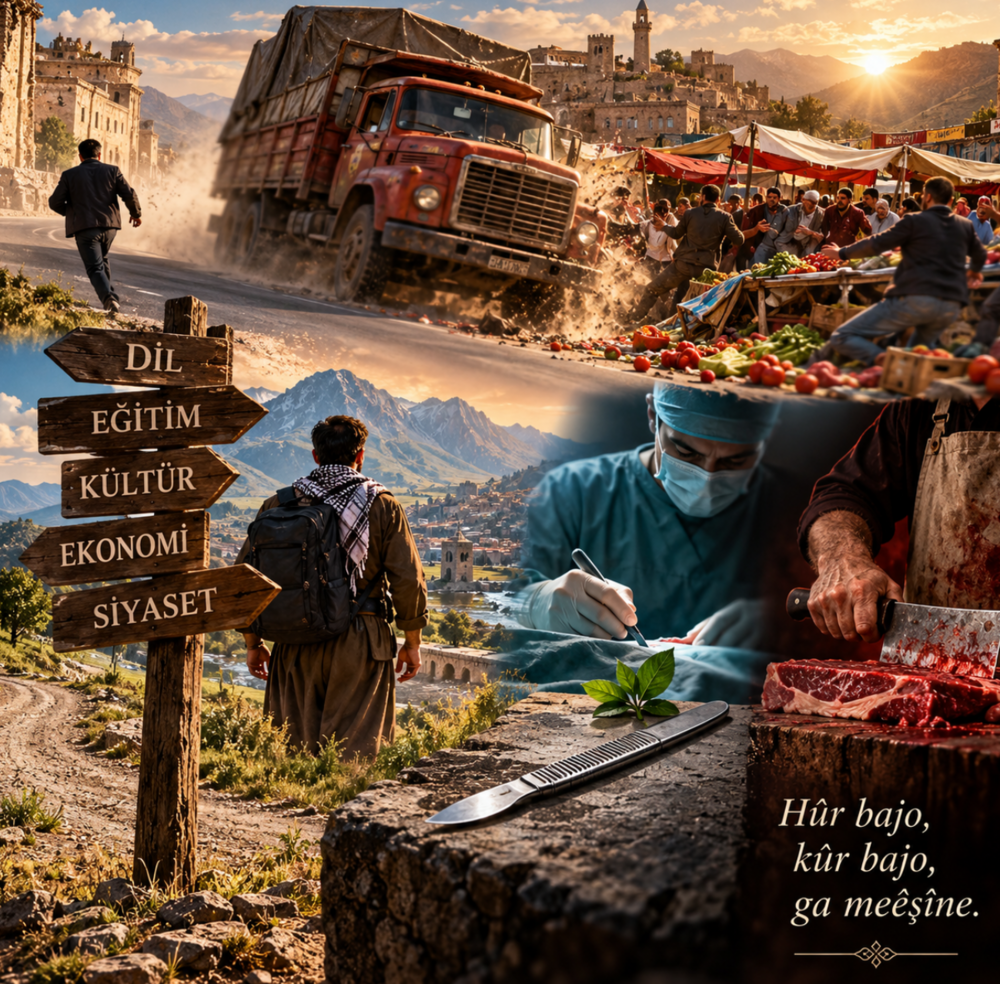
A Truck Entered the Market
Do not force yourself to position yourself against a group or an ideology. Have a goal; not an enemy.
Here’s the anecdote…
Back when social media didn’t exist and news was followed through newspapers, Temel was a truck driver.
One day, while descending a hill in the city, the truck’s brakes failed. On the right side a market had been set up, bustling with crowds. On the left, there was only a single person walking.
Temel thought to himself:
“If I turn right, there’s a market, so many people… Maybe I should turn left, at least there’s only one person there.”
The next day, headlines in the newspapers read:
“A truck entered the market, I don’t know how many people were killed.”
Temel said:
“It all happened because that lone man ran into the market.”
Mübarek focused not on turning left to escape, but on crushing the man on the left at all costs. When the man fled into the market, he followed him into the market.
When serving the Kurds, have an idea, have a method of service. Do not force yourself to position yourself against a group or an ideology. Have a goal; not an enemy.
If, while focusing on a service, you criticize another group’s ideas because you are ideologically at odds with them, that is acceptable. But if you criticize them merely for the sake of criticism, you lose both your way and your purpose.
After a while, you stop thinking about where you want to go and start considering crushing the group you are positioned against.
Choose your path not by looking at the man in front of you, but by looking at the destination you want to reach.
Are you working for language? Focus on language.
Are you working for education? Focus on education.
Are you working for culture? Focus on culture.
Are you working for the economy? Focus on the economy.
If you are involved in politics, explain your own goals, program, and what you want to do.
Of course, criticize when necessary. But let criticism be a tool you use when needed on your path, not the path itself.
Otherwise, you’ll find yourself chasing after whatever direction the person or group you oppose takes.
Don’t fixate on crushing the person.
Then you’ll find the truck in the market.
THE DOCTOR'S SCALPEL, THE TOWN'S KNIFE
I didn’t need to write much; you already understand.
A doctor wields a scalpel because his aim is to restore the patient’s health. It is a service to life. The person the scalpel touches is alive. Therefore, wisdom, knowledge, skill—all are carefully combined, and the scalpel is applied accordingly.
He does not act brutishly, nor does he recklessly swing and cut the veins of life.
The butcher also uses a knife.
But if the butcher is cutting meat, it means he is swinging the knife at a body that is already dead. Even if he points his knife at a living animal, it is to cut it.
The doctor's scalpel also cuts, as does the butcher's knife. The issue is not whether something is cut, but why it is cut.
When criticizing, especially when criticizing a nation that bears trauma, deep fears, and painful experiences, let your criticism be like the scalpel in a doctor's hand.
Let it be for healing.
Let it be to keep life alive.
Let your effort be to serve life.
Of course, Kurdish society needs criticism. And a great deal of it.
Tell us where we are wrong.
Show us our shortcomings.
Do not hide our illnesses.
When necessary, also strike with the scalpel.
But hold the scalpel as a doctor would. Your aim should not be to kill the body, but to keep it alive.
Because the issue is not only:
“Is what I say correct?”
There is another question:
“Why and how am I saying this truth?”
If the purpose of criticism is to heal, then it is a scalpel.
If the purpose is to belittle, wound, plunge someone into despair, or satisfy your own anger, the tool in your hand ceases to be a scalpel.
We also need a town, but do not cut into the fabric of the nation like a butcher.
Our ancestors said: “Hûr bajo, kûr bajo, ga meêşîne.”