
A fresh breath for the blockchain: the TNPoS mechanism
PezkuwiChain's validator selection mechanism, TNPoS, entrusts the network not to those with the most money but to a committee formed with equal seats from nine independent layers.
The most common way of selecting validators in blockchains, nominated proof of stake (NPoS), tends over time to keep bringing the same wealthy group to power. PezkuwiChain's TNPoS mechanism aims to break this link through the design itself.
📍 How does it work?
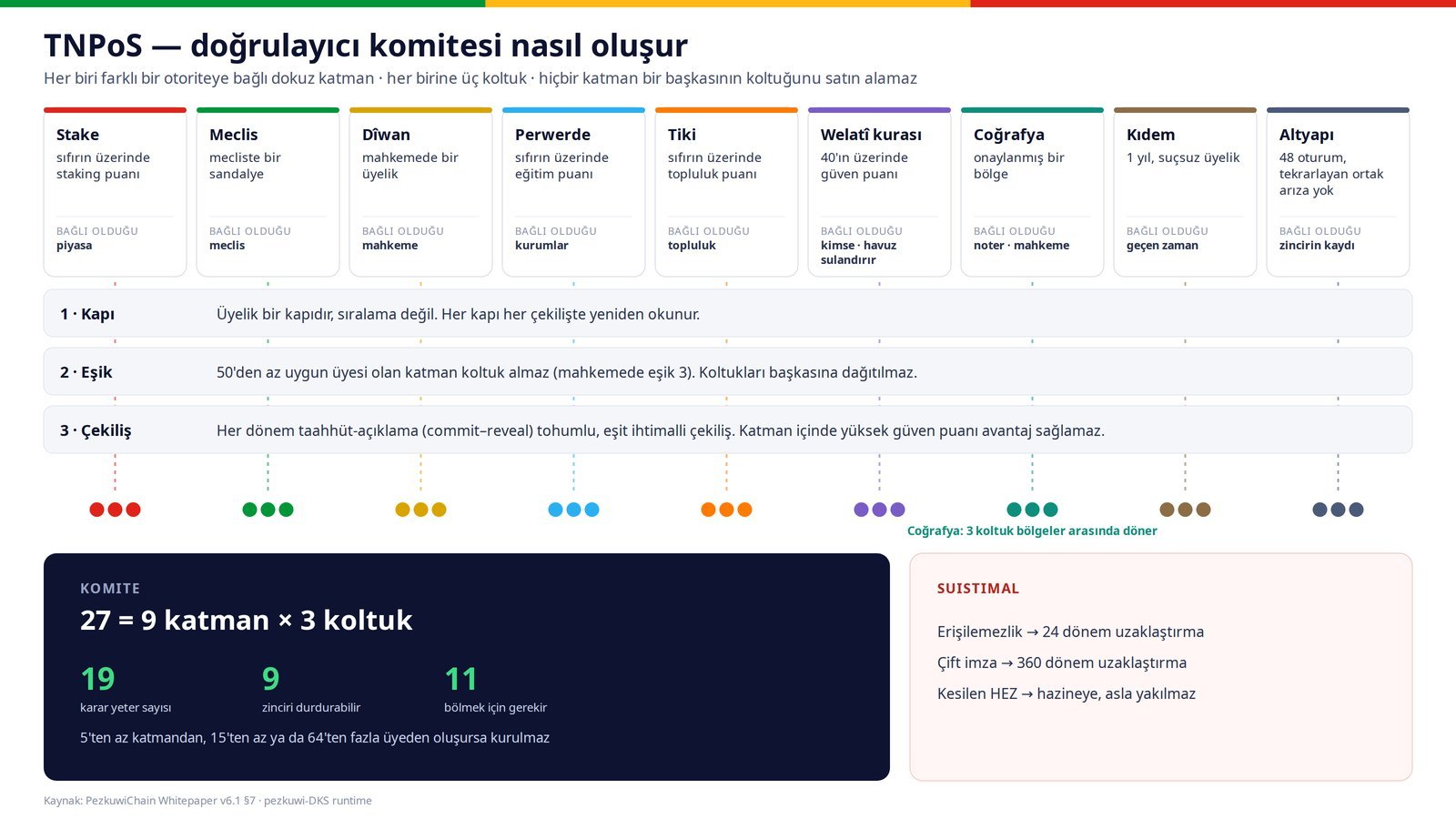
TNPoS fills the validator committee from nine independent layers. Each layer gets three seats, regardless of how much capital stands behind it. The full committee consists of 27 validators.
🧩 The nine layers
- Stake: citizens with a staking score above zero. Accountable to the market.
- Assembly: elected assembly members.
- Council: constitutional court members.
- Education: citizens with an education score. Linked to accredited institutions.
- Community badge: those holding community and contribution badges.
- Random citizen: any citizen with a trust score above 40.
- Geography: citizens whose belonging to a part of the nation is confirmed (Bashur, Bakur, Rojava, Rojhilat, diaspora, and Caucasus). Seats are rotated among the regions.
- Seniority: one year of uninterrupted, offense-free pool membership. Cannot be given or bought; earned only through time.
- Infrastructure: having verified 48 sessions and not showing a repeated pattern of dropping out together with others. The only gate passed through actual work.
The security argument rests on the layers being tied to different authorities: two layers linked to the same institution count as a single layer.
🎲 Membership is a gate, not a ranking
The most important point that sets TNPoS apart from score-based systems is this: a high trust score inside a layer provides no advantage whatsoever. The score only determines whether you can enter the pool; the seat itself is distributed through an equal-probability random draw. A very wealthy citizen and a citizen who has barely crossed the threshold have exactly the same chance within the same layer. The seed for the draw is produced through a commit–reveal method, so no single participant can determine the outcome alone.
🛡️ Thresholds against a weak committee
A layer with fewer than fifty eligible members takes no seat at all, and its seats are not handed out to others. The only exception is the 11-member court, whose threshold is three. No committee can be formed with fewer than five layers, fewer than 15 members, or more than 64 members. In a full committee the quorum for a decision is 19; halting the chain requires 9 validators acting together, while splitting it requires 11.
⚖️ The cost of abuse
TNPoS's own penalty is exclusion: a validator that becomes unreachable is barred from the pool for 24 periods, while one that double-signs is barred for 360 periods. The economic penalty is handled by Asset Hub, and the HEZ that is deducted is not burned — it is transferred to the treasury.
🎯 Why does it matter?
TNPoS separates network security from capital accumulation, taking into account contribution, training, institutional legitimacy, and time. The whitepaper stresses that the number of independent nodes is a measure that must be constantly assessed for the network, and that this number is openly published on the chain.
--- 📎 Source: PezkuwiChain Whitepaper v6.1 ↗