
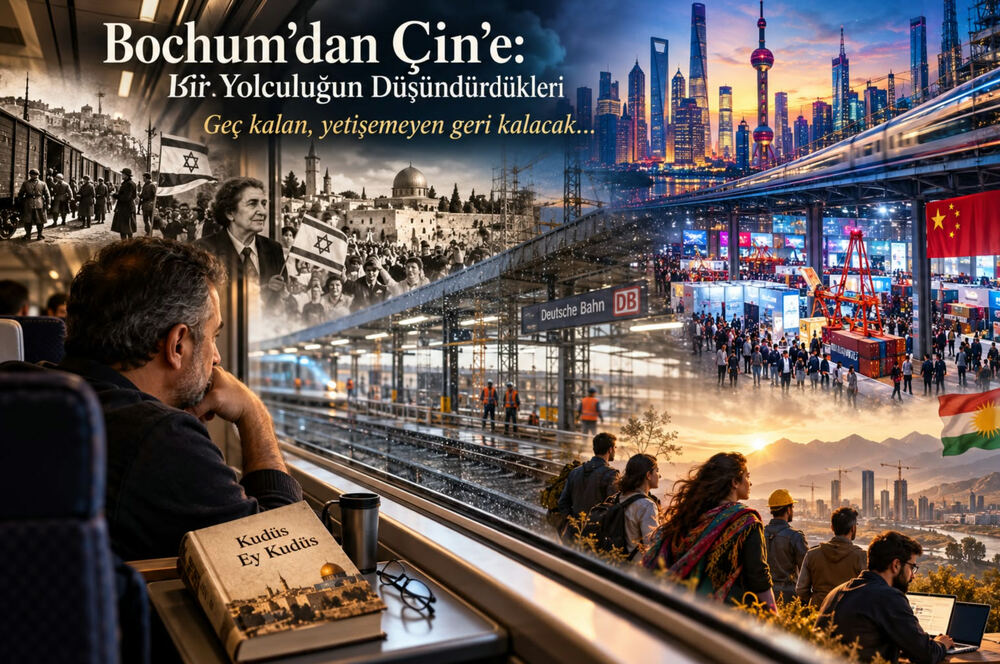
From Bochum to China: What a Journey Makes One Think About
Latecomers, those who can't keep up will fall behind…
To catch a China Airlines flight departing from Frankfurt, I set out from Bochum by train to Hagen, and then by high‑speed train toward Frankfurt.
I hadn't used the German railways in a long time. There was a striking difference between the Deutsche Bahn I knew from twenty or thirty years ago and what I saw today.
The tracks and stations were under repair, water dripped from ceilings in some places, and trains were almost invariably delayed. The German railways, once held up as a global model for punctuality, discipline and engineering, now seemed a mirror of the country's present condition.
Reading in public transport used to be a habit of mine. This time I took the book Jerusalem, Oh Jerusalem with me. I planned to read it during the three‑hour journey and then on the plane.
I opened the book and was instantly transported to the streets of Jerusalem and the charged atmosphere of 1947. Golda Meir and her colleagues were awaiting the outcome of the United Nations vote.
At that moment, a slight commotion began two seats ahead of me.
A woman in her late fifties was seated in her seat, surrounded by the bags she had placed around her. A stop later, a German of the same age arrived. He told the woman that she was sitting in the wrong place and that the seat was reserved for him.
His words seemed like a request, but the tone of his voice carried more command than courtesy. The man was so confident that, after the woman said a few things, she gathered her belongings and got up.
I returned to Jerusalem again.
The UN vote had concluded, and a two‑state solution had been accepted. Jews poured into the streets, and celebrations began.
"We will finally have our own state too!"
Yet some Jewish leaders, amid the jubilation, were calculating the looming long‑term war. They knew that the proclamation of a state would not end everything.
Meanwhile, the woman returned with a conductor beside her.
The conductor, with great confidence, checked the ticket of the man who had taken the woman's seat.
— This is not your seat. Your seat is 34B, three rows ahead, he said.
The man who had just asked the woman to move now gathered his own belongings. The woman sat back down in her place.
The man still didn’t stay silent. He began to point out Deutsche Bahn’s shortcomings to the conductor.
Kondüktör gave a brief reply:
— They’re a separate issue. But in this case the one at fault isn’t Deutsche Bahn, it’s you.
I smiled to myself.
That indefensible sense of being unquestionably right, even over a tiny seat dispute, without needing to listen to the other side…
I returned to the book.
In Jerusalem, Jews were dancing. Until just yesterday, people wanted by the British administration were on the streets. Even some British officers were joining the celebrations.
The book narrated the Jews’ struggle to establish a state after the Holocaust.
Reading those lines inside a train in Germany felt strange.
Because on these lands, on these railways, people had once been packed into wagons and taken to concentration camps. There were also ordinary people who neither wondered where they were being taken nor cared to notice.
A portion of those who survived the trains, years later, threw themselves into an extraordinary effort on another continent to build a state of their own.
History sometimes puts strange encounters in front of a person.
On one side Germany’s past, on the other today’s small displays of superiority. Of course a whole society cannot be judged by the behavior of a single individual. But that self‑assured attitude reminded me of some habits left over from history.
Moreover, the disciplined, hardworking, engineering‑marvel‑creating infrastructure of Germany’s past was unfolding before my eyes.
It seemed as if something from the old sense of superiority remained, yet much of the spirit of work that created that superiority had vanished.
And China appeared in my mind.
It was as if the work discipline, the passion for production and the engineering excitement that Germany has been losing were migrating to the other side of the world.
When you arrive in China, the first thing that catches your eye is not only the skyscrapers, massive stations and modern airports, but the pace of life itself.
On one side destruction, on the other reconstruction. At every corner small and large workshops, people working day and night, parts being continuously manufactured and assembled…
It feels like an unannounced mobilization of labor.
The line between night and day has vanished. Until midnight, streets, shops and workshops remain lively.
It sounds as if an unseen general is addressing the entire public: “We will leap into a new era! For that, everyone will work day and night, produce, and learn!”
And it seems millions have answered that call.
The world flows here as well. Weeks‑long exhibitions at massive fairs, presentations, meetings, commercial ties… People from every corner of the globe arrive, deals are struck, goods are bought and sold.
One word lies behind all this movement: SPEED.
Produce quickly, learn quickly, change quickly. The rest will follow.
And it is coming, too.
In the 2000s, this accelerating transformation is turning a massive rural population into a new civilization that produces, urbanizes and competes with the world.
When looking at this scene, one thinks of a beehive.
Bees work inside the hive with such intensity that it seems there is no other world outside. Yet their labor is not limited to the hive: flowers are pollinated, nature changes, life multiplies.
China is the same. With its own production drive, it is now changing the outside world as well.
It is inviting the world to a speed race.
Those who are late, who cannot keep up, will be left behind.
While thinking about all this, my mind inevitably goes to the Kurds.
There are Kurds also trying to keep up with this great speed race.
A part of them, like the Jews in Jerusalem, have focused all their energy on Kurdistan, on a people's freedom and the struggle to build their own future.
Another part, like the Chinese, is buried in work. They set up workshops, open factories, trade, develop relationships all over the world. They work, they accumulate, they grow.
But most of the time these two worlds move separately.
Yet the real issue is to bring these two energies together.
To combine Jerusalem’s historical consciousness with China’s manufacturing enthusiasm.
Dreaming of just one country is not enough. One must also create the knowledge, economy, technology and institutions that will keep that country standing.
Just making money, building factories, succeeding in trade is not enough either. All this accumulation must meet the future of its own society.
It should involve Jerusalem, work, and speed all at once.
The Kurds have this potential.
Successful entrepreneurs, engineers, scientists, artists and innovators are emerging all over the world. There is a great human energy that has learned to survive under harsh conditions and to create opportunities out of scarcity.
What is missing is the transformation of this scattered energy into a collective force.
Just like in a beehive.
When I traveled from Bochum to Frankfurt, I carried the story of Jerusalem with me. As I flew from Frankfurt to China, my mind blended Germany’s weary railways, Jerusalem’s bustling streets, and China’s nonstop workshops.
Three different geographies, three different histories, three different times…
In one, the splendor of the past is being surpassed.
In another, a people are trying to build a future for themselves after great catastrophes.
In the third, millions are continuously producing, building the future today.
And amid all this, I think of my own people.
We also have a hive. We have diligent bees, big dreams, and accumulated energy.
Let's see when our hive will combine its internal production and struggle and reach a power that can also influence the outside world.
When will it reach its own peak?
The train was delayed.
But in my mind there was now a question larger than the train's delay:
Will we be able to catch up with the accelerating train of history?