
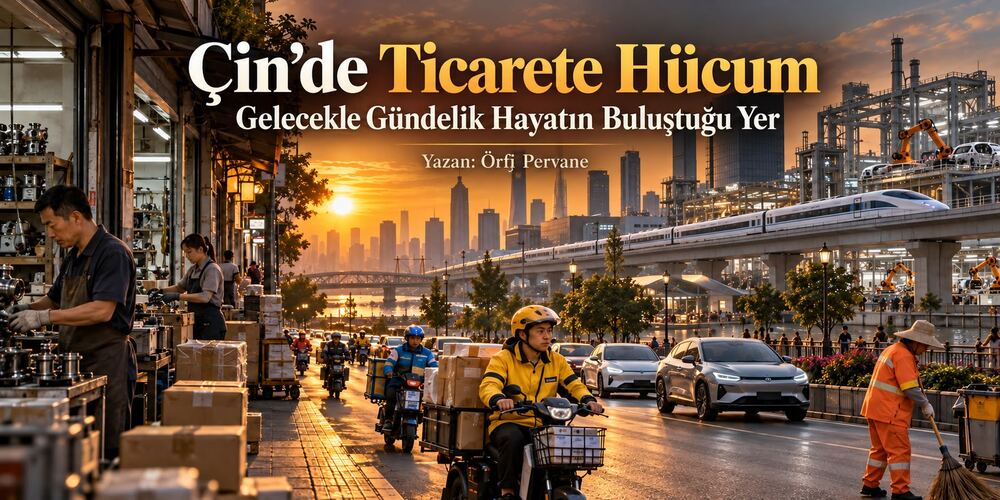
Assault on Trade in China: Where the Future Meets Everyday Life
China’s massive transformation, where technology, manufacturing and commerce intertwine, not only creates new economic opportunities; it also signals fresh pathways for Kurds and their diaspora to engage with the world.
Assault on Trade in China: Where the Future Meets Everyday Life
When you look at China, you cannot see just one landscape. On one side there are factories run by robots, electric‑vehicle plants, high‑speed trains and extensive metro networks. On the other side there are workers sweeping the streets, craftsmen in small workshops, hands preparing packages and people loading their cargo onto motorcycles and merging into traffic.
At first glance these two worlds seem far apart, but they are actually parts of the same economic motion. China’s huge wave of production and trade does not rise solely on high technology. Supporting it is a broad network of human labour and services that stretches from factories to streets, from warehouses to markets.
A product manufactured by robots in a factory reaches, at another stage of its journey, a small shop, a packaging workshop or the hands of a motorbike courier. Large‑scale technology and the modest tools of everyday life complement each other.
Two different speeds on the same street
In China's major cities, modern transport infrastructure and electric vehicles represent the visible face of transformation. Yet another movement runs through the same streets: small motorcycles and electric two‑wheelers that carry people, food and cargo. They slip into narrow alleys, weave between shops, and at times swarm the traffic like a line of ants.
Their hustle reminds us that the economy lives not only in giant factories but also in the aggregate of millions of small enterprises. China's transformation is far from finished. Disparities in living conditions persist between megacities and rural areas. Even within the cities, those employed in the tech sector and those scraping a living in precarious jobs occupy different rungs of the same economic ladder.
Technological progress does not instantly eliminate human labor; it reshapes its role and form. While automation expands in some sectors, delivery, maintenance, warehousing and service jobs grow in others. The economy of the future and today's struggle for livelihood move side by side on the same street.
The pull generated by production
China's influence extends far beyond what it produces within its own borders. The manufacturing capacity, supply chains and trade networks established here also affect other parts of Asia. The design of a product, the production of its components, assembly, transportation and sale can link different countries together.
This movement attracts not only goods but also people. Entrepreneurs, traders, students and workers from various corners of Asia, as well as from Africa, the Middle East, Europe and other parts of the world, are looking for a place in this economy. Some act as bridges between manufacturers and buyers; others develop services in logistics, translation, consulting, marketing or hospitality.
When the gears of the economy speed up, opportunities do not arise only from large deals. The person who helps a trader find the right manufacturer, the firm that monitors the flow of goods, a restaurant serving foreign visitors, or even a small packaging workshop all become part of this movement.
For this reason, seeing China merely as “the world’s factory” is insufficient. The country is also a vast arena where trade is learned, relationships are forged, and new business models are tested.
From the Gold Rush to an Assault on Trade
This economic pull in China evokes the gold‑rush era in the United States. Back then, people flocked to new territories hoping for wealth, establishing new lives not only in the mines but also in transportation, trade and services. Towns swelled around the prospectors, markets emerged, and new economic ties developed.
What drives the movement toward China, however, is production and trade rather than gold. A large share of those who come here aim to expand their existing businesses, find new suppliers, or carve out a niche within global networks. What they seek may be a factory, a client, or a new link that can be forged between two countries.
Of course, these two historical experiences are different. Those who migrated to America came from a wide range of backgrounds; the gold rush also had severe consequences for indigenous peoples. Yet there is a common thread: the expectation of economic opportunity spurs people into action, and that movement generates social changes that go beyond its original purpose.
In China's commercial hubs, commerce is not limited to shopping. Languages, customs, cuisines and ways of doing business intersect. As new partnerships and service sectors emerge, trade creates a transformation that is as social as it is economic.
The Social Questions of Development
In the post‑World II development experience of the Western world, economic growth was accompanied in many countries by an expansion of the welfare state, labor rights and democratic institutions. These gains were the result of prolonged struggles, political choices and historical circumstances.
China's path, however, is different. While economic growth and technological capacity generate a major transformation, questions such as income distribution, working conditions, social security, the gap between cities and rural areas, and individual rights remain important.
It is impossible to state with certainty today how economic development will translate into changes in the social and political spheres over time. Rising prosperity can generate new expectations and demands; how these will be addressed remains one of the key questions facing China.
An Invitation for the Kurds
I often view the world through a Kurdish lens. The dynamism I observe in China raises this question: where do the Kurds stand in this massive economic transformation?
For those living in the homeland, joining such an adventure can be difficult due to factors such as visas, capital, language and connections. However, the Kurdish diaspora spread across various countries can leverage its experience and networks to seek ways to enter this great gateway of trade.
The starting point is turning our focus toward Asia. Those who have the chance must go, see, meet people and understand markets on the ground. Sometimes simply getting to know a producer, learning a language, or noticing a need between two markets can open a new path.
First, we must see; then, within what we have seen, open a door for ourselves. This movement unfolding across China and the broader Asian region also holds opportunities for Kurds that await observation and comprehension.