
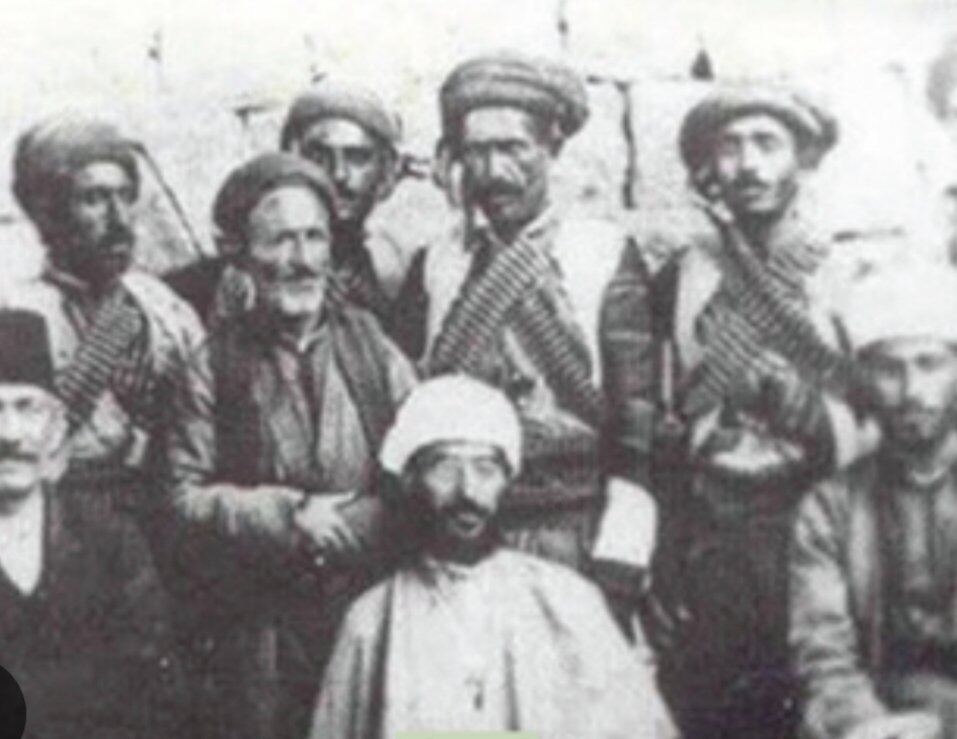
The Conflict Between Dagestani Davut Lav and His Son Fazil Pasha and Kurdish Leader Abdulselam Barzani
Kurdish Leader Abdulselam Barzani’s Struggle Against the Ottoman State and Armed Groups in the Caucasus
The attacks by Dagestan’s Fazil Pasha and his father Davut Lav on Sheikh Abdulselam Barzani were driven by the Ottoman and Iranian governments’ policy of suppressing Kurdish uprisings. At that time, the Ottoman Empire employed local forces to bring independent movements in Kurdish areas under control.
Reasons for the Attack
1. Sheikh Abdulselam Barzani’s Movement Against the Ottomans
Between 1907 and 1914, Sheikh Abdulselam Barzani launched a movement defending Kurdish independence and rights against Ottoman rule.
Local officials and tribes loyal to the Ottoman Empire saw this movement as a threat to their own positions.
2. Ottoman Regional Policy
The Ottoman administration largely relied on other Kurdish and Circassian commanders who were loyal to the state to suppress independent Kurdish leaders.
Dagestani Fazil Pasha and his father Davut Lav were important figures appointed by the Ottoman Empire in the region, and they were mobilized to prevent Sheikh Abdul Salam Barzani from gaining strength.
3. Iran and Ottoman Competition
The Barzani movement was active in the border areas between Iran and the Ottoman Empire.
The Ottomans were concerned that the Barzani movement might forge an alliance with Iran.
Conclusion
Sheikh Abdul Salam Barzani faced a strong Ottoman military operation and was captured in 1914 and executed in Mosul. During this process, Ottoman‑aligned commanders such as Dagestani Fazil Pasha and Davut Lav played a crucial role in securing Ottoman dominance in the region.
This episode was part of the Ottoman Empire’s classic strategy toward Kurdish movements: using commanders drawn from Kurdish or other Muslim communities in the area to maintain local control against Kurdish leaders.
Dagestani Fazil Pasha’s father, Davut Lav, belonged to a noble family and was a renowned gunsmith specializing in gold and silver inlay. He was also a close associate of Imam Shamil’s armorer and one of the favorite friends of his son, Gazi Muhammad.
Davut Lav’s brother, Haji Ali Lav, served as Imam Shamil’s treasurer.
His son, Fazil Pasha, was interested in firearms from childhood and grew up with a keen enthusiasm for horse riding. After completing his education in Russia, he held important positions in the Ottoman army.
The “Gazi Muhammad” mentioned as a friend of Davut Lav, the father of the Dagestani Fazil Pasha, is not Imam Shamil’s son but most likely the Chechen leader Gazi Muhammad who fought against the Ottoman Empire and Tsarist Russia in the Caucasus.
Two different figures named Gazi Muhammad emerge:
Gazi Muhammad (Leader of the Gazavat Movement – 1829‑1832):
He was the first imam to fight the Russians in the Caucasus.
In 1829 he launched the “Gazavat” war in North Caucasus.
He was killed in 1832 while fighting the Russians at Gimri.
He was succeeded first by Hamzat Bek and later by Imam Shamil.
Imam Shamil’s son Gazi Muhammad:
He was Shamil’s son.
He fought the Russians alongside his father.
When Shamil surrendered in 1859, he was also taken to Russia.
It is more likely that Gazi Muhammad, a friend of Davut Lav, was Imam Gazi Muhammad who fought in the Caucasus from 1829 to 1832.
GEOGRAPHY OF DAGESTAN
Dagestan is a republic in North Caucasus that belongs to the Russian Federation.
North: Kalmykia
West: Chechnya and Stavropol Krai
South: Azerbaijan and Georgia
East: Bordered by the Caspian Sea.
Its capital is Makhachkala. Dagestan lies in the southeastern part of the Caucasus Mountains and is famous for its ethnic diversity.
Dagestan is extremely ethnically diverse, with more than 30 peoples living there.
Shamil Teymurov
29.10.2026