
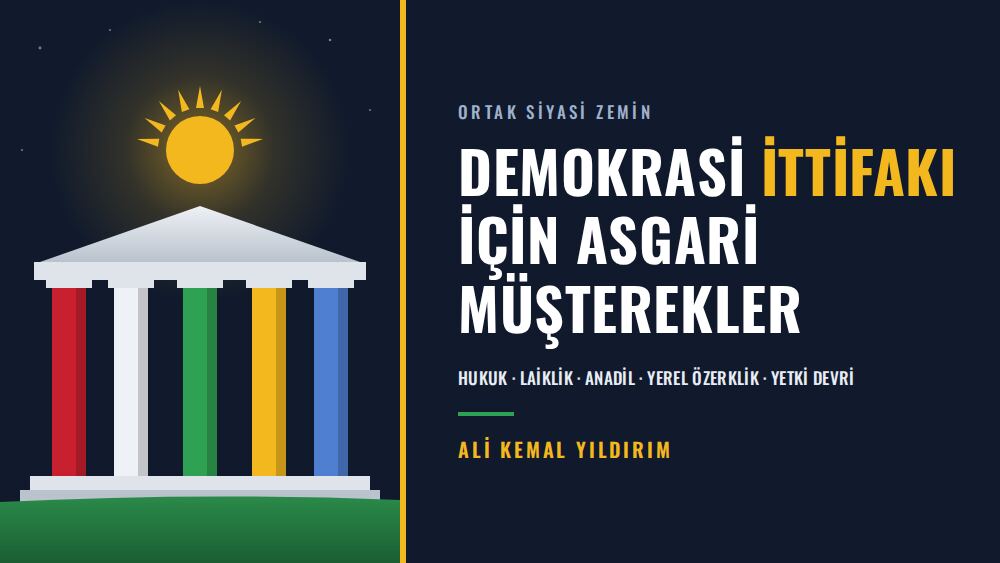
Minimum Common Ground for a Democratic Alliance
Rule of law, secularism, mother‑tongue education, local government autonomy and devolution of authority: shared foundations on which a new democratic alliance can agree.
In Turkey, for the democratization process to become truly effective and for societal problems to be solved through democratic means, it is crucial to identify the minimum commonalities on which diverse political and social groups can reach consensus. Within this framework, the core principles and primary objectives of a new democratic alliance can be discussed under the following headings.
1. Rule of Law and Fundamental Freedoms
The democratic alliance should adopt judicial independence, the rule of law, press and expression freedom, as well as freedom of thought and association as its foundational principles. The sustainability of a democratic system depends on limiting the state by law and guaranteeing individual rights and liberties.
Restricting the powers of officials is part of defining the legal boundaries of the state.
2. Secularism and the Religion‑State Relationship
The alliance must advocate for the separation of religion from the political and administrative interference of the state, in other words, for the state's neutrality before all faiths. True secularism entails not only the separation of religious institutions from state governance but also the state's refusal to impose any religious or sectarian doctrine on society. This approach guarantees that different religions and forms of non‑belief can freely exist on the basis of equal citizenship. To this end, legal provisions should be enacted to prevent any faith group from disrespecting the rights of others.
3. Multilingual Education and Learning of Mother Tongues
The education system, from primary school through university, should undergo a comprehensive reform that takes into account Turkey’s multilingual and multicultural social fabric.
In this context, a mandatory and systematic education model should be created in which, alongside Turkish, students can learn at least one of the country’s indigenous languages. The teaching of Kurmanji, Zazaki, Laz and other native languages should be addressed within this framework.
Students should be required to reach a certain proficiency level in a second native language as a condition for university admission. This would help protect, develop, and make visible the languages of different linguistic communities in the public sphere. For the reform to succeed, its implementation must be phased and a sufficient educational infrastructure should be established in advance.
To make this reform possible, a dedicated unit should be created within the Ministry of National Education; teachers need to be trained, curricula prepared, teaching materials developed, and adequate budget allocated to monitor the implementation together with the necessary infrastructure.
4. Autonomy of Local Governments
To strengthen the democratic functioning of local administrations, the principles of local government autonomy should be introduced based on the European Local Government Autonomy Act. Administrative and financial powers of local governments should be expanded, and the local population must be enabled to participate directly and effectively in decisions that affect their living environment.
This approach will contribute not only to the development of local democracy, but also to reducing the administrative and political burden on the central government.
5. Devolution of Authority and Regional Democratic Representation
Devolution should be considered a fundamental reform area for Turkey's democratization and, in particular, for resolving the Kurdish issue. However, the scope, institutional structure, and legal limits of devolution must first be addressed through a broad-based negotiation and assessment mechanism.
For this purpose, it would be appropriate to establish a special assembly or parliamentary commission composed primarily of elected parliamentarians, based in Diyarbakır, that will discuss regional issues and develop proposals for solutions. This structure, open to all members of parliament who are concerned with the problems of the relevant region and wish to take part in this work, should enable different political views to come together in a democratic negotiation setting. Designing this assembly not merely as an advisory body but as an institutional negotiation mechanism that devolves authority and develops models of regional democratic governance will be effective for a lasting solution.
The mechanism in question should not be limited to parliamentarians alone. To increase societal participation and expert input, subcommittees or advisory units should be created in which academics, local government representatives, civil society organisations and relevant social groups can take part. The necessary administrative structure and budget must be provided to ensure that these activities can be carried out regularly and effectively.
Conclusion: Shared Political Will for a Democratic Solution
The policies pursued by the state for many years have turned the democracy problem and the Kurdish issue into two fundamental challenges that are not independent of each other; rather, they mutually reinforce one another. The failure to achieve a democratic and lasting solution to these problems not only deepens social tensions but also paves the way for the strengthening of authoritarian and centralist tendencies.
Therefore, for the democratic future of Turkey and Kurdistan, it is essential to address these two issues together. The proposed principles aim at a common political platform based on the rule of law, equal citizenship, cultural and linguistic rights, local democracy and democratic participation, rather than the exclusive interests of any political view or social group.
The proposals presented here should not be seen merely as temporary measures to manage current problems. They are steps aimed at establishing the institutional and societal foundation needed for building a democratic political order in Turkey and achieving a peaceful, just and lasting solution to the Kurdish issue.
Bringing together diverse political and social groups around these minimum commonalities could contribute to the formation of a new, inclusive democratic alliance. I hope that these proposals will be debated and refined, especially by political actors willing to assume responsibility for democratization and social peace.
19.11.2026