
The Sociology of Statelessness: Why the Kurds May Be This Era's "Vanguard Nation"
Statelessness is read in classic paradigms as a loss in history. The cryptographic revolution could turn that geopolitical weakness into the flexibility to build an entirely new civilization.
When the classic paradigms of political philosophy are applied to the world map, a nation left without a state is read only as a victim and a loser of history. Yet the cryptographic and digital revolutions of the 21st century can turn this geopolitical "weakness" into a significant mathematical and sociological advantage. Historical grievance gives way to the flexibility to build a brand‑new civilization; in other words, to become a "Vanguard Nation." The philosophical, technological and historical foundations that could allow the Kurds to achieve this leap rest on the following dynamics:
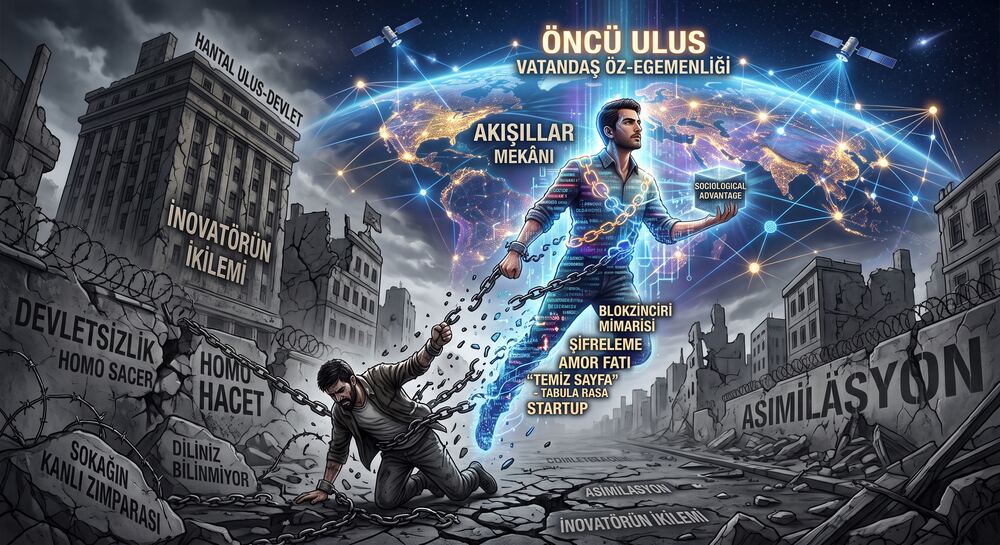
Agamben's "Homo Sacer" and the Street's Bloody Sandpaper
Italian philosopher Giorgio Agamben formulated in the most striking way what it means to be left stateless in the nation‑state building of the twentieth century. Agamben's concept of Homo Sacer (the Sacred Man) describes a "bare life" stripped of legal and political protection, exposed to assimilation at any moment.
For centuries the Kurds have been exactly this Homo Sacer figure in the eyes of sovereign states. Statelessness is not a romantic borderlessness; it is the inability to tell one’s pain in one’s mother tongue in a hospital, the erosion of cultural memory in the gears of assimilation, the appearance of an "unknown language" in court records. The friction of the street is a bloody sandpaper that separates flesh from bone. Looking over Agamben's shoulders, we see that sovereign states have kept the Kurds in a perpetual "state of exception," rendering them anonymous and condemning them to civil death.
However, the blockchain architecture of the twenty‑first century moves this deep cultural wound and Agamben's helpless Homo Sacer into a new "Space of Flows" conceptualized by sociologist Manuel Castells. Technology cannot erase the street’s pain retroactively; it can encrypt it, turning the citizen cast out of law into a self‑sovereign political actor who determines his own economic and digital destiny.
The Innovator's Dilemma, Amor Fati and the Hardware Leap
The Kurds' failure to build a traditional, Middle‑Eastern style nation‑state in the 20th century paradoxically constitutes today their greatest asymmetric strength. If we invoke Nietzsche’s Amor Fati (love of fate), the disaster of not having a state can become fuel for the nation to transcend itself through a global technology vision.
Clayton Christensen’s "Innovator's Dilemma" theory tells an interesting paradox: established institutions overlook disruptive technologies not because of poor management but because of rational, profit‑driven management. An institution focused on existing, lucrative stakeholders delays taking a small, initially "unprofitable" disruptive innovation seriously. Most existing nation‑states suffer a similar delay caused by institutional inertia—think cumbersome central banks and outdated land registries—and in some places this delay even serves corrupt interests. Digitizing an existing physical system inevitably creates friction with the status‑quo within that system.
Here, the historical position of statelessness offers a powerful zero‑friction and "tabula rasa" advantage in the digital age. The stateless diaspora has no heavy central‑bank legacy to dismantle. This does not deny the Kurdistan Regional Government’s thirty‑year institutional experience; it merely reminds us that the "clean‑sheet" advantage primarily describes the cross‑border diaspora. Statelessness can elevate that population to a "startup" position in the nation‑state market—an "Innovator" that outpaces bulky incumbents.
Of course, this "leap" is not completely independent of hardware frictions. Yet satellite internet (Starlink constellations) and decentralized peer‑to‑peer "Mesh‑Network" technologies can quickly bypass physical infrastructure gaps, completing the digital spine of this stateless society.