
Suicide in a digital jar: A simulation of the Kurdish nation's assimilation, and the opportunity cost
Alarm bells are ringing for Kurdish: You may be the last generation to speak it.
A mouse falls into a jar half full of rice. At first it is a blessing: food is plentiful, there are no predators, and filling its stomach takes no effort at all. In the first days it is strong enough to jump out whenever it likes. But it tells itself, "Everything is right here, I'll stay a little longer," and chooses to live in that comfort zone.
Days pass. The more the mouse eats, the deeper it sinks toward the bottom of the jar without noticing. The walls rise. When the rice runs out, it faces a bitter truth: it is now too deep to jump out, and the muscles it needed to leap have withered. It has sold its freedom for a temporary fullness and become a captive that depends on the mercy of others to survive.
In the age of artificial intelligence and the internet, the situation of Kurdish society, and of the young generation in particular, is no different from this mouse's cheerful suicide.
The rice jar is the endless, comfortable sea of content offered by the internet, global algorithms and the dominant languages (Turkish, Arabic, Persian, English). Communicating in these languages, consuming technology, joining the economic system is "free rice": it takes no effort and pays off socially and economically right away.
The mice are the families who consider teaching their children their mother tongue "unnecessary", or who hide behind the excuse that "there are no mother-tongue schools anyway, and the few that exist are poor", and the young people who have gone numb in this comfort zone.
"The institutions are poor" is not an objective finding; it is a cover for inaction and intellectual laziness. No infrastructure falls flawless from the sky. Institutions improve only through a society's stubborn demand, its investment and its insistence on using them. As long as Kurds dodge the cost of building the infrastructure of their own language and take refuge in the comfort of ready-made systems, they are digging their own intellectual and cultural graves.
Sinking to the bottom of the jar: An assimilation simulation
Language is not just a tool for communication; it is a nation's operating system. Abandon the operating system, and what remains is an assimilated subset running on the hardware of the dominant culture. Before the internet and AI, assimilation was a slow erosion that took three to four generations. Today, with algorithmic content consumption, that has shrunk to a generation and a half.
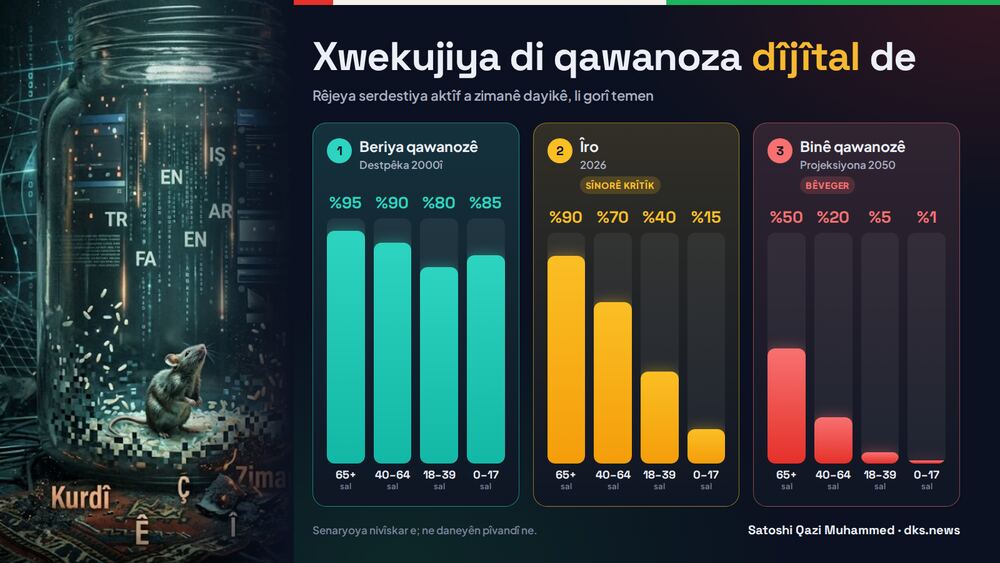
The figures below are a scenario showing how the population that actively understands, speaks, thinks and creates in Kurdish erodes across age groups. They are not measured statistics but a projection based on the author's observation; their purpose is to show the direction and speed of the trend.
Phase 1: Before falling into the jar (early 2000s)
The internet is not yet widespread. The language passes on at home and in the street through a natural network effect. The base is broad; the cultural backbone holds.
- 65 and older: 95%
- 40-64: 90%
- 18-39: 80%
- 0-17: 85%
Phase 2: Where the rice runs out (today, 2026)
AI and the digital revolution reach every corner of life. Children have been handed over entirely to the dominant languages through screens. Families abandon the mother tongue under the illusion that "they'll understand it anyway". The pyramid has turned upside down; the system is signalling collapse.
- 65 and older: 90%
- 40-64: 70%
- 18-39: 40%
- 0-17: 15% (critical threshold)
Phase 3: The bottom of the jar, the point of no return (2050 projection)
When today's 0-17 age group become parents, they will not be able to pass on a language they do not know. Kurdish becomes an academic relic: its street life dead, surviving only as old texts in AI datasets.
- 65 and older: 50%
- 40-64: 20%
- 18-39: 5%
- 0-17: 1% (statistically negligible)
Harsh truths and the opportunity cost
Under this scenario and at the current pace of digital change, 20 to 25 years are enough for the Kurdish nation to be largely assimilated, that is, to lose its reflex for linguistic and cultural production. By 2050 the cultural backbone will be broken. Why?
The AI barrier. AI models run on large amounts of data. As long as Kurdish datasets are not produced and children talk to large language models in the dominant languages, technology builds an ecosystem that leaves Kurdish out. The mother tongue turns into a "primitive" memory outside the modern world.
Escaping responsibility. Stepping aside with "the institutions are poor" is intellectual laziness. No institution falls flawless from the sky. A society that demands, funds and pushes the system by sending its children creates its institutions. Those who refuse to pay this price for today's comfort are renting out their children's minds to assimilation.
Irreversibility. When the mouse finished the rice, it had no muscles left to jump. Language is also a muscle that grows with use. Twenty years from now, when today's young people want to "return to their identity", they will lack the vocabulary, cultural references and historical context to express it. They will become hollowed-out, tragicomic figures trying to defend their identity with the concepts of the dominant language.
You are wasting time. Lingering in the comfort zone and believing the fairy tale that "future generations will sort it out" is cheerfully nibbling the rice in that jar. One generation is left before the bottom comes into view.
One way to pay the price today
The only way past the AI barrier is for Kurdish to produce its own data in the digital world. Anyone who speaks Kurdish can contribute today by reading a few sentences for KurdAi Voice's voice donation campaign: kurdishtts.dks.news/bexsh