
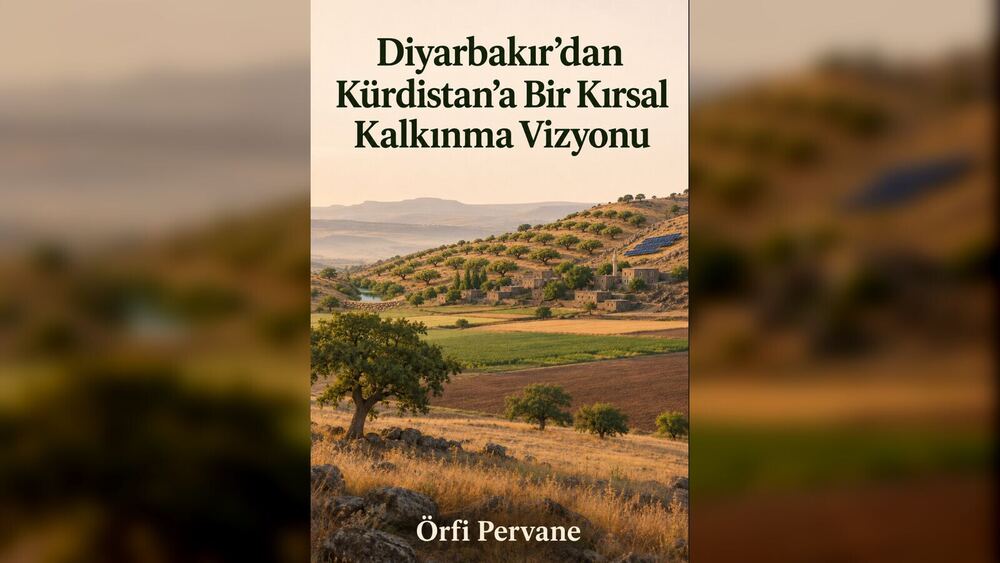
From Diyarbakir to Kurdistan: A Vision for Rural Development
A feasibility study and pilot project launched by a municipality and a civil society organization in a few villages in Diyarbakir could raise production, household income and employment in rural Kurdistan within a fifteen-year plan.
This proposal is a development vision aimed at raising production, household income and prosperity in the rural areas of Kurdistan over the long term. A municipality and a civil society organization in Diyarbakir could lead this vision by launching a joint feasibility study and pilot project in a few villages. The aim is to develop, on land that lies unused or is worked with traditional methods and to the extent the soil and water allow, forms of production that both meet households' needs and provide a regular income. As the quantity and quality of produce stabilize, the growth of processing, packaging and sales in the region could open up new fields of work in nearby districts and across our lands as a whole.
In different parts of the world, programmes that bring together producer organization, technical support, financing and cooperation with buyers have been able to raise incomes. The mission of the municipality, NGO and producer representatives who will lead this work in Diyarbakir is to apply this approach in line with the soil, climate, production knowledge and social conditions of the Kurdish lands. The lead team organizes the research, seeks start-up funding, carries out the trials together with the villagers and publishes the results. Once the pilot is seen to benefit households, other municipalities and NGOs can adapt this experience to their own localities.
From the pistachio experience to production basins
Batman, Siirt and Antep could be learning partners in this work. Pistachio production is well established in all three provinces. According to the Institute of Agricultural Economics and Policy Development (TEPGE), which compiled the 2023 data of the Turkish Statistical Institute (TÜİK), the area under pistachio cultivation was approximately 1.43 million decares in Gaziantep, 401,000 in Siirt and 129,000 in Batman. Through interviews with producers, cooperatives and businesses in these localities, it would be possible to research how orchards were established, how costs were covered until the first income arrived, and how the crop is harvested, processed and sold. This knowledge can be used to improve existing production in areas suited to pistachio and to build a similar economy around other crops under different soil and climate conditions.
The network of production, processing and sales that has formed around tea on the Black Sea coast is an example of how a production basin works. In Diyarbakir, Bingöl or our other provinces, the decision on which crop could form the basis of such a basin is made on the strength of field data. A basin can bring together villages that produce under similar conditions and can benefit from shared collection, processing or sales services. For example, trials will show whether viticulture comes to the fore in one group of villages, and a particular fruit or a rain-fed crop in another. Alongside this production, households can continue their other activities that contribute to their own food needs and income.
Feasibility and pilot project
The municipality could take on the fieldwork, the budget and coordination among institutions. The NGO could organize village meetings, reach out to households and monitor the results together with the producers. While agricultural engineers and universities examine the soil, climate and production options, infrastructure experts calculate the needs for water, electricity, roads and storage. Giving small producers, tenants, women, young people and landless households a say in the decision-making process ensures that the pilot rests on the real needs of the village.
Soil depth and pH, slope, sun exposure, rainfall, snow, frost risk and the water available in dry years are examined together. Irrigable plots and rain-fed production areas are assessed separately. A slope that looks empty may be used as pasture or may hold vegetation that prevents erosion. For this reason, the land's current function and the rights to its use are also investigated. Several production options are then tried out on small plots. Improving an existing vineyard, trying another crop on dry land or establishing a new orchard are assessed by the same measures. What matters is not only whether the crop grows but also when and how much income it leaves the household.
Before the pilot begins, households' economic situation and water use are recorded. Harvest results are compared with data from households in similar conditions that remain outside the pilot. The decision to scale up is made by weighing together the net gain the pilot brings to households, how that gain is distributed, and water use.
Start-up budget and investment financing
For the initial research and pilot infrastructure, suitable rural development programmes of the World Bank, the European Union and Turkey are explored. For investments in production and processing, the producer's own capital, loans, grants and a credit fund that local industrialists could support may be considered together.
Agricultural economics and finance experts within the consortium identify suitable sources, prepare income and expenditure accounts, and plan the repayment schedule according to the period when production will start generating income.
From production to market and employment
Market research begins before planting. Producers, cooperatives and buyers discuss the quality, quantity, delivery dates and payment terms in demand. Initial sales can be tested by using services from existing facilities. As the supply of produce and demand become regular, Kurdish industrialists and other local entrepreneurs in the region can invest in drying, cold storage, processing and packaging. The capacity of a new workshop or factory is determined by the volume of produce the surrounding villages can supply and by how much of the year the facility can operate.
Cooperatives can strengthen producers' bargaining power through collective sales, shared storage, transport and quality control. Offers from domestic and foreign markets are compared on the basis of the net price the producer actually receives. Working with more than one buyer allows producers to direct their produce to the channel that gives them the best net return.
As the processing and marketing network develops, jobs can emerge in quality control, food technology, machinery maintenance, logistics, accounting and sales. These jobs ensure that landless households also get a share of development. Vocational schools and businesses can match training to the work on the ground. Regular and secure work, together with access to transport, the internet, education and health services, can make it easier for young people to stay in the village or to return. To understand this effect, seasonal migration, permanent relocation and return are monitored separately.
Examples from around the world and the region's experience
Colombia and Bolivia. In programmes that connect producer organizations with buyers, technical support and investment were carried out around a shared business plan. In independent evaluations cited by the World Bank, the increase in participating households' net agricultural income compared with the control group was measured at 29% in Colombia and 28% in Bolivia. This experience shows the importance of establishing the relationship with the buyer from the moment the crop is chosen.
Brazil. The Bahia rural development project reached 38,783 households in 326 municipalities. The World Bank reported an increase of 29% in the average real net income of the producer organizations supported, and of 71% in organizations run by women. These are results at the level of the organizations. The project's completion report found the quality of its monitoring and evaluation to be limited. In the Diyarbakir pilot, the organizations' earnings and the extent to which those earnings reach household budgets could be measured separately.
India. The Sujala project in Karnataka carried out soil and water conservation work in rain-fed farming areas with the participation of villages. The World Bank's completion report estimated increases of 32% and 25% in the net agricultural profit margin per hectare in two agricultural zones. Some villages reported that migration to distant regions declined when local demand for labour rose during the conservation work. This observation shows the importance of measuring temporary jobs and permanent employment separately in the pilot.
Europe. Under the LEADER programme, local authorities, civil society and businesses draw up joint development strategies. The evaluation covering the 2014–2020 period found positive contributions to local governance and social capacity. The European Court of Auditors reported that participation had become easier, and that it was difficult to measure with the available data the benefit obtained in return for the additional administrative costs. This experience offers a concrete reason for the lead partnership to keep its decisions, budget and results open.
Diyarbakir, Batman and Siirt. In the earlier IFAD-supported development project, irrigation and road works made progress and producer organizations received equipment support. Because baseline measurements and comparison data were lacking, the independent evaluation was unable to reliably determine the impact on household income. For this reason, recording household and production data from the first day of the new pilot is important for determining, later on, which practices can be carried over to other villages.
From five years to fifteen
In the first five years, the municipality and the NGO carry out the feasibility study, the baseline measurement, the production trials and the first sales with a few villages. Which practices generate income under which conditions, water needs, investment costs and the difficulties encountered are compiled in a publicly available report.
Towards the ten-year mark, the practices that have produced results are tried again in other localities. Producers and businesses in Batman, Siirt and Antep can share their accumulated know-how on pistachio. Diyarbakir, Bingöl and other localities make their own crop and investment decisions on the basis of field data. In places where crop volume and buyer demand are sufficient, shared storage, packaging and processing investments come into play.
Towards the fifteen-year mark, the goal is a rural economy made up of households with more than one source of income, producer organizations that reach regular buyers, and local businesses working with a stable supply of produce. Success is assessed by how much household income has risen, how much of that income stays in the locality, how many permanent jobs have been created, and whether the soil and water remain in a condition fit to sustain production.
This approach can also bring environmental and social benefits. Protecting vegetation on slopes can help limit erosion, while harvesting rainwater and using water efficiently can help villages adapt to drought and changing climate conditions. More regular income and job opportunities in the village can also ease the pressure to migrate because of economic hardship.
This approach gives municipal governance the task of developing and carrying out a long-term project. The municipality carries the villages' priorities into its investment plan, brings experts and institutions together, conducts the search for funding and is accountable for the results.
The municipality and the consortium can also bring into this work the knowledge, experience and connections of compatriots from the region living in the diaspora. Diaspora professionals and entrepreneurs can connect local producers with agricultural enterprises in countries such as the Netherlands and Spain that use limited land efficiently. Together with local agricultural teams, they can help adapt experience in scientific production methods, efficient water use and crop planning to the conditions of the villages. Entrepreneurs and hometown associations in the diaspora can provide financial support for the pilot or become partners in suitable production and processing investments. In this way, they can contribute directly to production and employment in their homeland with the know-how they have gained abroad.
Whether the work that begins with a few villages in Diyarbakir spreads across the Kurdish lands depends on other localities being able to draw on this experience and build their own crops, scales of investment and sales networks.