
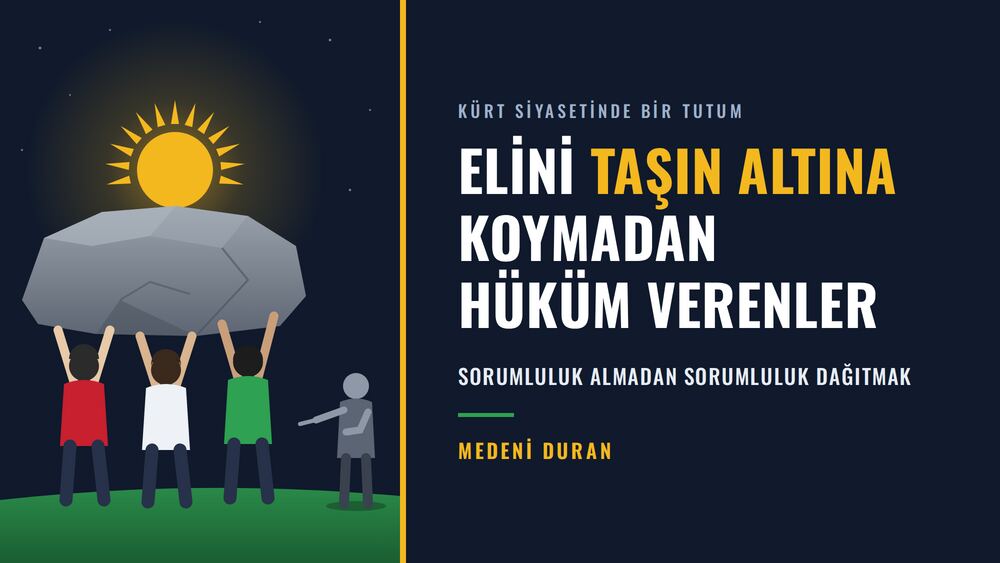
Those Who Pass Judgment Without Taking Responsibility
A person's desire to protect themselves does not turn into a right to defame the fighters.
There is an attitude we must address in Kurdish politics: the endless attacks launched by people who have never been associated with any Kurdish organization, have not taken on a shared responsibility, and have not put their hand under the stone, against those who have devoted a significant portion of their lives to the struggle for national or collective rights.
I am not speaking of everyone who is not a member of an organization. A person can think, create, and defend the rights of their people without belonging to a group. They can make valuable contributions without joining any party. The attitude I refer to is one that, without taking any responsibility itself, places everyone who does assume responsibility under suspicion; it looks for an accounting behind every initiative, a hidden link behind every call for unity, and a betrayal within every political effort.
The number of such people may not be large, but the noise they generate far outweighs the work they actually do.
"The Boundary Drawn with “May Nothing Happen to Me”"
When I speak of a person who does not give up their comfort, I do not mean someone living in luxury. This person may be washing dishes in a restaurant, working in a shop, repairing shoes, or may have completed their education and acquired a profession. What job provides their livelihood is irrelevant to this discussion. Every labor is worthy of respect.
Here, comfort refers to the inviolable zone a person draws around themselves: “Nothing should happen to me.”
I do not want to be seen at a meeting. I do not want to take on a responsibility. I do not want my name associated with an initiative. I want to be able to step back when needed. But let me also pronounce the harshest verdicts about the people who take all this on.
We cannot expect everyone to take the same risk. People have fears, family responsibilities, health issues, concerns about making a living. These are understandable. Yet how can it be explained that someone who seeks understanding for their own reservations behaves so brutally toward the responsibility that another person has assumed?
The choice of a person who wants to protect themselves does not become a right to smear those who are fighting.
Let the Subject of Criticism Be Clear
We criticize the viewpoints that see the future of the Kurds dissolving within Turkish, Arab, or Persian political sovereignty. We question the policies that postpone Kurdish national rights to an uncertain future and tie the Kurds' will over their own lands to the approval of external centers. This debate has a clear foundation: the future, status, and sovereignty of the Kurdish people.
So, what is the basis of the attacks directed at those who, like any other nation, defend the Kurds' right to sovereignty over their own territory?
Someone steps forward and says, “The Kurdish issue is not about how the Kurds can better adapt to someone else’s political order; it is about the Kurds deciding their own future.” To that end, they meet with people, organize gatherings, write, attempt to organize, and take on the responsibility of building a collective.
Which of their views do you oppose?
Do you find its program insufficient? Explain. Do you see its mode of organization as wrong? Debate it. Do you consider its claim to representation problematic? Question on what authority it is based. Is there a contradiction between its words and actions? Put it forward.
Each of these is necessary. Defending a national cause does not exempt anyone from criticism. Having contributed in the past does not grant immunity against today's mistakes.
But constantly tying people to certain positions, reading intentions without evidence, and tainting every step they take with suspicion—what discussion does that advance? If you have a claim, present its basis. Political assessment cannot be made by generating doubt over people's names.
Silence Toward the State, Courage Toward One's Own People
One of the contradictions that truly needs to be addressed emerges here. Some individuals whose voices we do not hear against state policies that restrict Kurdish rights suddenly become extremely bold when Kurds try to take a step forward among themselves.
They direct the harshness they do not aim at the state toward people who take responsibility within their own community. In the face of denial policies, they easily construct sentences they have not built for those who hold a meeting, publish a statement, or try to form a partnership.
It is our right to ask why.
Because here the very choice of target carries a political meaning. Attacking the person you can reach by staying silent against the powerful also puts the measure of courage up for debate. Moreover, while those who are the object of criticism can answer you, argue with you, and be in the same circle, if you do not show the same openness before the state, you must first hold yourself accountable for this attitude.
We will, of course, speak about the mistakes of our own people. However, we will also discuss the silence in the face of state pressure, and the boundless anger that stands side by side with every Kurdish initiative.
Denying Every Initiative the Right to Exist
When Kurds fail to come together, they are asked, “Why don’t you unite?” When they try to unite, they are instead accused over with whom, why, and what agenda they are gathering.
Their standing apart is a flaw, their seeking partnership a cause for doubt. Their speaking is unnecessary, their silence is irresponsibility. Their taking steps is wrong, their waiting is weakness.
With these standards, no initiative can develop. Because from the very beginning, the opportunity to make mistakes and correct them is taken away.
Yet politics is not a task performed by flawless people under perfect conditions. People come together with their differences of opinion, their limitations, the burdens they carry from the past. They draft a program, test it, see its flaws, and try to change it. The value of criticism emerges here: to the extent that it helps produce a more robust outcome.
A language that constantly belittles and discredits every effort as it emerges leaves behind mistrust. After a while, people begin to retreat not only because they fear the state but also because they are exhausted by attacks from their own surroundings.
Won’t we ask what this brings to the national struggle?
Distributing Responsibility Without Taking It
I am not telling anyone “you didn’t fight, stay silent.” One does not need a past service record to speak out. Sometimes an outsider can see a mistake that those inside cannot. A person not tied to any organization can offer a very timely criticism.
However, the right to criticize does not erase responsibility for what is said. If you accuse someone, you must have evidence. If you condemn a method, you must explain why. If you find everyone inadequate, we also need to hear what you consider the correct path.
What is the path you propose? Through which political effort will the Kurdish national rights be achieved? With what kind of organization, which institutions, and what form of social participation?
Without answering these questions, a debate that targets only individuals leads nowhere.
The Kurdish people face weighty issues. Solving them requires people who think, write, organize, and strive to reach each other. We are not obliged to accept everything they say as correct. However, when discussing their work, we must consider effort, evidence, and fairness.
My objection is the mindset that places itself beyond all responsibility while claiming the authority to judge everyone. It is an attitude that grants unlimited excuses to its own fears while showing not the slightest understanding of another's effort.
"You can say, 'May nothing happen to me.' You can also explain the reasons for that. However, when you target people who go beyond that line and try to do something for the people, simply because they have taken action, then your own attitude becomes a matter of debate."
The question is clear: what do you expect from those who advocate Kurdish sovereignty over their own lands and assume responsibility for it? Do you want them to correct their mistakes, or to do nothing at all?