
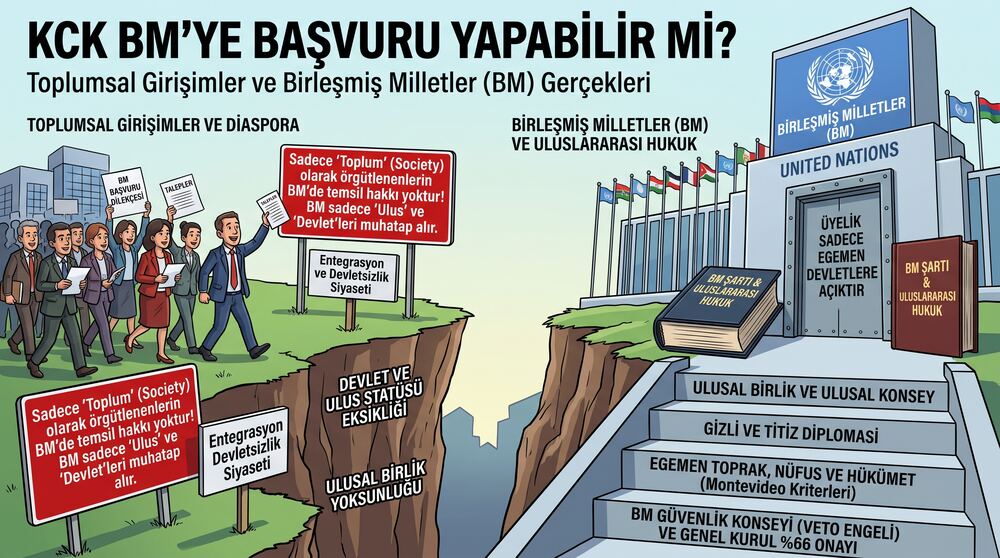
Can the Integrationist KCK Submit an Application to the UN?
KCK’s attempt to apply to the UN emerges as a political move that disregards the diplomatic realities of a structure lacking state and international recognition, while framing the Kurdish issue on the axis of “society” rather than a claim of national representation makes the legal and political ground of this initiative contentious.
The leaders and members of the KCK, a diaspora organization of the dissolved PKK, have repeatedly stated in numerous statements that they follow Öcalan, implement his directives, and advocate integration and statelessness.
Integration cannot be counted among the demands of a nation, let alone a minority. It is a foreigners policy applied in many advanced states—particularly in Western Europe, the United States, Australia and Canada—to enable immigrant communities to adapt to the everyday life of the sovereign host nation.
The PKK, having dissolved itself at the wish of the state and of Öcalan, has openly championed integration. It seeks to dissolve within this colonial state. The public backlash against this political fiasco and the limited participation in its activities have prompted a new, albeit half‑baked, nationalist action that aims to sabotage any genuine petition.
However, it is clear that they are not sincere and that their primary goal is to consolidate their base.
Recently, in Brussels, they organized a conference aimed at applying to the United Nations. In reality, UN application efforts are not conducted through public statements; rather, they are carried out in strict secrecy so that the other side does not take preventive measures. States that might support the application are prepared through diplomatic channels. Unity among national parties and institutions is secured, a national council composed of representatives of all these bodies is formed, and the work is carried out by that council.
Because the relationship between the United Nations and a people must be national. Yet the KCK, whose name literally means “Koma Civakên Kurdistan” – the Union of Kurdish Communities – understands the Kurdish nation not as a nation but as a society.
A society has no right of representation in the United Nations because societies do not possess the attributes of a nation. A nation rests on a common language, culture, history and a shared sociology. An organization that calls a nation a society cannot meaningfully apply to the United Nations, which is a union of nations. The UN represents a union of nations; however, since a state cannot exist without a nation anchored in territory and sovereignty over that territory, membership is open only to states.
Within the United Nations, states are peoples whose membership has been accepted. There is no official procedure that begins with a “membership application” for a people or population that lacks any state status or even a recognized representative status. Undoubtedly an application can be submitted; however, without the necessary preparations it would not meet the purpose. The official conditions and procedure for membership, according to Article 4 of the UN Charter, make membership available only to states that accept the Charter’s obligations, are peace‑loving and are capable of carrying them out.
The UN itself does not recognize states or governments; recognition is performed by other states. The organization can only admit members or approve the credentials of representatives. A state’s membership process works as follows: the application is submitted to the Secretary‑General together with an official declaration that the Charter’s obligations are accepted. The Security Council then examines the application.
At least nine of the fifteen members must vote in favor for a recommendation; a negative vote (veto) by any of China, France, Russia, the United Kingdom or the United States blocks the recommendation. If the Council recommends, the matter goes to the General Assembly. A two‑thirds majority is required for admission. Membership takes effect on the date the acceptance decision is adopted. This process presupposes that the applicant is already regarded as a “state.” The criteria frequently cited in the Montevideo Convention—permanent population, defined territory, government, and the capacity to enter into international relations—together with recognition by other states become decisive at this stage. For peoples without a state status, the practical routes are as follows. Because direct membership is closed, the historically pursued avenues can be listed as:
1‑ Form a representative organization. A political organization, liberation movement or provisional administration that claims to act on behalf of a people is established. The Palestine Liberation Organization (PLO) is a typical example: in 1974 the General Assembly, by resolution 3237, granted it observer status as the representative of the Palestinian people.
2‑ Seek the support of member states for observer status. There is no fixed application form for observer status at the General Assembly. Usually the interested party notifies the Secretary‑General of its intention; subsequently one or more member states submit a draft resolution and the General Assembly votes. General Assembly resolution 49/426 (1994) stipulates that observer status is essentially limited to states and intergovernmental organizations whose activities concern the Council. In 2012, by resolution 67/19 (138 in favour, 9 against, 41 abstentions), Palestine was upgraded to the status of a “non‑member observer state.” This status does not confer voting rights but does allow participation in many meetings and certain privileges. The Holy See (Vatican) occupies a similar position.
3‑ Appeal to UN bodies within the framework of the right of peoples to self‑determination. Article 1 of the Charter affirms the right of peoples to self‑determination. For former colonies, petitions and lobbying can be made through the Special Committee on Decolonisation, human‑rights mechanisms or relevant reporting procedures. These do not lead to membership or automatic recognition; they serve as tools for political support and visibility.
4‑ Bilateral recognition and diplomatic groundwork. Recognition by a sufficient number of UN member states bolsters both the claim to statehood and the chances of a future formal application succeeding in the Security Council and the General Assembly. Without recognition, an application may be technically submitted but cannot advance in practice.
Points to keep in mind: entities such as the “Unrepresented United Nations” (UUN) or similarly named groups are not official United Nations bodies; they are private initiatives. Civil networks like the Unrepresented Nations and Peoples Organization (UNPO) also provide lobbying and visibility but are not UN organs.
In summary, the process does not begin with merely “submitting a petition to the UN”; it starts with political organization, gathering support from other states, and securing a draft resolution from a member state in the General Assembly. Full membership becomes possible only after widespread state recognition and the removal of any Security Council obstacle. Each case depends on political balances; there is no legal “automatic right.”