
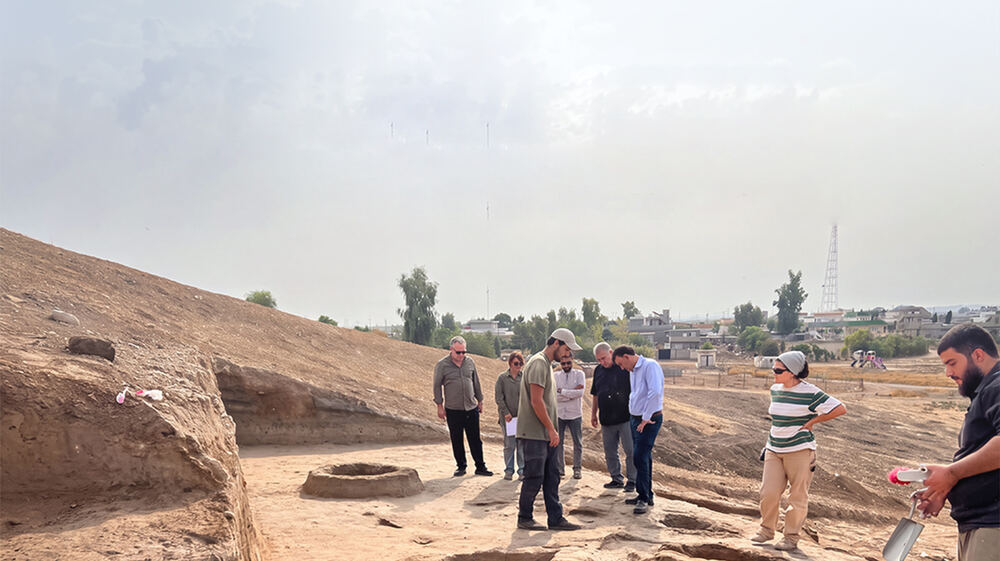
Excavations Begin at Four Historic Mounds in Erbil with Italian and French Universities
In Erbil, under the supervision of Kurdistan Region authorities, comprehensive archaeological digs have been launched at four major mounds with the participation of Italian and French universities.
In Erbil, under the supervision of the General Directorate of Historical Monuments and Cultural Heritage of the Kurdistan Region, extensive excavations are being carried out at four key historic mounds through a partnership of the Italian CAMNES Research Center, the University of Milan, France’s Sorbonne University and the Erbil Directorate of Historical Monuments.
Ali Mulan Mound is located 10 kilometres southeast of Erbil and the settlement from the Chalcolithic period and the “Ninova 5” phase dates back to 4500 BC. Hilawa Mound, considered the largest archaeological site in the Erbil Plain from the 5th millennium BC, is a 22‑metre‑high hill with traces from the Halaf and Ubaid periods extending back to 6000 BC. Alyawa Mound lies about 3 kilometres from Alyawa and served as a 30‑hectare settlement in the Bronze Age; it hosted continuous human occupation up to the Islamic period. Kasr‑e‑Shamamuk, covering 70 hectares 30 kilometres south of Erbil, was an important provincial capital in the Neo‑Assyrian period and has a history stretching from the 2nd millennium BC to the Sasanian era.
These excavations document that settled life and urban development in the region extend back 8 000 years (to 6000 BC), positioning Erbil as one of the main hubs for archaeological research in the Middle East.
Source: Kurdistan24