
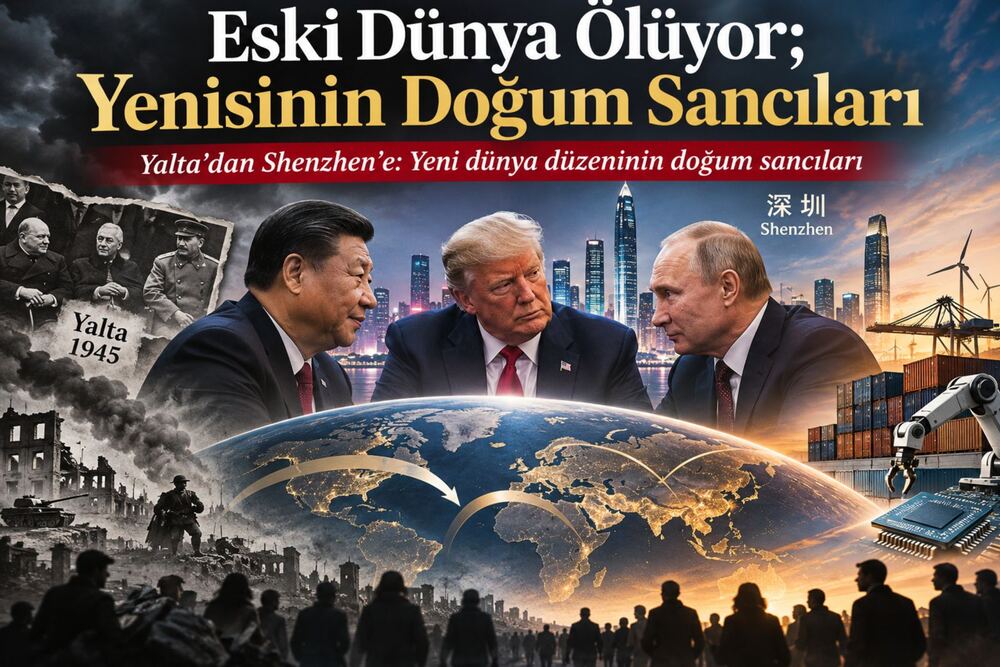
The Old World Is Dying; the Birth Pangs of the New
From Yalta to Shenzhen: the birth pangs of a new world order
Describing periods of historical crisis, the Italian thinker Antonio Gramsci said that the old world is dying and the new one cannot yet be born. In this interregnum, he argued, a variety of crises and extraordinary developments appear.
The state the international system finds itself in today brings back this assessment Gramsci made almost a century ago.
On 19 November 2026, in the Chinese city of Shenzhen, US President Donald Trump, Russian President Vladimir Putin and Chinese President Xi Jinping met at a historic three-way summit. After the talks a joint declaration was issued on preventing nuclear war, reforming the United Nations, energy security and the powers of international judicial bodies. But no concrete solution was announced on the core disputes, such as Ukraine, Iran and Taiwan.
This development cannot be treated as merely a piece of diplomatic news. On the contrary, it can be read as the first sign of the new world Gramsci spoke of, the one not yet born.
From Yalta to Shenzhen: Different Thresholds of History
In February 1945, as the Second World War was drawing to a close, Roosevelt, Stalin and Churchill met at Yalta. The victors of the war were discussing the future of post-war Europe and of the international order.
Yalta became one of the important thresholds at which the new order took shape. Afterwards the world settled into a bipolar balance of power led by the United States and the Soviet Union.
The 1989 Malta Summit, in turn, was one of the symbols of the end of that bipolar order. The Soviet Union then dissolved, and a new period began in which the global supremacy of the United States became evident.
In Shenzhen, the make-up of the table has changed. China has taken Britain's place. This change also reflects the shift of the world economy and of the geopolitical centre of gravity towards Asia.
Yet there is a fundamental difference between the two summits: Yalta tried to shape the order that would follow a great war, while Shenzhen can be read as a search for ways to manage the contradictions between the powers without entering a new world war.
Of course, we do not yet know whether such a search has really turned into a common strategy. That will be decided by time on the one hand, and on the other by the stance of the actors left out of these talks and by how satisfied the three are with the division.
A Thirty-Year Transition Is Nearing Its End
The expectation of a unipolar world that took shape after the dissolution of the Soviet Union did not last long.
China's economic and technological rise, Russia's renewed military and geopolitical weight, the limits that American global supremacy has run into, and the growing influence of regional powers have pushed the international system into a new search.
In this respect, the last twenty to thirty years can be seen as a transition in which the old balances came apart but the new ones have not yet been institutionalised.
This is where the importance of the Shenzhen summit lies.
The United States, China and Russia meeting at the same table means that the present distribution of power is recognised at the diplomatic level. China hosting the summit in particular symbolically reinforces the global power position the country already holds.
Events will show whether this meeting signals that the end of the transition is near, or that a new stage of a longer transformation has begun.
Compromise on One Side, a New Bargain over Division on the Other
The joint declaration of the three great powers contains no explicit decision on dividing the world into spheres of influence. The struggle over these spheres of influence has in any case been on display in practice in recent years. Ukraine, Syria, Iran and Venezuela are clear examples.
It is clear that crises such as Ukraine, Iran, Taiwan and the Middle East are linked to these great powers' efforts to define one another's security limits and strategic interests.
Limiting Russia's influence in other areas in exchange for its territorial demands in Ukraine, building new security balances in Iran and the Middle East, or managing the tension around Taiwan stand out as possible headings of future bargaining.
These are not yet the details of decisions already taken. But they should be read as steps by the great powers to develop methods of compromise that, even if they do not end the rivalry between them, keep that rivalry from turning directly into a global war.
That is why the announcement at the summit of a common principle on preventing nuclear war matters. But it does not show that the danger of a Third World War has gone away. Even so, the fact that one of the first topics was nuclear weapons can be taken as a sign that all sides want to take this catastrophe off the table as an instrument of rivalry.
Reactions
International assessments have highlighted the gap between the summit's historical symbolism and its concrete results.
Reuters Breakingviews columnist Ka Sing Chan notes that the summit did not produce an order-building agreement on the scale of Yalta, and that the economic disputes between the three countries make a lasting settlement difficult.
Experts at the Council on Foreign Relations see the three leaders meeting at the same table for the first time as significant, while questioning whether it will turn into real results on nuclear arms control, Ukraine and trade.
The assessments of Atlantic Council experts also contain different views. Some regard China's joining a nuclear risk dialogue as limited progress, while others warn that the summit could weaken the great powers' accountability before international law.
Jonathan Eyal of the Royal United Services Institute draws attention to the dangers that great powers shaping international rules to suit their own interests could pose for small states.
The common point of debate in these commentaries is not so much the summit's historical importance as whether the principles announced will turn into enforceable agreements.
Those Left Outside the Table
Britain, which was at Yalta, is not at Shenzhen. The European Union is also outside the talks. India, Pakistan, Iran and other regional powers are not represented at the table either.
But not being at the table does not mean being ineffective in international politics.
The diplomatic relations Britain could develop through Turkey and Syria, its efforts to preserve its position in the Middle East and its influence within NATO are subjects that deserve study in this context. Many Middle East-focused assessments express the view that Britain still retains the ability to turn developments in the region in its favour.
Nor would it be right to assume that Europe is automatically represented by the United States. Indeed, German Chancellor Friedrich Merz has stated that he opposes Europe being divided by decisions taken without it.
Iran's close relations with China and Russia do not mean that these countries can decide on Tehran's behalf. India, with its economic, military and demographic weight, is one of the powers that cannot be kept out of a new international system.
So a compromise that may form among the three great powers will not make the interests and objections of other states disappear.
The implementation, lifespan and durability of the new system will depend on the place and position in the division not only of the three actors but also of the other powers named above.
On What Economic Foundation Will the New System Rest?
The global transformation is not limited to military and geopolitical relations. The economic order is changing too.
China's rise has brought back to the agenda the importance of production capacity, industrialisation, technology and the state's role in steering the economy.
In the United States and Europe as well, strategic industrial investment, energy security, technological independence and state support are becoming ever more important.
These developments do not show that the world has adopted China's economic and political model wholesale. But it can be said that, alongside a finance-centred conception of globalisation, control over production, technology and strategic resources has become decisive once again.
Whether this transformation will result in a stronger social state, or in the state steering capital accumulation and strategic production more directly, is a separate debate. In this context, we are living through the signs of the Western world moving away from the social state for the sake of taking part in this race, as it has for a long time.
The character of the new world order will be determined not only by the military balances between the great powers, but also by how production is organised, how economic gains are shared and how societies are affected by this transformation.
In the recent mass demonstrations we have also heard the footsteps of social reaction against this transition being carried out from above. Contrary to what is assumed, this transition will be accompanied not by social silence but by social struggle.
Will the New Order Be Lasting, or an Order in Constant Change?
Perhaps this is the most important question to dwell on in order to understand the Shenzhen summit.
The world that emerged after Yalta was shaped for a long time by distinct blocs and relatively stable balances of power.
Today the situation is different. The United States and China are economically interdependent yet strategic rivals. China and Russia cooperate closely, yet not all their interests coincide. India, Turkey and various regional powers can act with different partners on different issues.
This picture shows that, rather than a world divided into three spheres of influence with fixed borders, we must also keep in view a fluid international system in which three great powers stand out but other centres of power are influential as well.
In such a system, compromises will be periodic rather than lasting, and alliances will depend on changing conditions. The sharing of power will become not an order settled once and for all, but a process renegotiated over and over again.
In that case, Shenzhen carries historical meaning less as the completed founding meeting of a new world order than as the beginning of this era of constant negotiation.
Is This a Sign of Birth?
Gramsci's observation that the old world is dying and the new one cannot yet be born still offers an important intellectual framework for understanding the uncertainty in international relations today.
The Shenzhen summit does not proclaim that the new world has been born. But it shows the need felt by the main global powers to manage the problems of the existing order not only through mutual threats but also through direct negotiation.
At Yalta there was a search for a new order at the end of a war. At Shenzhen there is a search for new balances without being dragged into a great war.
Whether this will turn into a lasting division of power or into a fluid world system managed through ever-changing compromises is still uncertain.
Perhaps Gramsci's awaited new world will not, this time, emerge in a single moment of birth.
Rather than being established at once, the new order will take shape amid constantly shifting balances of power and endless negotiations.
The historical meaning of the Shenzhen summit is not so much that the old world has ended, but that it marks a new stage in the struggle over how the new world will be born.