
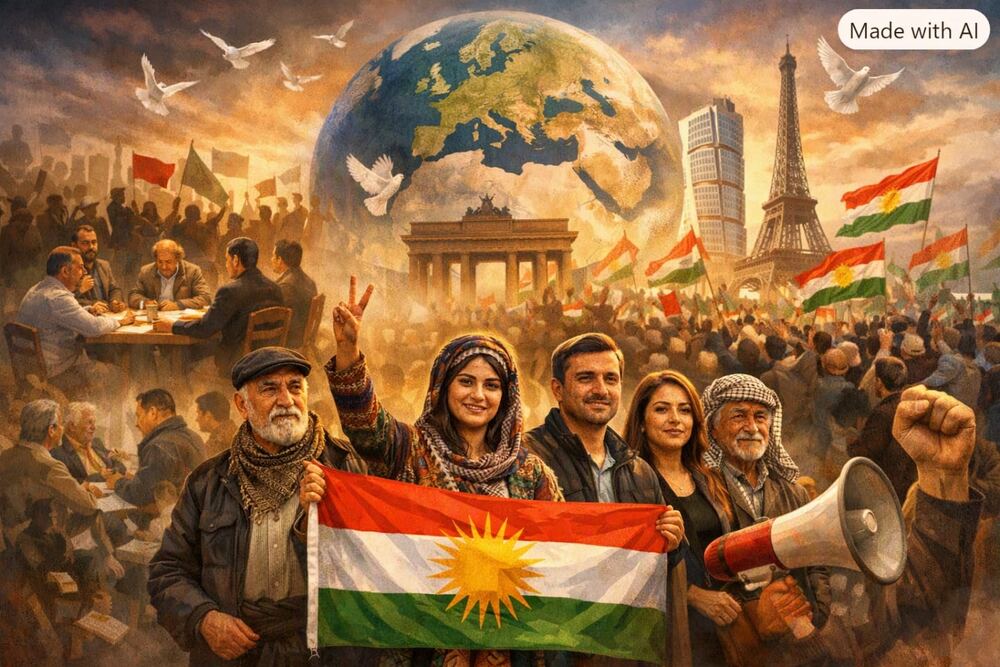
For an Effective Kurdish Diaspora
A strong Kurdish diaspora is possible not through the power of organizations and leaders, but through a nation‑based organization founded on merit, democratic participation, equal representation and shared social responsibility.
For years I have emphasized a fundamental distinction regarding how Kurdish society should organize: instead of an organization‑ or group‑centric approach, adopting a nation‑based model of organization. I have expressed these views in various articles since 1984. In Sweden, I actively advocated for a model in which all Kurds, regardless of political views, ideological leanings or organizational affiliations, could become members; a structure organized around local administrations, with leaders chosen by democratic elections.
However, at that time I encountered resistance from narrow‑minded approaches that prioritized protecting group associations and each group’s own institutional space – in other words, their “home” – over social integration. Nevertheless, some progress was made. In fact, this model needed to be expanded and institutionalized not only in Sweden but also in other European countries. Yet a lasting and comprehensive development in that direction was not achieved.
One of the core contradictions of the issue is that groups which cannot move to a people‑based organization nevertheless continue to claim to represent the Kurdish nation. This problem is not limited to the Apocu movement or any particular political line. The appearance of similar tendencies in different ideological and organizational circles shows that the problem goes beyond individual organizations and is a deeper matter of political culture and social organization. A structural issue like this is also one of the reasons why an effective and strong Kurdish diaspora has not emerged.
What conditions are required for a strong diaspora?
To build an effective diaspora, I believe the following principles must first be adopted:
First, merit and the public good must be the basis. Regardless of political views or ideological affiliation, the most competent, experienced and responsible individuals in society should be able to serve in joint institutions. Appointments should be determined by competence and social contribution, not by personal closeness, group affiliation or organizational loyalty.
Second, the paternalistic model based on party and group dominance must be abandoned. Democratic mass organizations should not be seen as subsidiaries under the control of any party, ideological movement, or narrow group. The legitimacy of these institutions should stem not from allegiance to a particular political centre, but from their ability to represent different segments of society and to be based on the will of their members.
Third, the equality and shared belonging of all social strata must be internalized. No segment of Kurdish society should enjoy greater representation merely because it adopts a particular ideology or is affiliated with a certain organization. Joint institutions should aim not to erase differences but to enable those differences to coexist on an equal footing.
Undoubtedly, moving away from mindsets shaped by an authoritarian political culture is not easy. Nevertheless, to build a democratic social structure, this culture must be subjected to critical scrutiny. Organizational forms that, fed by distrust of oneself and one's own ideas, aim to preserve the domain of a narrow circle or group should be challenged. Such structures, rather than fostering social solidarity, can gradually reproduce exclusive networks of relations and personal dependencies.
It is clear that building an effective diaspora is closely linked to education, intellectual capital, institutional capacity and political awareness. Therefore, the success of the diaspora cannot be measured solely by the number of associations, the breadth of memberships, or activities shaped around individuals’ personal and bureaucratic needs. What truly matters is the ability of these institutions to devise solutions to shared social problems, train qualified personnel, forge effective international relationships, and develop a long‑term societal vision.
People who place societal progress ahead of personal advancement must be able to transcend narrow group interests. Such an approach requires seeing individuals with differing viewpoints not as outsiders but as stakeholders in a shared social responsibility. When a person treats his own political view as the sole truth and tries to align the rest of society around it, it becomes a major obstacle to building a democratic diaspora. Embracing society also means viewing its internal differences not as threats but as a richness for collective life and intellectual development.
In this respect, the problem facing the Kurdish community is not merely a lack of ideological pluralism. A deeper issue is the inability to turn pluralism into an institutional principle; a political culture that continues to reward loyalty over merit, group interests over the common good, and obedience over critical thinking. Similar problems can be observed in Turkish political and social life in various forms. Thus, the issue concerns not an immutable characteristic unique to a particular community but authoritarian relational patterns that have emerged over historical processes.
The mistakes of a political movement or leader do not automatically make their opponents right. Nevertheless, the perception that an authoritarian leader or movement is an indispensable option for the Kurdish people should also indicate that alternative political actors and viewpoints have failed to build societal trust. Democratic alternatives cannot limit themselves to criticizing existing actors; they must concretely present a more inclusive, merit‑based, and accountable model of politics.
In conclusion, building an effective Kurdish diaspora cannot be achieved merely by establishing more associations or expanding existing organizations. For this, a new political and institutional culture must be developed that places common social responsibility above organizational affiliation, merit above personal loyalty, and democratic participation above relationships based on obedience.
Success, above all, requires presenting a different vision and maintaining a clear, consistent, principled distance from authoritarian mindsets. Democratic mass organizations should also be one of the most important arenas where this transformation can be tested. These institutions must become structures in which the various segments of society are represented on equal terms, leaders are chosen through democratic means, decisions are made transparently, and leaders are accountable to their members.
Unless such a transformation takes place, converting the Kurdish community's potential on the international stage into institutional power will be difficult.
A strong diaspora should be measured not by the size of a group or a political movement, but by its capacity to bring together different segments of society around shared democratic principles.