
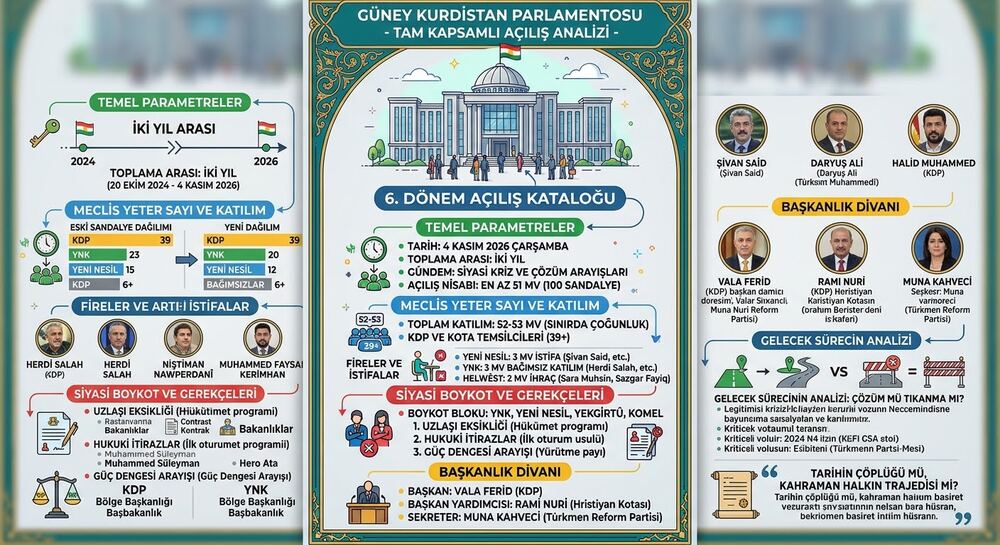
South Kurdistan Parliament Opens After Two Years
The South Kurdistan Parliament, reconvened after a two‑year hiatus, once again laid bare the deep dead‑end of Kurdish politics, caught between the government's helplessness and the opposition's irresponsibility, rather than solving the political crisis.
Will the November 4 session be able to resolve the political crisis?
The Parliament of the Iraqi Kurdistan Regional Government had been unable to meet for about two years due to deep disagreements among political parties following the general elections held on 20 October 2024.
When the calendars turned to Wednesday, 4 November 2026, the parliament finally opened its doors to hold the first session of its sixth term. Yet this opening did not end the chronic political crisis in the region; instead it signalled new alliances and fractures.
POLITICAL BOYCOTT AND PROCEDURAL DEBATES
Ahead of the session led by the Kurdistan Democratic Party (KDP), political actors based in Sulaymaniyah and opposition blocs adopted a joint stance to boycott the parliament. The Kurdistan Patriotic Union (YNK), New Generation Movement (Newey Nwe), Yekgirtû (Kurdistan Islamic Union) and Komel (Kurdistan Justice Community) officially announced that they would not attend the session.
The boycott bloc cited the following points as justification for its decision:
Lack of Consensus: The parliament was opened unilaterally without a broad inter‑party agreement on the government programme, the allocation of ministries and the administrative model.
Legal Objections: The oldest member, Muhammed Süleyman, who according to the parliamentary rules should chair the first session, together with independent MP Hero Ata, refused to preside on the grounds that legal procedures were not followed.
Search for Power Balance: A balancing formula between the KDP and the KYB has not yet been found for top executive posts such as Regional Presidency and Prime Minister.
Political Stalemates and Exodus at the Threshold of the Quorum
For the 100‑seat parliament to convene, the constitution required at least 51 members—a simple majority—to be present in the chamber (quorum). Because the votes of the PDK, which holds 39 seats, and the minority‑quota representatives were insufficient to meet the quorum, the eyes turned to parties that had taken a boycott decision. The fate of the session was decided by opposition and YNK‑list MPs who were elected but did not follow their parties’ directives and entered the chamber. The parliament met with a borderline majority of 52 to 53 members present.
At this critical juncture, the following developments occurred within the internal dynamics of political parties:
New Generation Movement: MPs affiliated with the movement—Şivan Said, Daryuş Ali and Halid Muhammed—announced minutes before the session that they had resigned from their parties and would attend the session as “independents.” As a result, the New Generation Movement’s seat count fell from 15 to 12.
Herdi Salah, Niştiman Nawperdanî and Muhammed Faysal Kerimhan, who were elected from the YNK list, also acted independently of their parties and took their seats in the chamber. As a result of these defections, YNK’s seat count in the parliament fell from 23 to 20.
Helwêst (Stance) Movement: Despite the movement’s decision to boycott, Sara Muhsin and Sazgar Fayiq participated in the session and were immediately expelled by the party leadership on the grounds that they acted contrary to disciplinary rules and political will.
Other participation: Two MPs and one socialist representative from the People’s Front (Bereya Gel) also attended the session, contributing to the formation of a legal majority.
The presidential podium was set.
After the legal quorum was met, a vote was held and the new leadership structure of the parliament was shaped. KDP’s Vala Ferid was re‑elected as Parliament Speaker, while Rami Nuri, from the Christian quota, was appointed Deputy Speaker, and Muna Kahveci of the Turkmen Reform Party was assigned as Parliament Secretary.
SOLUTION OR A NEW STALL?
Although the November 4 session marks an institutional step by ending the parliament’s two‑year inactivity, it has not fully resolved the regional governance crisis. The boycott front, led by the YNK and the New Generation Movement, describes the newly formed parliament and any government it might shape as “lacking legitimacy.”
Political analysts warn that if the power‑sharing dispute between Erbil and Sulaymaniyah remains unresolved, the stalemate could continue into the next phase – the election of the Regional President and Prime Minister. The administrative stability of South Kurdistan appears to depend on whether the parties will return to the negotiating table in the coming days.
We tried to use a highly measured tone. Yet, there is a situation in South Kurdistan’s political life that exceeds all limits. The ruling party is opportunistic and helpless, while the opposition is a thousand miles away from national responsibility. What will happen at this rate?
Only disappointment will follow, defeat will follow, and because of the clumsy, short‑sighted political institutions that cannot take a single step beyond mutual accusations, another page will be added to the Tragedy Book of a heroic people who are being buried in the landfill of history.