
South Kurdistan’s crisis is not in parliament, it is in the system
The deadlock in South Kurdistan is not a parliamentary crisis but a crisis of the system. Resolving it does not depend on the rivalry between the KDP and the PUK disappearing altogether, but on building a lasting common ground on which that rivalry can be kept beneath shared national interests.
The latest crisis over the reopening of the Kurdistan Parliament cannot be read simply as a new political dispute between the KDP and the PUK. The current picture reflects structural problems carried over from the 1990s, now resurfacing in different forms. What is happening, therefore, is less a passing political crisis than a current expression of chronic problems in the way the Kurdistan Region is governed.
South Kurdistan’s fundamental problem is not whether parliament opens or whether a party boycotts its sessions. The real issue is that political institutions have been stripped of their role as mechanisms of social representation and turned into tools through which the parties consolidate their own political dominance. The struggle for control over parliament, the government, the security institutions and economic resources lies at the heart of today’s crisis.
According to information in open sources, the KDP and the PUK last met on forming a government in September 2026 and came close to agreement on certain points. Under this framework, the Presidency of the Kurdistan Region and the Prime Ministry would stay with the KDP, while the PUK would take a Vice Presidency of the Region with expanded powers, the Deputy Prime Ministry and the Speakership of Parliament. It was also discussed that the PUK would take the Finance and Peshmerga ministries and the KDP the Oil and Interior ministries. The parties, however, failed to agree on the Interior Ministry in particular, because it is a strategic post with decisive authority over the police, the Asayish and the internal security apparatus. For that reason the PUK has demanded the ministry, while the KDP regards it as one of its fundamental red lines for its security and political influence.
Yet alternative formulas that could have broken the deadlock were available. Giving the Interior Ministry to a third party other than the KDP and the PUK could have been one option to ease the lack of trust between them.
The partial unification of the KDP- and PUK-affiliated Peshmerga forces, as a result of efforts by international actors, had raised hopes that Kurdistan could build a common security capacity. The latest parliamentary crisis shows, however, that military unification carried out without political consensus and a shared strategic vision may remain largely formal and fragile. A security structure lacking political unity looks hard to sustain in the long run.
Meanwhile, there is also debate over whether the PUK might set up a parallel administration centred on Sulaimani, and whether this approach could in time turn into a demand for a separate federal region. The Iraqi Constitution, however, provides no clear legal mechanism for any part of the existing Kurdistan Region to break away unilaterally and form a new federal region. Baghdad’s political and legal backing for such an initiative therefore looks unlikely.
Moreover, for an Iraqi central government that has strengthened its centralist tendencies in recent years, the emergence of Sulaimani and Halabja as a separate federal entity could encourage similar demands in Iraq’s other Sunni and Shia regions. For that reason, Baghdad prefers to face a single Kurdish interlocutor on vital issues such as oil, the budget, border security and the “disputed” territories.
Baghdad’s most likely approach, then, is not to fully recognise a possible PUK parallel administration, while using the KDP–PUK crisis to further restrict the Kurdistan Region’s federal rights. In other words, Baghdad’s main priority may not be mediation but extracting the greatest possible benefit from the existing political division.
In recent years the Iraqi central government has narrowed the Kurdistan Region’s political and economic room for manoeuvre by exploiting the disputes between the KDP and the PUK. The disputes over oil revenues, budget transfers, public-sector salaries and constitutional powers are among the clearest examples.
The parliamentary crisis therefore does not affect only relations between Erbil and Sulaimani. A divided Kurdistan Regional Government will have less bargaining power in dealing with Baghdad. As political fragmentation deepens, the Kurdistan Region’s ability to protect its constitutional rights and defend its economic interests will weaken as well.
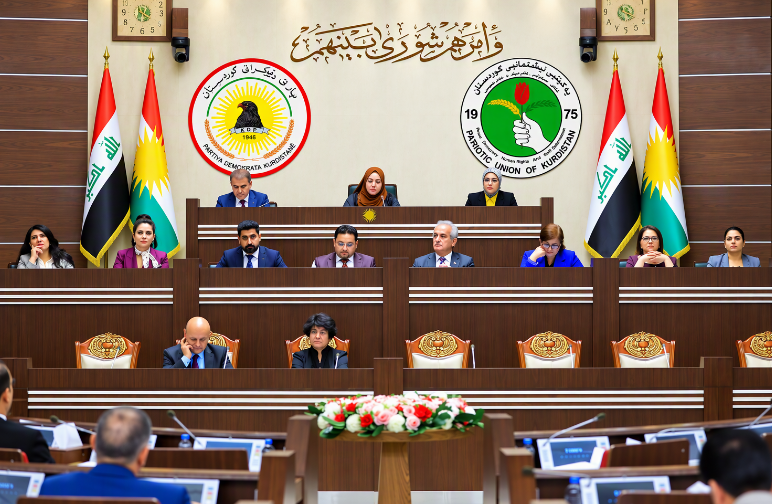
At this point the KDP has managed to reactivate parliament with 52 votes. The aim of this, however, should not be to exclude the PUK altogether but to create leverage that encourages it towards political consensus. Otherwise parliament may turn into an institution with limited representative capacity and constantly questioned legitimacy.
A new early election could in theory be an option for overcoming the crisis of trust between the public and the political parties and for restoring democratic legitimacy. Yet the failure to form a government for nearly two years after the last election has seriously damaged voters’ faith in the political process. A new election in the short term could therefore lead to lower turnout and a deeper crisis of representation rather than a solution.
As long as the current structure persists, with the KDP maintaining de facto political and security control in Erbil and Duhok and the PUK in Sulaimani, similar crises seem likely to recur whatever the election results, whenever genuine agreement between the parties cannot be reached.
Regional actors, for their part, will keep developing separate relations with the KDP and the PUK rather than treating the Kurdistan Region as a single political interlocutor. The states of the region, Turkey and Iran above all, assess the division within the Kurdish political movement in line with their own national and regional interests. This gives Ankara, Tehran and Baghdad the opportunity to turn the KDP–PUK rivalry into a field of bargaining against both Kurdish political forces.
If the KDP and the PUK cannot build a new framework of partnership on fundamental issues, it is hard to see either of them emerging as the winner. In that case Baghdad, Ankara, Tehran and Damascus could benefit further from the existing division, while the party that suffers most would be Kurdistan.
The solution should therefore be sought not in a “winner takes all” mindset but in a new model of governance that places the sharing of power and revenue between Erbil and Sulaimani under transparent, legal and institutional guarantees. A system in which local powers are clearly defined, institutions are freed from the shadow of the political parties and joint decision-making mechanisms are strengthened stands out as one of the most realistic options for overcoming the current crisis.
The fundamental threat facing the Kurdistan Region today is not that any one party loses power, but the steady erosion of the Kurdish political system’s capacity to act together. Historical experience has shown that every deep political division among Kurds can increase the influence of outside actors and weaken the gains Kurdistan has achieved. The current crisis should therefore be seen not merely as a question of parliament, government or budget, but as a strategic matter directly tied to Kurdistan’s future status and the preservation of its political existence.
Protecting and developing the constitutional, political and institutional gains Kurdistan has achieved depends not on the rivalry between the KDP and the PUK disappearing altogether, but on building a lasting common ground on which that rivalry can be kept beneath shared national interests.
Given the current regional and domestic political conditions, such a consensus should no longer be seen as merely a political choice, but as one of the basic conditions for Kurdistan to protect its gains.
X: @cetin_ceko