
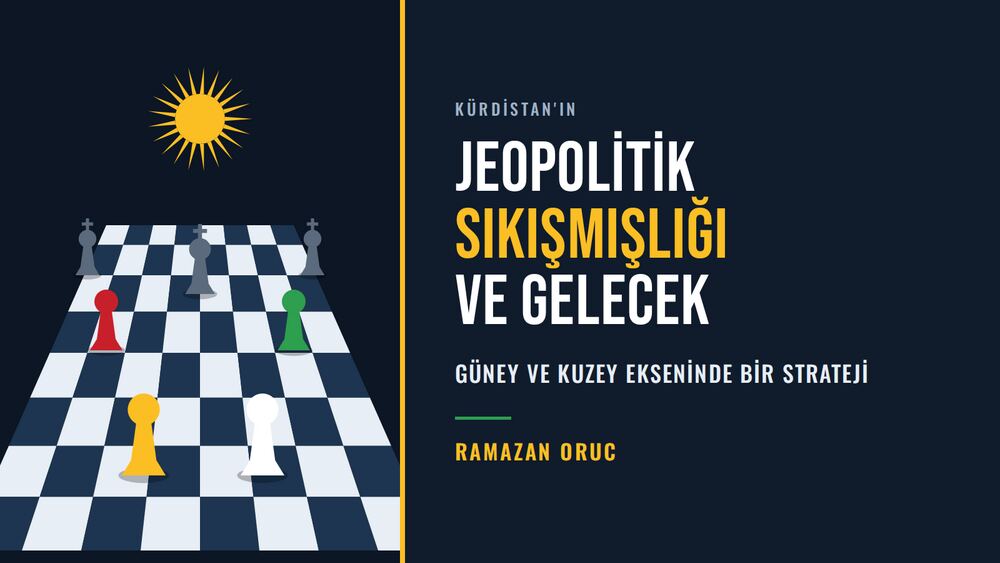
Kurdistan's geopolitical squeeze on the South–North axis and a strategy for the future
The way out of the historical deadlock on the chessboard: each part building itself first, then a shared democratic and just will beyond dogma.
As a historical and geographical reality, Kurdistan is divided into four parts, the product of interventions by regional status quo powers, the international balance of power and internal political dynamics. In today's political world, however, two main axes stand out as directly shaping the geopolitical centre of gravity and the national destiny of this land: South Kurdistan and North Kurdistan.
The political structures, levels of institutionalisation and social movements in these two parts determine Kurdistan's future, both through the balance of power between them and through their vulnerability to the assimilation and security policies of the colonial states.
In this article I intend to examine, within an analytical framework, the geopolitical deadlocks centred on South and North Kurdistan, the risks created by the power struggles between the two parts, the weaknesses produced by internal fragmentation, and a gradual strategic roadmap for building national consciousness.
South and North: the two decisive actors
Although all four parts of Kurdistan have been exposed to colonial interventions, the South and the North are the decisive actors of the process in terms of institutional experience and mass social base.
Thanks to the de facto situation that emerged after 1991 and the constitutional status gained with the 2005 Iraqi Constitution, South Kurdistan has succeeded in developing an autonomous administration with its own parliament, Peshmerga forces and international diplomatic networks.
Yet rather than evolving into an institutional nation-state, this state-building process has become trapped in traditional dynastic or "father/chief"-centred forms of rule and patronage politics, shaped along the axis of two deep-rooted parties and tribes (the KDP and the PUK). The administrative, military and financial division between these two centres makes fragile the constitutional autonomy and regional status won at a heavy price over many years.
A structure that cannot build its internal unity and a shared strategic mind becomes open to the interventions, struggles for influence and political blackmail of regional centres such as Baghdad, Ankara and Tehran. This leads not only the South but every other part as well to lose diplomatic and political ground.
North Kurdistan, for its part, forms the sociological backbone of the national movement, both through the size of its population and through its historical and political legacy. Having preserved its social resilience against decades of security-driven policies, demographic engineering and systematic assimilation, this part possesses a broad, mass dynamism.
The harsh interventions of the centralised state and the pressure of assimilation make it difficult for local political institutions and civil society to develop a sustainable strategy. Administrative crises in the South, opaque models of governance or fragmented positions, meanwhile, have a directly demoralising effect on social psychology and national consciousness in the North.
Discord on the chessboard
If the regional equation is likened to a chessboard, the moves of the sovereign status quo states are comprehensive, long-term and coordinated, while the relationship among Kurdistan's political actors rests on discord and rivalry.
The effort by a political structure in one part to control or neutralise formations in another part in line with its own narrow ideological or regional interest weakens every line of defence on the ground. A structure that cannot act in harmony with its own components cannot possibly withstand the multi-directional moves of its opponent.
Instead of developing an independent strategic mind against the policies of the colonial structures, placing hope in the regional contradictions between rival states leaves the parts defenceless again at every moment of crisis.
Gaps in building national consciousness
The deep internal crises in every part today reflect not only geographical obstacles but also shortcomings in the building of a collective identity and national consciousness.
The land of Kurdistan is home to heterogeneous faith groups, sectarian differences and sharp ideological polarisation. This mismatch in the social fabric leads political groups and parties to see one another as rivals or threats instead of turning towards common goals. Sociological realities show that these divisions will not disappear in a short time.
Building national consciousness is the product of a historical and social process. For that reason, rather than entering into destructive rivalry with one another, the parts need to strengthen their own social fabric.
A gradual and rational strategy
To overcome the present geopolitical squeeze and to build an independent future in the long run, a gradual and rational strategy is essential.
In the short term, each part should concentrate on solving its own administrative, political and economic problems. It is essential that each matures through its own governance, without becoming a burden on the resources of another part or trying to dominate the others. A structure that establishes the rule of law, merit and fair government within itself will lay solid ground for the growth of national consciousness.
Only in this way, with long-term goals, will it become possible for the fragmented structures to unite around a shared vision. Every political structure must be able to sacrifice its own ideological, sectarian or partisan sacred cows to the overriding need for national independence and freedom. The common ground of an independent homeland must be held above all narrow interests and dogmas.
The will of the ballot box and inclusive justice
The permanence of independence and autonomy processes is directly tied to the standards of justice and democracy of the administrative system to be built.
Once national existence has been secured, the form of government must be decided not by ideological imposition but by the transparent will of the majority of the people, expressed at the ballot box in free and fair elections.
The maturity of a democratic state is measured as much by its respect for the will of the majority as by its protection of the rights of every ethnic, religious and cultural minority within it on an equal footing with those of the majority. An understanding of inclusive justice must be the most fundamental and unshakeable pillar of the future state.
Conclusion
In conclusion, this is what I propose: Kurdistan's geopolitical reality of division into four parts demands a cool-headed, rational and step-by-step strategic mind rather than emotional rhetoric.
The fractures along the South–North axis in particular have shown that internal strife and narrow party interests can put the fate of an entire land at risk.
In the short term, each part completing its own internal construction and administrative maturity, and in the long term, moving beyond ideological dogmas to meet in a shared will for a democratic and just future, is the only way to break the historical deadlock on the chessboard.
With greetings and prayers...