
The Sovereignty Paradox Under the Umbrella of Dominant States
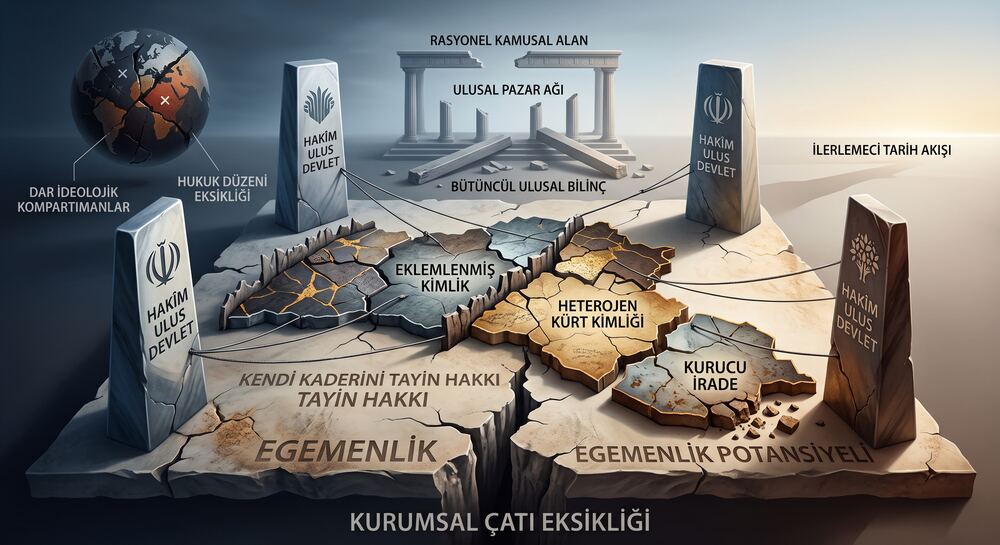
Is it possible to speak of a homogeneous Kurdish national identity under the umbrella of dominant nation‑states?
The question, raised specifically about the Kurds, actually begins with the problem of a nation—drawing on a subject‑centered sovereignty thesis—attempting, of its own volition, to construct a new legal order or founding power.
It is clear, as political theory asserts, that ethnicity is one of the foundations of the nation‑state, because the ground of ethnic affiliation forms the basis of national‑identity consciousness. Yet, when the Kurds are considered, the transformation of that ground into a cohesive national identity or a shared economic‑political project demands a comprehensive and multilayered debate.
The core reason for this impasse is that, during their modernization, the Kurds have not become a “founding subject”—an ethnic group situated within the legal framework of dominant states—and consequently their transition into a modern, sovereign nation has been interrupted.
In political philosophy, however, the transformation of a community from an ethnic congregation into a modern nation is completed when it exercises its right to self‑determination, that is, when it expresses the founding sovereign will both territorially and legally.
The historical division of the Kurdish region among various dominant nation‑states constitutes the greatest structural obstacle to that will. Fragmented by borders, this arrangement has made impossible a shared imagination that would lay the groundwork for nation‑building, an integrated market network, and a unifying language‑or alphabet policy. Consequently, Kurds have experienced, in each fragment, different practices of assimilation, integration and modernization, leading not to a cohesive national identity but to a heterogeneous identity shaped by the political dynamics of the dominant states to which they are attached.
This places them in the literature as the largest “stateless nation” paradox—possessing sovereign potential yet lacking an institutional framework.
Although recent globalization theories have advanced the thesis that the nation‑state has broken away from ethnic identity and entered a post‑national arena, the counter‑argument—that the nation has maintained its functional link and structural continuity with the state apparatus—remains current.
Thus, even if there is no essential bond between the concepts of nation and state, modern politics, by its very nature, entails a philosophical unity of meaning and mutual dependence. In this sense, the nation not only plays a decisive role in expressing will; it also emerges as an active “subject” in the Carl Schmitt sense, capable of making decisions that bridge the social and legal spheres without disrupting the system’s functionality. The modern concept of the state, therefore, directly alludes to a sovereign nation.
The reduction of Kurds to mere instruments of transformation in the hands of sovereign powers, rather than being a transformative agent of modern political history, is not accidental but stems from a consciousness of not being a nation. This situation is directly linked to the Kurds' disconnection from the rational dynamics of progressive historical flow and their inability to build inclusive institutional structures rooted in their own distinct living spaces. The chronic institutionalization crisis and the paradox of statelessness that the Kurds have fallen into throughout history collide with the hard‑to‑overcome walls of internal and external obstacles that are in a dialectical relationship with each other.
The biggest obstacle to the Kurds attaining the freedom to decide their own future and achieving rational political centralization is division. Political centralization, by its nature, requires individual interests to be sacrificed for a public will. However, in Kurdish social structure, exploitative micro‑institutions based on organizations, parties, leader cults and, in other words, narrow ideological compartments have historically prevented the formation of an inclusive coalition at the national level.
As noted at the roots of the political order, in mediocrities where organization and ideological outlook prevail over public institutionalisation, a rational bureaucracy and legal system cannot be built.
The Kurdish political intellect has failed to dissolve these ties and create a pluralistic, modern public sphere; on the contrary, it has even operated modern political structures with organiser or clique‑driven reflexes.
This institutional blockage's economic‑political leg is formed by the lack of a “national bourgeoisie” and the absence of capital centralization. As Max Weber notes in his theory of rational capitalism, the emergence of the modern nation‑state depends on the centralization of local capital into a national market. In the Kurdish region, however, accumulated economic capital has continuously flowed into the metropolises of the dominant nations due to the lack of stable and inclusive institutions, creating a “border” that is both dispossessed and de‑capitalized. On this ground, where a strong middle class and a commercial class have not become institutionalized, political power has failed to reach the broad masses; the economic‑political structure remains far from inclusive, trapped in an exploitative and rent‑seeking plane.
At the intellectual level, Kurdish enlightenment has fallen into the mistake of rigidly imitating ideological templates of dominant nations rather than generating philosophical thought from its own autochthonous roots. This situation, which Frantz Fanon conceptualized in the practices of colonized minds, has produced a form of “learned helplessness” in the Kurdish intellectual world and, in the sense of Gramşiyan, a consent to the cultural hegemony of the dominants. This discursive shallowness, unable to analyse its own historical experience through rational reasoning, has trapped society not in a progressive historical consciousness but in the comfort of a romantic victimhood narrative.
Note: Some expressions are quoted from artificial intelligence.
Share