
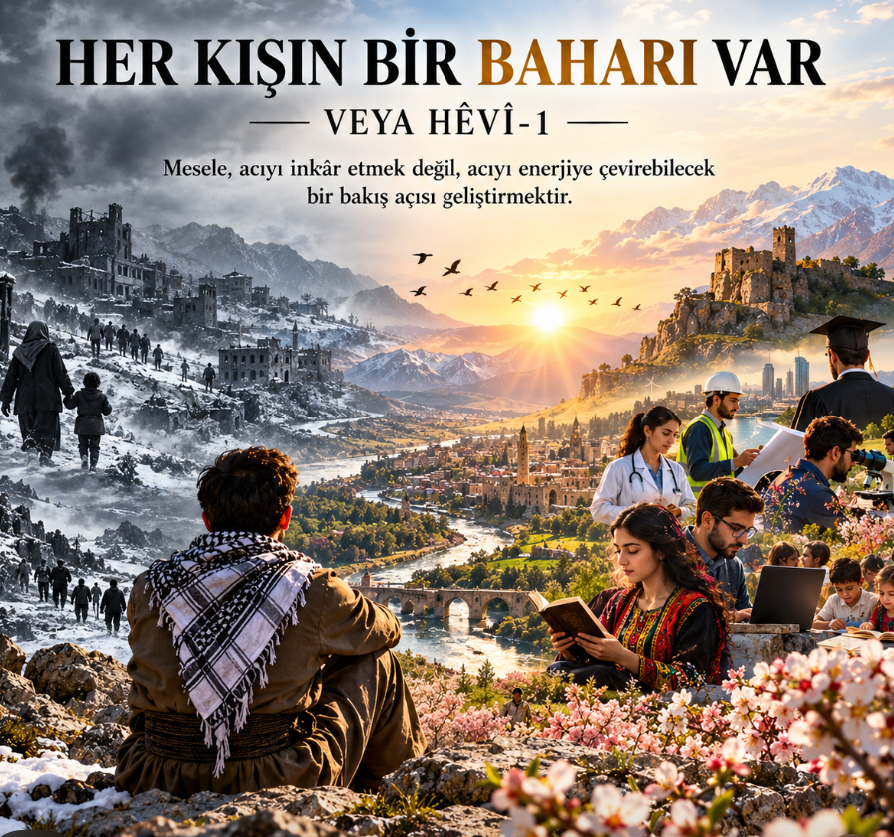
Every Winter Has Its Own Spring, or Hope-1
The issue is not to deny the pain, but to develop a perspective that can turn pain into energy.
The recent developments in Rojava have deeply wounded Kurds around the world.
Feeling sad is natural. Feeling pain is also natural. But pain is something else; drowning in it, especially losing hope, is entirely different.
We may not always be able to change events. However, we can change the meaning we assign to them. The same event can drain one person's energy, paralyze their fighting spirit; for another, it can be the start of rethinking, regrouping, and working.
The issue is not to deny the pain. The issue is to develop a perspective that can turn pain into energy.
Striking examples of this can be found in the life of Bediüzzaman Saidê Kurdî.
His life passed through exiles, courts, prisons and heavy oppression. So much so that the weight of his experiences made him say the following words:
“There have been times when I chose death over life a thousand times. If my faith had not prohibited me from suicide, perhaps today Said would have rotted beneath the earth.”
However, what is striking is not only what happened to him.
It is how one interprets what happens to them.
ISLAM HAS BEEN FRAGMENTED
In 1910, while returning to Van via Tbilisi, he has a conversation with a Russian police officer in Tbilisi. The era is a dark one. It is a time when, except for the Ottoman Empire, almost the entire Muslim world is in the hands of colonial powers. It is a period in which no spark of hope has been struck.
When the Russian officer says “Islam has been fragmented,” he objects strongly and replies in just two words:
“They have gone to study.”
He then describes India as “a ready-made chapter of Islam” and Egypt as “an intellectual offspring of Islam,” and defines them as students receiving education in British schools. He characterizes the Caucasus as a child educated in the Russian military school. He states that they will graduate one day and return.
That is what we need to reflect upon.
The Russian officer looks at the same scene and sees disintegration.
Seîdê Kurdî looks at the same scene and sees preparation.
The event is the same.
The perspective is different.
And when the view changes, a person's energy also changes.
SEE CONTINUITY AS SERVICE AND TURN IT INTO SERVICE
After the martyr Sheikh Said uprising, Seîdê Kurdî was taken from Van, first sent to Burdur, then to Isparta, and finally to Barla. In this desolate place where no bird flies, no caravan passes, and there is not even a road, it was expected that he would be forgotten, yet Barla became the center where important sections of the Risale‑i Nur were written in his life. At the age of fifty, one can see in his Thirteenth Letter where he drew the energy—or perspective—that enabled him to perform this service.
While abandoning politics and withdrawing from the world to contemplate the hereafter in a mountain cave, the people of the world forcibly removed me from there and expelled me. The Compassionate and Wise Creator turned that exile into a mercy for me. The seclusion in that mountain, which was exposed to insecurity and to causes that would corrupt sincerity, was transformed into a safe, sincere haven in the mountains of Barla. While in exile in Russia, I intended and prayed that in the last part of my life I might retreat to a cave. The Most Merciful made Barla that cave for me and gave me its benefit. Yet He did not place the burdensome hardship of the troubled cave upon my frail body.
He interprets the isolation imposed to keep him away from society as an opportunity that allowed him to focus on serving the Qur'an. He even says that the various obstacles placed against him were turned by God into a mercy for his service.
In other words:
They experienced exile; he saw the field of service.
They gave him loneliness; he found an opportunity for contemplation.
They pushed him away; he searched for a way to reach people from his place.
Moreover, he had none of the resources we have today.
There was no television.
There was no internet.
There was no WhatsApp.
There was no social media.
There was no large publishing house.
In the early period, treatises were copied by hand by people. Sources indicate that by the 1950s, the number of such hand‑copied treatises had reached roughly 600,000 copies.
A person's circumstances can be extremely limited; but hope and the will to work need not be.
SO WHAT DO THE KURDS HAVE TODAY?
Of course we will do our accounting and study our lesson. But today our issue should not be limited to the question “What have we lost?”
We must also ask:
What do we have?
There are hundreds of thousands of Kurds who have grown up in Europe, the United States, Canada and other parts of the world.
They have young people who speak the languages of the countries they live in.
There are doctors, engineers, academics, teachers, businesspeople, lawyers, bureaucrats and technology experts.
A new generation is studying at universities.
There is capital.
There is knowledge.
There is technology.
And perhaps most importantly of all, there is a Kurdish community that is beginning to become aware of each other.
Even within the pain in Rojava, I see a positive aspect that deserves attention:
Almost all Kurds mourn for Rojava. When Rojava suffers, the Kurds in Bakur are saddened.
It is heard in Başûr.
It is felt in Europe.
It is spoken about in America.
People now easily:
No longer say, “What does it have to do with me, the Kurds in Syria?”
Perhaps this is one of the most valuable lessons to be drawn from this suffering:
Kurds are beginning to feel each other's pain as if it were their own.
NOW WE MUST ASK A DIFFERENT QUESTION
Therefore, constantly asking the following question will not move us forward:
“What have they done to us?”
In addition, we now need to ask a bigger question:
“What can we do?”
In which common fields of service can we bring together so many people, knowledge, capital, experience and capability that are scattered across the four corners of the world?
What can a Kurdish doctor do together with other Kurdish doctors?
What can a teacher do?
What can a software developer do?
What can a businessperson do?
What can an academic do?
What can a parent do at home?
What can a student do?
What can we do for our language, for education, for technology, for the economy, for our families, for our youth?
Perhaps what we need today is not to gather everyone under the same ideology.
Instead of searching for a common ideology, we might look for common areas of service.
Because a nation’s future is not built solely on political events. It is built through schools. Through language. Through books. Through the economy. Through technology. Through families. Through institutions and people who trust one another.
What has happened in Rojava is certainly painful. Yet if this pain paralyzes our resolve to fight, makes us hopeless, it only deepens; if it brings us closer together, it takes on a different meaning.
The words we perhaps need to tell ourselves today are the words that Seîdê Kurdî said to the Russian police in Tbilisi:
“Every winter has a spring, every night has a dawn (morning).”
But spring is not merely waited for.
One prepares for spring.
Now the great question facing the Kurds is:
On which common foundations will we bring together such scattered talent, knowledge, capital and human resources?
The finest answer we can give to hopelessness is not merely to hope; it is to organize, to learn, to produce, and to work together.