
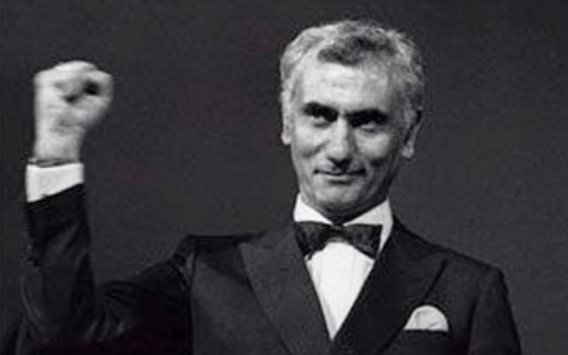
The Giant of Kurdish Cinema Yılmaz Güney Passed Away 42 Years Ago
A Pioneer and Creative Figure of Kurdish Cinema
The pioneering and creative figure of Kurdish cinema, world‑renowned film actor, director and screenwriter Yılmaz Güney, bid farewell to life in France 42 years ago today.
Nicknamed the “Ugly King,” Yılmaz Güney, who received numerous awards for his works—including the Palme d’Or at the Cannes Film Festival—appeared as an actor in 114 films, directed 26, produced 15, and wrote the screenplay for 64.
Yılmaz Güney passed away on 9 September 1984 in Paris, the capital of France.
In 1982, with the film Yol, Yılmaz Güney won the Palme d’Or at Cannes, achieving success not only as a screenwriter and director but also as an actor.
Güney, whose films such as Yol, The Herd and The Desperate have left a lasting imprint, also edited the 1981 version of Yol.
Child of a Siverek father and a Varto mother
Yılmaz Güney was born in 1937 as the son of a father from Siverek and a mother from Varto in Muş. Having spent his childhood in Adana, Güney hailed from the village of Desman in Siverek.
Yılmaz Güney began his film career in 1959 with the movies “Bu Vatanın Çocukları” and “Alageyik,” directed by Atıf Yılmaz.
Writing stories for magazines such as Yeni Ufuklar and On Üç, Yılmaz Güney was prosecuted on the grounds that one of his stories amounted to communist propaganda, and in 1961 he was arrested to serve a sentence of one and a half years in prison.
After leaving prison, Yılmaz Güney continued from where he left off, making mostly adventure films at the time. His movies depicted the poor and their rebellion. One of his significant works from this period is “Hudutların Kanunu,” directed by Lütfü Akad and written by Güney himself.
Cezaevi ve firari yılları
In 1971, Yılmaz Güney was sentenced to two years in prison and exile on the charge of sheltering Mahir Çayan and his comrades. During his incarceration, Güney published his thoughts on cinema and art, as well as poems and stories, in the magazine Güney, which he had started at that time.
After being released from prison in 1974, Yılmaz Güney shot the film “Arkadaş” that same year. Also in 1974, while filming “Endişe”, he was arrested on suspicion of murdering district judge Sefa Mutlu at a tavern in the district of Yumurtalık, and the trial that began on 25 October at Ankara’s First Heavy Penal Court resulted on 13 July 1976 in a sentence of 19 years’ imprisonment.
After serving five years, he escaped abroad on 9 October 1981 while on temporary leave from Isparta Semi‑Open Prison. He went to France, where he spent the rest of his life.
On 26 October 1982, he was stripped of his Turkish Republic citizenship.
Even while incarcerated, his connection to cinema continued. During this period he wrote the films “Sürü” and “Yol”, which were directed by Zeki Ökten and Şerif Gören. While in prison he also published an arts‑and‑culture magazine called “Güney”.
He re‑edited the film “Yol” and won an award at the Cannes Film Festival. After moving to Europe, he shot the film “Duvar” in France. “Duvar,” which portrayed the prison uprising Güney witnessed in 1976 at the Ankara Central Closed Penitentiary and Detention Center—originating in the juvenile wing and spreading throughout the prison—became Güney’s final film.
Spending his final years in Paris, Güney died on 9 September 1984 from stomach cancer, a diagnosis later revealed to be false. His grave is located in the 62nd division of the Père Lachaise Cemetery in Paris.
Güney set a record at the Altın Koza Film Festival by winning 12 awards in four categories, a feat that remains unsurpassed.
Historic 1984 Newroz speech: “We will win, we must win”
Yılmaz Güney secured a place in the memory of the Kurdish people with this powerful speech delivered at the Newroz program held in Paris in 1984:
“We do not want to be the children of a colonial country; we want to be the children of an independent, united, free Kurdish nation, of Kurdistan. We want to sing songs of love and freedom in our own land, in our own language. We want to shape and rebuild our world, our land, with our own hands. We want to live freely and independently in our own country, under our own flag. We will win, we will definitely win.”
The Interview Emerged 37 Years Later
A segment of the interview conducted with Kurdish filmmaker Yılmaz Güney in 1982 surfaced 37 years later, in 2019.
In a recording recovered from documentary filmmaker Süleyman Özdemir’s archive, Yılmaz Güney offers his assessment of the Kurdish issue in relation to his film “Yol”.
The interview is part of a 30‑minute conversation conducted by journalist Nazım Alfatlı, who interviewed about cinema, politics and women for the Belgian state television. A 20‑minute segment of the interview was broadcast at the time as part of a documentary.
The remaining 10‑minute portion, which had not been released until 2019, was found in the personal archive of documentary filmmaker Süleyman Özdemir, who lives in Brussels.
Güney, in his film “Yol”—banned in Turkey for 19 years and known as one of his boldest works for which even viewers were punished—addresses the Kurdish issue and women’s issues.
Yılmaz Güney said that filmmaking was, for him, a tool of struggle, resistance, and rebellion.
The Yılmaz Güney Foundation, established after his death and led by his wife Fatoş Güney, carries out work to preserve and publish his works.