
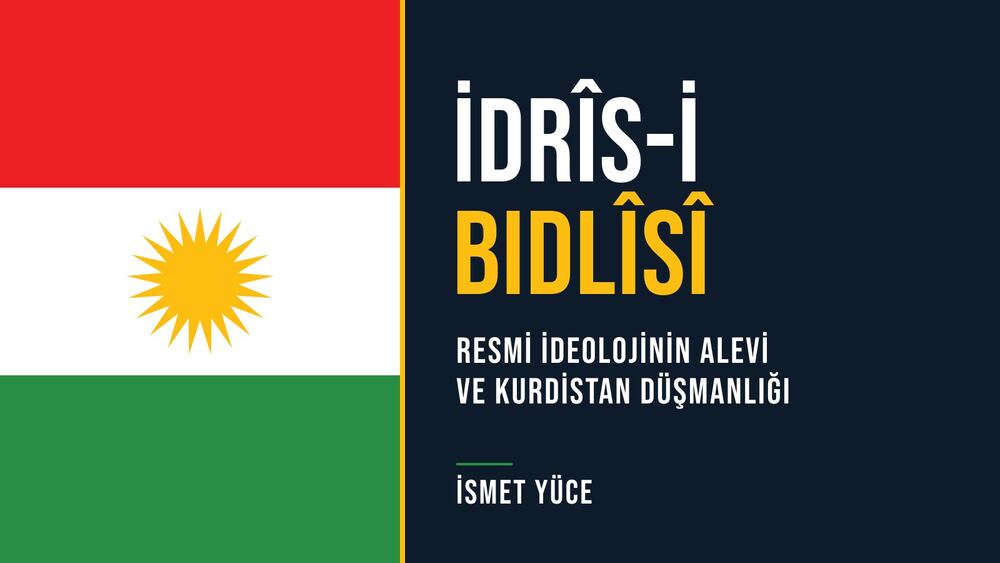
Idris-i Bidlisi: The Official Ideology's Hostility Toward Alevis and Kurdistan
The perpetrator of the massacres of the Qizilbash under Yavuz Sultan Selim (Selim I) was the state; portraying Idris-i Bidlisi, a Kurdish scholar and diplomat of limited power, as responsible for these massacres is part of the official ideology's hostility toward Kurdistan, which aims to sever Kurdish Alevis from their Kurdish identity.
During the Iranian-Ottoman war between Yavuz Sultan Selim (Selim I) and Shah Ismail, the Ottoman Empire massacred multitudes on the pretext that they supported Shah Ismail; the perpetrator of these acts was not Idris-i Bidlisi.
Do you commemorate the Shias of Iran, Pakistan and Afghanistan, who are under constant attack and being killed today, or the 100,000 Feyli Kurdish Shias who were killed and deported in the 1980s for being Kurds, by saying "Alevis are being massacred"? No; the Kemalist intellectuals' declarations that invoke the name of Idris-i Bidlisi to pursue hostility toward Kurdistan neither mention nor remember them. The answers to this question also show us that what is being done is a system of mobilization centred on hostility toward Kurdistan.
We, by contrast, protest the massacres of Shias in Iran. Can you protest these massacres? Can you issue a declaration protesting the fact that the Dersim, Koçgiri and Zilan massacres were carried out by Mustafa Kemal's government itself? No, you cannot. This means that this mobilization is not a friendship toward Shias developed through Idris-i Bidlisi; on the contrary, it is hostility toward Kurdistan.
In Idris-i Bidlisi's time, Yavuz Sultan Selim assigned Bidlisi to bring Kurdistan together under the roof of a union of emirates and to establish a relationship with the Ottomans on that basis. Despite Idris-i Bidlisi's great efforts, however, the Kurdish emirates could not unite. When Bidlisi reported this to the centre, the decision of the centre and Bidlisi's diplomatic and intellectual efforts led to the Kurdish emirates being attached directly to the centre, each one separately.
Beyond this, Idris-i Bidlisi had no role whatsoever in the massacres. At the same time, as is well known, Shah Ismail controlled the region as far as Maraş. It is established in the historical sources that Shah Ismail, who invited Kurdish emirs and their representatives, some ten in number, to diplomatic talks, killed these emirs or held them in his dungeons for a long time. By this logic, the Kurds should also have developed a "hostility toward Kurdish Alevis" over this event; yet, as is well known, no hate speech or turmoil of any kind has arisen on this matter.
The most tragic part of it is that those who pursue hostility toward Kurds, Kurdistan and Kurdish Alevis through Idris-i Bidlisi do not count Jafarism, Shiism, Ismailism or the Shiism of Afghanistan and Pakistan as part of Alevism, and regard themselves as outside this circle. Even so, pursuing hostility toward Kurdish Alevis through Idris-i Bidlisi, whose role in the Shah Ismail-Ottoman wars was decidedly limited, is entirely the product of a psychological operation and of the official ideology's policies of historical manipulation and assimilation. Attacking Idris-i Bidlisi on the basis of misremembered history stems from hostility toward Kurds and Kurdistan. It must be recognized that, although this has no historical references, it was constructed by the official ideology in order to stoke hostility toward Kurds and to use it for domestic political opportunities whenever desired.
Note that hostility toward Idris-i Bidlisi is pursued only by "so-called" Kurdish Alevis. Western Alevis, Turkish Alevis or Alevis of other regions develop no writing or discourse on this subject. Idris-i Bidlisi is a learned Kurdish emir. He heads one of the smallest emirates in Kurdistan, and in the 1500s the military strength of this emirate is quite limited.
Indeed, the massacres in question were carried out by the hand of the state as Yavuz Sultan Selim passed through the region during his wars with the Shahs of Iran. We are firmly opposed to every kind of massacre. We by no means condone the killing of any Kurd, Alevi or Sunni; the loss of even a single life is one too many. But that is not the issue; the issue is the error of interpreting the Shias killed in the strategic territorial struggle the Ottoman system waged with Shah Ismail through Idris-i Bidlisi, an intellectual Kurdish diplomat of limited power.
We believe this is being carried out through a hostility toward Kurdistan directed from the centre. This stance must be seen as a continuation of Fuat Köprülü's operation, and that of the final years of the Committee of Union and Progress and the early years of the Republic, to "first Bektashize, then Sunnify and ultimately Turkify the Kurdish Alevis". It must be stressed again that the Feyli Kurds are also Shia, and in the 1980s they suffered a massacre by Iran and Iraq reaching into the hundreds of thousands.
While people are killed every day in Afghanistan and Pakistan for being Shia, the fact that the offshoots of the official ideology do not utter a single sentence about this, yet bring up Idris-i Bidlisi at every opportunity to comment through hostility toward Alevis, confirms our assessment. The same is what has recently been attempted through the Alevis of Syria. We oppose the massacre of the Syrian Alevis and stand by them; yet we see that even this is used, time and again, as a tool for attacking the Kurds.
What should be understood from this is that these debates are steered from the centre, proceeding from Kemalist patterns of thought about Kurdish Alevis, in order to deepen hostility toward Kurds and Kurdistan and to distance Kurdish Alevis from their historical codes by Turkifying them. It is essential that historical figures such as Idris-i Bidlisi be reread on the basis of primary sources. Only in this way will historical facts and judgements fall into their proper place.
Let us conclude by citing the findings of the historian Assoc. Prof. Yalçın Çakmak on the subject:
"As is well known, in Turkey too, history serves, or is made to serve, as an important battering ram for securing legitimacy, especially in identity politics. Moreover, it would in any case have been out of the question for a sultan to send decrees to his administrators ordering the killing of the Qizilbash in lands that were not his own domain. He has stated that some of the widespread accusations attributed to Idris-i Bitlisi and the claims of a 'Qizilbash massacre' do not reflect the truth, and that the main party responsible was Yavuz Sultan Selim. Regarding Idris-i Bitlisi, he states that in the Alevi-Qizilbash events of the 16th century Bitlisi was not a direct perpetrator of any massacre, and that responsibility for these events and decisions belonged to Yavuz Sultan Selim. The frequently cited killing of the Qizilbash predates the Battle of Chaldiran, that is, 1514. The geography was Ottoman territory, and it does not include the Kurdish lands that gradually came under Ottoman rule after Chaldiran, that is, after 1514. The statement that 'Bidlisi, and therefore the Kurds, were killers of the Qizilbash' is nothing but an illusion. As far as we understand, the Alevis' first acquaintance with, or 'first discovery' of, Idris-i Bidlisi coincides with the publication in book form by the Ministry of Culture, in the early 2000s, of Hicabi Kırlangıç's doctoral dissertation titled 'Idris-i Bitlisi, Selim Şah-name', completed in 1995. So when we ask whether there is any historical document or testimony concerning the involvement of either Bidlisi or the Kurds in the 'killing of the Qizilbash' in question, it is impossible for us to answer 'yes'!"
Notes, Sources and Quotations
- Yalçın Çakmak, "Katliam, Hıyanet, Mübalağa, Kahramanlık: İdrîs-i Bidlîsî Tartışmaları ve HÜDA PAR" (Massacre, Treason, Exaggeration, Heroism: The Idris-i Bidlisi Debates and HÜDA PAR), Birikim magazine, 27 April 2023.
- Idris-i Bidlisi, Selim Şâh-Nâme (The Book of Shah Selim), ed. Hicabi Kırlangıç, Hece Yayınları, Ankara, 2016.
- Vural Genç, "Şah ile Sultan Arasında Bir Acem Bürokratı: İdrîs-i Bidlîsî'nin Şah İsmail'in Himayesine Girme Çabası" (A Persian Bureaucrat Between Shah and Sultan: Idris-i Bidlisi's Attempt to Enter Shah Ismail's Patronage), Osmanlı Araştırmaları / The Journal of Ottoman Studies, XLVI (2015), pp. 43-75.