
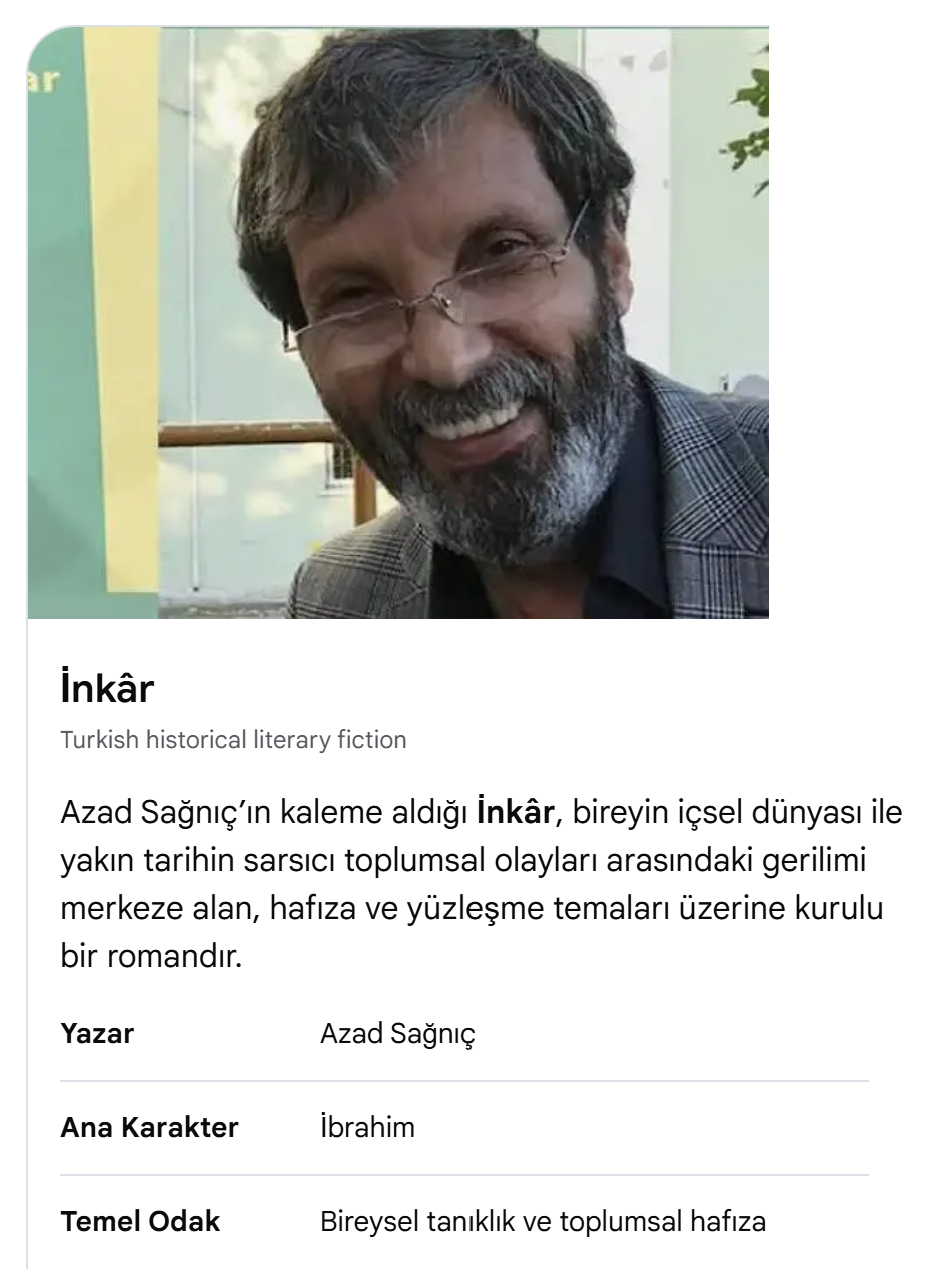
Denial
Azad Sağnıç’s novel *Denial* traces this question through the life of Ibrahim Gürbüz.
How much can a person's life bear of a nation's memory that is being silenced?
Azad Sağnıç’s novel Denial follows this question by drawing on the life of Ibrahim Gürbüz. The story begins in the past of a family displaced by war and forced migration; it moves from a childhood in Girêsor, through the sense of alienation in Tire, the political searching of youth, to the torture chambers and prisons of the 12 September coup. In Ibrahim’s journey, the denial of Kurdish identity does not remain a distant historical fact: it settles into everyday life through a humiliating question asked at school, a child forced to hide his own name in a language that cannot be spoken, and practices that aim to break a prisoner’s will.
One of the novel’s strongest veins is the way memory is preserved across generations. The stories told by Ibrahim’s grandmother Serayê keep the routes of migration and the abandoned homeland alive in the family’s collective memory. The love and solidarity he builds with Aynur accompany Ibrahim through his hardest years. Denial does not look for struggle only in political decisions and major events; it also finds it in a mother’s determination, a wedding broken up during a prison visit, the door opened by friends, and the silence of a father trying to protect his child from fear.
Ibrahim’s imprisonment, which stretches from Mamak to Sağmalcılar, and the relentless pressure and years of life on the run that continue after his release, form the novel’s most shocking sections. Throughout his life he faces three assassination attempts. Sometimes he survives by luck, other times he stands bravely against danger, clinging to the ideas and truths he believes in. Yet the narrative does not stop there. It reaches toward the cultural institutionalization of Kurdish life around the MKM and the Istanbul Kurdish Institute, the founding of Yaşam Radio, and the emergence of the İsmail Beşikçi Foundation’s thought. In this way it shows how Ibrahim’s experiences generate a forward‑looking responsibility: banned languages must be heard, testimonies must be written, archives must be preserved. In the final pages the re‑emerging threat makes the cost of this effort feel far from a thing of the past.
Tatvan‑born author Azad Sağnıç has, through research books and historical novels, turned his focus to the Kurdish community’s memory, political struggles, and the scars left by the 12 September coup. As a writer who himself endured detention, torture and imprisonment during the coup period, he transforms the memories and testimonies shared by Ibrahim Gürbüz into literary narrative. By carrying the weight of events together with the details of everyday life, he brings the reader not only into a historical era but into the world of the people who lived through it.
Denial starts from a single life story and tells a broad social memory where migration, language, love, fear and resistance intertwine. Dedicated to Kurdish women like Serayê who carry memories from generation to generation, the novel leaves the reader with this question: when a nation’s past is denied, how does remembering and narrating it become a way of living?
Ronahî Elîf Gun 2026
Note: Book presentation and interview; KIRAATHANE ISTANBUL LITERATURE HOUSE
Asmalı Mescid Neighborhood, Yemenici Abdüllatif Street No. 1. Date: 17 October 2026. Time: 15:00
Beyoğlu, Istanbul.