
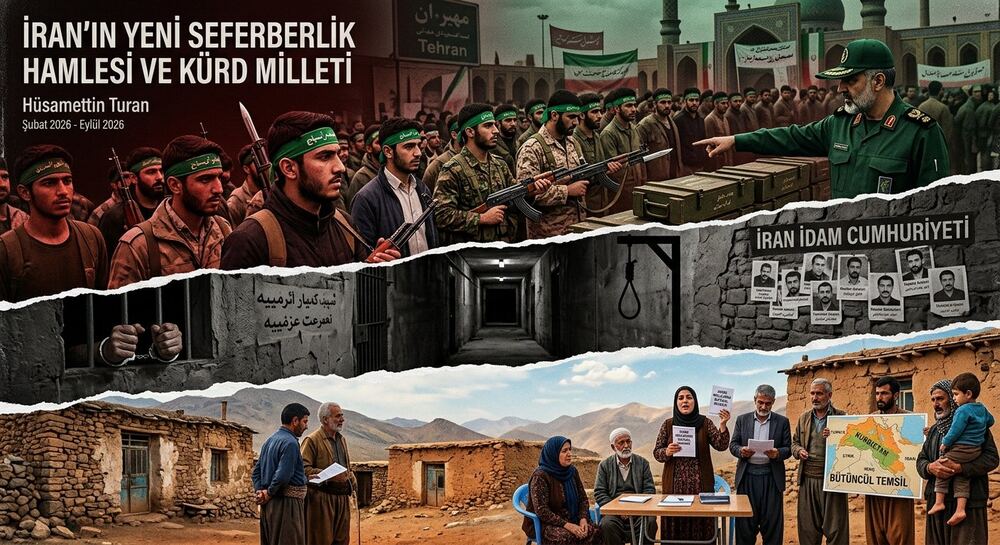
Iran's New Mobilization Drive and the Kurdish Nation
Iran's mass mobilization launched under war conditions is not merely an expansion of military capacity but a new structure that enlarges the regime's security and control capabilities in the regions inhabited by the Kurdish people; this process points to a new era that could have direct repercussions for the Kurds' political will, social security, national status and future.
With the worsening conditions of the war that began in Iran in February 2026, the state's launch of a broad voluntary mobilization program cannot be seen merely as a military development. The expansion of a regime built on execution and repression's security capacity in wartime and the re‑arming of society carry a significance far beyond the announced figures; they constitute a direct threat to the Kurdish people's political will, national status, security and international representation.
According to statements from Iranian authorities, more than 600,000 people have registered for the program conducted under the name "Janfada-ye Iran", and participation in the trainings is expected to exceed one million. However, it should not be overlooked that these figures are not independently verified as a count of military personnel and do not correspond to a regular ground army of one million. Available information indicates that the structure is designed as an additional volunteer defence layer to the Revolutionary Guard and Basij, i.e., it aims to expand the social base of the existing security apparatus rather than replace it.
Indeed, the program has ceased to be merely a registration campaign. According to a statement made by the Besic administration during a drill held in Tehran on 18 September 2026, the process of integrating registered volunteers into defense battalions and regular units has officially begun, initial and advanced training programs covering land, air and sea domains have been established, and the expansion of the initiative to other provinces is planned. The organization of volunteers into local units of 72 members and neighborhood defense battalions, and the inclusion of topics such as neighborhood security, intelligence monitoring and counter‑espionage in the training curriculum, indicate that the structure is designed not only as a reserve force for the front lines but also as an internal security layer aimed at societal control.
The significance of this design should be judged not by the proclaimed scale of the mobilization but by the regime's capacity to reshape its relationship with the peoples it governs under its sovereignty in wartime conditions.
For the Kurdish nation, the critical point is not the numerical size of this mobilization, but that the war has turned Iran's internal security doctrine into an outright preparation for extermination.
Kurds in Iran have long been at the center of security policies because of their political activities, their location in border regions, and the presence of some Kurdish armed groups. The European Union Agency for Asylum reports that Kurds can face arrests, discrimination and severe penalties due to their political activities; the state treats certain Kurdish political actions as matters of national security. In this respect, making Kurds the object of security policy is not a new condition that emerged with the war, but an established trend toward annihilation that the war has accelerated.
It is clear from the data recorded in the early months of the war that this trend is not a mere abstract possibility.
According to human rights data released in May 2026, at least 36 prisoners were executed within a two‑month period, including Mehrab Abdollahzadeh and Nasser Bakerzadeh at Urmia Central Prison, and Ramin Zaleh and Karim Maroufpour at Neqede Central Prison, who were put to death without notifying their families or lawyers.
The death sentences of Pakhshan Azizi, Hatem Ozdemir and Yousef Ahmadi, which have been approved by the Supreme Court, as well as those of Rauf Sheikh‑Maroufi, Mohammad Faraji and Mohsen Eslamkhah, whose cases are under Supreme Court review, are being held under the threat of execution.
Such a concentration of political executions has been virtually unseen since the 1980s.
In the first four weeks of June 2026, at least 26 Kurdish citizens in Rojhelat were detained or arrested, with the whereabouts of at least eighteen of them undisclosed, and it was also documented that smugglers continued to be killed in the border regions during the same period.
The expansion of security capacity in a war environment does not merely mean a more intense surveillance or border security implementation. A volunteer structure of hundreds of thousands, organized at the neighborhood level, trained in intelligence tracking and counter‑espionage, taught to use weapons, finds its real meaning not on the front line but in the territories where peoples living under the regime’s sovereignty reside.
All preparations constitute a genocide preparation against Kurds and Belucas; the intensification of the death penalty practice, extrajudicial detentions, porter massacres in border areas and the establishment of neighborhood battalions are all parts of the same preparation.
Eliminating the distinction between being Kurdish and being linked to an armed organization is the legal veneer of this preparation. Kurdish identity, a claim for cultural rights or political activity, by itself does not constitute being a party to an armed conflict; however, the practice of the Iranian regime refuses to recognize this distinction, coding an entire people as a collective security threat. Labeling a population under a state's sovereignty as a threat en masse is not a legal order but a logic of annihilation.
In this context, the stance of international actors will also be decisive. In an environment where regional and global powers act according to their own strategic interests, turning the Kurds into tools of other states' policies creates long‑term vulnerability beneath the façade of short‑term gains. The primary aim of international support should not be to drag the Kurds into a conflict but to guarantee the existence, political will, and rights of the Kurdish nation. The first step toward that is the complete isolation of the Iranian Death Republic from the international community.
The head of terrorism and regional instability is the Iranian regime; without the collapse of this regime neither security in the region nor freedom for the peoples under its sovereignty can be established.
In the Islamic Republic of Iran, neither Baluchistan, nor South Azerbaijan, nor Kurdistan is free and independent. When these peoples regain their own states, the wave of terror that has enveloped the region for decades will lose its source. Today Iran is at a critical juncture; the scenario opened by war has led the regime to seek to arm society in order to prolong its lifespan, and the cost of this pursuit is intended to be first borne by the Kurds and the Baluchis.
Under these conditions, ending the fragmentary organizational approach in Kurdistan is no longer a postponable discussion. The politics each fragment establishes within the borders of its own state cannot represent the Kurdish people as a whole, and leaves the nation's will in the hands of regional equations.
A civil body encompassing the entirety of Kurdistan must be established.
Such an entity must also be based on the fact that the strength of the Kurdish nation cannot be measured solely by military capacity. Language, culture, education, political organization, economic resilience, independent sources of information and diplomatic relations are the fundamental components of national existence. Reliable documentation of rights violations and the activation of international mechanisms are, for this very reason, as decisive a field as military preparedness.
Iran's new mobilization move cannot be read as merely an increase in the number of soldiers from the Kurdish perspective. The real issue is how the war expands the Iranian regime's destructive capacity and how that expansion is directed toward the political, cultural and social existence of the Kurds.
The future of the Kurdish nation cannot be left to the war calculations of others; the Kurds must be able to act as a subject that safeguards their own political will, identity and rights.
The political will, national status, security and international representation of the Kurdish nation are not items to be postponed under the shadow of war. The isolation and dismantling of Iran's Death Republic, the unification around a civilian body that encompasses all of Kurdistan, and the Kurdish nation's attainment of its own state are today inseparable components of the same equation.
Al Jazeera. (2026, September 18). Iranians Gather in the Largest Challenge to the US Since the War Began.
European Union Asylum Agency. (2025). Country Guide: Iran.
IranWire. (2026, September 17). Revolution Guardians Expand Civilian Weapons Training Under the Name “Janfada”.
IranWire. (2026, September 18). Besic Chairman: Jan-Fada Volunteers Are Integrated into Defense Units.
Kurdistan Human Rights Network. (2026, May 23). Political Executions Rise in Iran: Concern Grows for Kurdish Detainees.
Washington Kurdistan Institute. (2026, June 29). Kurdistan Bulletin: June 2026.