
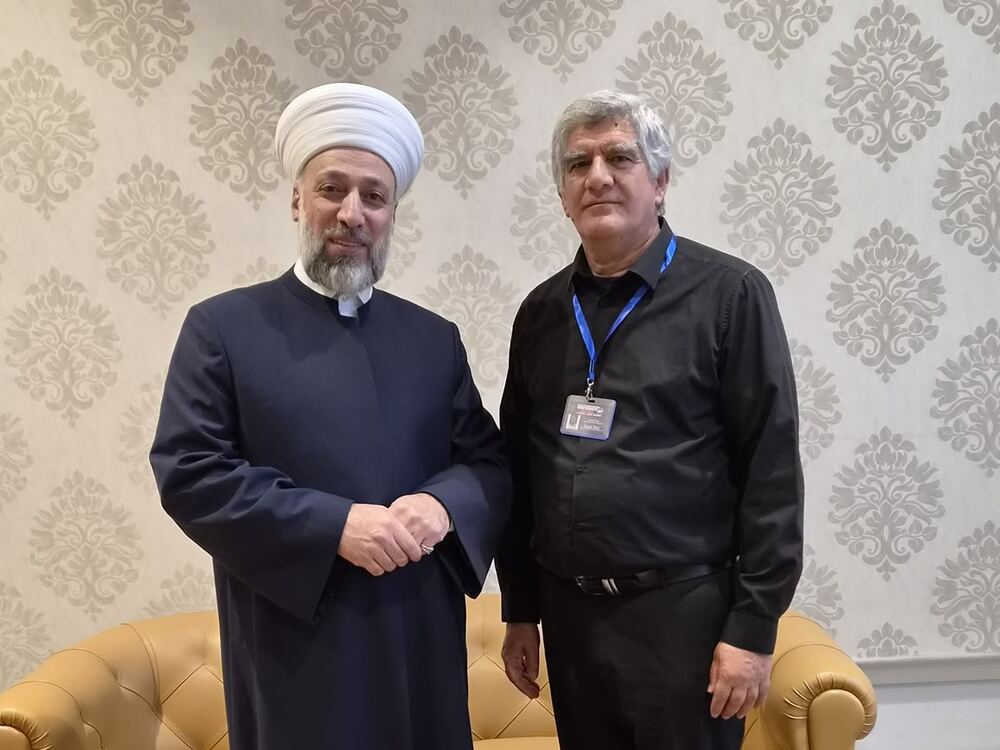
İsmet Yüce: "Our Diversity of Faith Has Kept Kurdistan Kurdistani"
After the conference on faith in Tbilisi, researcher and writer İsmet Yüce spoke to us: "Kurdish belief systems and cultural differences have ensured that this land remained Kurdistani, and they will strengthen this in the future as well."
İsmet Yüce was born in the Gurgum region. Because of the dissident activity he began at an early age, he completed his pre-university education in various parts of Gurgum and in other cities. He first studied philosophy, then completed a degree related to sociology in Europe and wrote a master's thesis on media. He is one of the founders of the London-based Kaniye Kurda group. In response to the assimilation policies aimed at Kurds and Kurdish Alevis in North Kurdistan, the group translates sources of Kurdish history from Persian and Soranî into Kurmancî and Turkish; to date, ten books have been published by Van-based Sitav Publishing. Yüce is the author of two books, Sources of Kurdish Nationalist Thought and Truth-seeking Alevism and the Serencamname. In his article "İdrîs-i Bidlîsî: Official Ideology's Hostility to Alevis and Kurdistan," published in October 2026, he argued that the campaign waged in the name of Bidlîsî is a product of official ideology aimed at severing Kurdish Alevis from the Kurdish nation.
On 21 November 2026, at the third conference organised in Tbilisi by the Ronahi Association on belief systems among the Kurds, he gave a talk titled "The Diversity of Belief Systems Strengthens Our Unity." We spoke with him about this talk, about Kurdish Alevis, about official ideology's policy of dividing the Kurds through faith, and about the faith heritage of the Kurdish nation.
Who Is İsmet Yüce?
1. Could you briefly introduce yourself? Where were you born, and what kind of family did you grow up in? How did you start working on the history of Kurdish belief?
We Kurds usually answer questions like "Where were you born, how old are you, what is your profession, what kind of education did you receive?" either very reluctantly or in great detail. I think this is also connected to how we define ourselves in general. I received my pre-university education in various parts of the Gurgum region, where I was born, and even in various cities because of the dissident activity I began early on. I had the opportunity to receive several academic degrees: first I studied philosophy, then I completed a degree related to sociology in Europe, and after that I wrote a master's thesis on media.
2. What works have you produced so far, and is there a book or research project you are currently working on?
We founded a London-based group called Kaniye Kurda. Our aim was to translate sources on Kurdish history from various languages into Latin-script Kurmancî or into Turkish, in response to the assimilation policies aimed at Kurds and Kurdish Alevis in North Kurdistan. Within the framework of this work, we have so far published ten books translated from Persian and Soranî. These works were published by Van-based Sitav Publishing. Two books of my own have also been published: Sources of Kurdish Nationalist Thought and Truth-seeking Alevism and the Serencamname.
The first thing we translated was the Serencamname. This is the first time in history that the Serencamname has been translated from its original language, Goranî, into another language; we translated the book first into Latin-script Kurmancî and then into Turkish. We brought into Turkish three books by Prof. Cemal Nebez, who can be considered the father of Kurdish nationalist thought in the modern era. Again within the same programme, in order to bring the relationship between Khorasan and Kurdishness back onto the agenda, we had the opportunity to translate two volumes of the six-volume history of the Kurds of Khorasan by the Khorasani researcher Kelimullah Tewehudi. Most recently, we translated into Turkish a biography of İdris Barzani that did not exist in any language other than Arabic and Soranî.
At the moment, apart from my day-to-day political and cultural writing, I am preparing a book on the Sharafnama. As is well known, the Sharafnama is considered the first book of Kurdish history. I want to include the most striking and influential sections of the work in this book. The book will also examine the sources of the Sharafnama, what has been said about the work, and its significance.
The Tbilisi Talk
3. The title of your talk in Tbilisi was "The Diversity of Belief Systems Strengthens Our Unity." What thesis did you defend in this talk?
The Ronahi Association in Tbilisi carries out very strong cultural, academic and civic work under the names Barbang and Ronahi wherever there is a Kurdish community, above all in the former Soviet republics. The third of these events, in the form of a conference, was organised in Tbilisi by the Ronahi Association. The theme of the third conference was belief systems among the Kurds. Muslim Kurds, the Êzidî faith, Jewish Kurds, Alevi Kurds, Yarsan-Kakaî, Christian Kurds and Zoroastrians: a representative of each spoke about the culture and history of their own faith. It was a conference with a very large turnout.
The matter the conference participants generally focused on was this: external powers manipulate the faith and regional differences among the Kurds in order to prevent Kurdish unity and the Kurds' becoming a nation. We, for our part, emphasised that the Kurds are a unity and a historical force, and that they must be so. Our thesis was along these lines.
4. The religious diversity of the Kurds is usually presented as a source of division. Why do you argue the opposite, that this diversity strengthens unity?
The fact that the diversity of faith, language and culture in Kurdistan has on the whole been preserved in its original form has also brought with it the historical preservation of Kurdishness. As you mentioned in your question, the forces that use this diversity as a cause of division or as an opportunity are the colonialists who pursue a policy of assimilation in order to prevent Kurdish unity from being achieved. We think the exact opposite: Kurdish belief systems and cultural differences have ensured that this land remained Kurdistani, and they will strengthen this in the future as well. Of course, every kind of Kurdish activity carried out without being assimilated and without overriding Kurdish national thought and the overarching Kurdish identity strengthens this core idea. Our thesis starts from here.
5. Muslim, Êzidî, Yarêsan, Christian and Jewish Kurds spoke at the same conference. Why is it important that such a table was set up in Tbilisi?
The reason the third conference table, where belief systems were discussed, was set up in Tbilisi is connected to the presence of a strong organisation and an Êzidî community in the region. Because Kurdish organisations and figures in the former Soviet space have on the whole embraced the overarching Kurdish and Kurdistani identity in a very significant way, they also carry out their work in that direction. There are geographical, historical and socio-political reasons why the table was set up in Tbilisi.
Kurdish Alevis and Official Ideology
6. In your October article you wrote that the name of İdrîs-i Bidlîsî is being used to incite Kurdish Alevis against the Kurdish nation. Who is waging this campaign, and for what purpose?
The İdrîs-i Bidlîsî question has been interpreted from time to time, first by the state and then by the advocates of the "official Kurdish ideology." Because of an ideological outlook and a lack of historical knowledge, the matter has constantly been treated as opposition to Kurdish unity or as hostility to Alevis. But when we look at the real historical relations of the years in which the matter developed, we know that this was not the case. Today all the main sources of the studies done on the region, above all İdrîs-i Bidlîsî's own works, are in our hands and available to anyone who wants them. That being so, we think that producing hostility to Alevis out of the İdrîs-i Bidlîsî question, and through it hostility to Kurds, is an entirely manipulative move.
7. In your article you spoke of an operation of "first Bektashizing Kurdish Alevis, then Sunnifying them and ultimately Turkifying them." How did this process work, and what stage is it at today?
The operation of Bektashizing the Alevi system of thought, above all Kurdish Alevis, goes back to the Ottoman period of the 16th century. As is well known, the founding of the Janissary corps should to some extent be sought here as well. Then came the operations of the 18th century. Later, within the framework of Turkishness studies, a Bektashization movement was launched with the aim of distancing Kurdish Alevis from the general source ideas of Alevism, moving them further west, partly Islamising them and Turkifying them. This has continued in a great many forms almost from the 16th century to the present day, and we see that from time to time it has achieved the desired results.
Those of us who want to work on Kurdish Alevism or on the historical sources of Alevism argue that the exact opposite should happen. Bektashism is a domain of its own; starting from this fact, Kurdish Alevis must now also walk their own path.
8. How do you explain the fact that the state that carried out the Koçgiri, Dersim and Zîlan massacres now speaks as if it were the protector of Alevis?
As is well known, cultural, physical or geographical massacres are carried out by occupiers in order to bring a region and that region's economy under control. Throughout history, the massacres of Alevis too, as you mentioned, in Koçgiri, Maraş, Sivas, Malatya, Çorum and elsewhere, were brought onto the agenda at various dates and carried out for this purpose. But in the period we have now reached, especially after the 2000s, the central system, that is, the state, thinks that assimilation has been completed. What remains is to ensure that the assimilated community somehow moves within its own system or circle. The state bringing Alevism onto the agenda, trying to help, or creating Alevi institutions can be assessed within this framework.
9. Have Kurdish national movements and parties made enough room for Kurdish Alevis? Is there prejudice against Alevis in Sunni Kurdish circles?
This too is a great prejudice, and once again it is constantly kept on the agenda by the central colonialist authorities. As someone who has followed Kurdish civil and political organisation for very many years, I know that no Kurdish individual, institution or organisation has engaged in hostility to Alevis or in negative work aimed at Alevism. On the contrary, we see that not only in North Kurdistan but also in South Kurdistan and other regions, there is positive discrimination towards Alevis, that Alevis are valued and defended. I can say that most recently, at our meeting in Tbilisi, we were met with great interest because they saw us as an Alevi presenter.
The Kurdish Faith Heritage
10. What common roots do the Êzidî faith, the Yarêsan faith and Kurdish Alevism share? What is the connection of these faiths to the Aryan and Zoroastrian heritage?
From the strong historical sources we have, we see that the belief system among the Kurds began before the emergence of the monotheistic religions. Because it is a period close to us and comprehensible, all the influences come first and foremost from the Zoroastrian faith. If you pay attention, today you can see all the traces of Zoroastrian thought among the Yarsan-Kakaî, the Êzidîs and the Alevis. Whether it is accepted or not, this is how the practice works. Zoroastrianism is fundamentally a historical Kurdish, proto-Kurdish faith. In this respect, we too say that the main source of all the belief systems that carry historical Kurdish culture, such as the Êzidî faith and Alevism, comes from here. I repeat, we now have very strong sources.
However, over the course of history, in the 12th, 16th and 20th centuries, these faiths underwent a great many changes. It quite naturally became a necessity for these groups to diverge or to adapt themselves to the social and geographical situation they found themselves in. But their history runs from here.
11. There are those who try to portray some Êzidîs and Christian Kurds as outside the Kurdish nation. How does this separation resemble the policy aimed at Kurdish Alevis?
As can be seen, central systems always apply a great variety of methods to the regions, identities and cultures they want to keep under control: social, psychological, economic and military methods. Recently, the fact that Êzidî culture and the Alevi belief system have made themselves very visible, that Christian thought has somehow begun to spread among the Kurds, and that Kurdish Judaism has come onto the agenda more and become organised, disturbs the central systems. That is why they are quite naturally now doing to Êzidî, Christian and Jewish Kurdish groups the same manipulative work they previously did against Alevi culture and the Alevi community. This unity and visibility disturbs both the system and the non-Kurdistani "official Kurdish ideology." This is very understandable. What needs to be done is for both these groups and the civil society organisations and intellectuals who defend Kurdish national thought to be vigilant on this matter and to strengthen the work in their own fields.
12. Between those who set Islam against Kurdish national identity and those who try to strip Kurdishness of religion, what path should a Kurdish intellectual follow?
Among the Kurds, the structures and organisations that place Islam, through the idea of the ummah, ahead of national thought are very few. These are essentially tariqas known to be connected to the central system, that is, to the colonialist capitals. No Kurdish Islamic party, Kurdish Islamic movement or structure coming from our historical madrasa tradition puts Islam in place of, or in opposition to, Kurdish national unity or Kurdish identity. Most recently we talked about these things with the leader of the Partiya Îslamî ya Kurdistanê (Islamic Party of Kurdistan), Mr Hikmet Serbilind, on the Ütopia TV Ari programme on YouTube; anyone who wishes can watch the positive approaches I mentioned there. We see that the work carried out by these tariqas tied to the centre is not very effective and only proceeds within the bonds of the tariqa. Apart from that, we think that the approach of Islamic thought in Kurdistan to national matters is positive from the standpoint of Kurdistani national thought.
The Process and the Future
13. How is the integration process, which aims to bind the Kurds to the states they live in, affecting Kurdish Alevis and the other faith groups?
Unfortunately, the process is currently not progressing positively at all from the standpoint of Kurdish national unity. The reason for this is not only the faith and cultural differences among the Kurds, or the central systems using and steering these differences. It stems more from the fact that the forces that have organised or become institutionalised, as with the central Kurdish organisation in South Kurdistan, in Rojava and in North Kurdistan, are unable to organise unity, the future and the diversity within Kurdish communities under an overarching Kurdistani umbrella with national unity and national thought, and do not look at the matter with this outlook.
As I said in my answer to the question above, the idea of binding to the state is the theory of the "official Kurdish ideology" in the North. This ideology is not national; it looks at the issue ideologically; this movement looks at the matter individually. The organisations and structures it influences in other regions also move in the direction of binding themselves to the state. Yet we know from history that when states grow strong, they have never welcomed this attachment or this rapprochement with themselves; on the contrary, they have used it as an instrument of manipulation and dispersal. This attachment to the state should not be seen as the future. The period we are in is one in which structures where nations or belief systems come to the fore will grow stronger. The Kurdish nation too, with its faith and its culture, can build a strong future by starting from here. Representatives of the different faiths among the Kurds must absolutely value the overarching national identity and act on that basis, in order to represent themselves more strongly and to define and live their faith more effectively.
14. Can Hevbendî, founded in North Kurdistan on 7 November 2026, bring together Kurds of different faiths?
The newly founded Hevbendî movement you mention is a very important step towards a common Kurdistani thought. If you pay attention, the state's recent targeting of this formation, the detentions and the attempts at repression, show how serious this formation is in terms of unity and the fear it has created on the other side. But this organisation alone will not be enough. A broader, different kind of organisation and a Kurdistani approach are needed. Since this is a very long subject of debate, without dwelling on it any further, let me say this: the Kurds can reach a strong future by organising around an understanding based fundamentally on the perspective of living in their own homeland with their own national identity.
15. Finally, is there anything you would like to add?
Finally, we extend our sympathy to those working in Hevbendî over what they have been through, wish them success in their work, and state once again that we stand by them.