
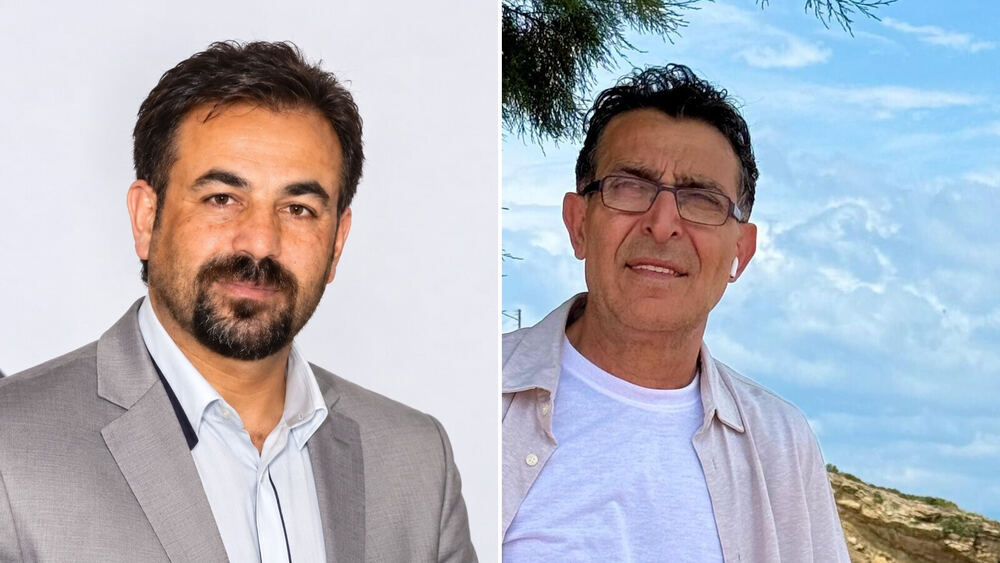
Kadir Satık: "No one will protect us as much as we protect ourselves"
Publisher Kadir Satık, one of the founders of the Kurdistan National Initiative: "Kurds need to act together more than just be united, to develop a common reflex."
Kadir Satık was born in 1966. At the end of the 1970s, still ten years old, he encountered the Kurdistan question through his father's and brothers' political work. In the September 12, 1980 coup, his father and brothers were arrested, and his youth years were spent behind prison doors. Later he worked at the reopened Komal Publishing House in Istanbul and took responsibility for the house. During the years when the magazine Stêrka Rizgarî was published, he faced detention, torture and police interrogations, spending a total of eleven years in prison. After leaving prison he moved to Europe. In the publishing activities led by his brother, he was part of the team that launched Le Monde diplomatique kurdî, and later participated in founding Weşanxane yên Rûpel, which publishes books in Kurdish and Turkish on Kurdish language, literature and history.
He was among the delegates of the Kurdish National Platform that emerged from the conference held in Amed in March 2026. In May 2026, he became one of sixteen members who left the platform, citing that the final statement and the parliament’s work were being placed under the control of a small circle. Those sixteen went on to found the Kurdistan National Initiative. In October 2026, in an article titled “If We Do Not Protect Ourselves, No One Will Protect Us,” he called on Kurds, after the United States’ withdrawal from Iraq, to rely on their own strength, an organized diaspora, and civil resistance. We spoke with Satık about why the initiative was created, the search for unity in Northern Kurdistan, the process, the security of the South, and the role of the diaspora.
Who is Kadir Satık?
1. Where were you born, what kind of family did you grow up in? When did you enter Kurdish politics and alongside whom?
At the end of the 1970s, when I was only ten, I found myself in a period when the Kurdistan question was being debated. My father's and my brothers' involvement in the process for political goals also led me down this path. When the military coup came in 1980, my father and brothers were arrested. Until I was seventeen or eighteen, my life unfolded behind prison doors; my brothers were inside and I had to visit them every week.
2. How did you get into publishing, and how has this path led you to your work today?
The Komal Publishing House, which was shut down on September 12, later reopened in Istanbul. I began working at Komal and eventually took on the responsibility of the publishing house. Meanwhile, the magazine Stêrka Rizgarî also started to be published. In those same years, I too faced torture, police interrogations and imprisonment. Everyone knows under what conditions Kurdish publishing was carried out at the time: police raids, detentions, and orders for collective arrests. During this period, eleven of my years were spent in prison.
When I got out of prison, I had no chance to live in Turkey; the pressure continued and I had to go to Europe. While struggling with livelihood difficulties there, I rejoined the publishing world led by my older brother. We started publishing the Kurdish edition of the world’s most respected newspaper Le Monde diplomatique kurdî. Then we founded Weşanxane yên Rûpel; we published books in Kurdish and Turkish on the Kurdish language, literature and history and continued this work.
After that period I began working for the Kurds to act together. Wherever a Kurd was doing a job, I tried to support it, wherever a union was being formed I tried to stand behind it; I did not distinguish between party, association, organization or cultural work. Still, I do not say “the unity of Kurds”.
Kurds need to act together more than being united, to develop a common reflex.
The Kurdistan National Initiative began working with this understanding, and I am part of the process. The joint participation of seven groups at the conference to be held on November 7 is very important to me: the Kurdistan National Initiative, the Kurdistan Socialist Party (PSK), the Kurdistan Patriots Party (PWK), the Kurdistan Democratic Party‑Bakur (PDK‑Bakur), the Movement of Life of Kurdistan (VEJÎN), PÊLKURD and Independent Kurdish Personalities. I see that these friends, without putting themselves forward, show a reflex of acting together sincerely, and that makes me very happy. I support this process to the end.
From the Platform to the Initiative
With what hope did you go to the conference in Amed on March 3, 2026?
I went to the Amed conference in March 2026 with the hope that a truly national foundation could be established in Northern Kurdistan. What I expected was a process where pre‑written texts would not be imposed, and where different political and intellectual circles could meet within a common national framework.
4. In your statement about the split, you wrote that the pre‑prepared “Destpêka Nû” text was presented as a final report. How did that happen, and what response was given to your objections?
"Presenting the “Destpêka Nû” text as a final report without discussion showed that the process was not conducted transparently. Our objections were brushed aside on the grounds of “the unity must not be broken.” The real matter was not the content of the text but the way it was imposed."
A national platform cannot be built by forcing everyone to accept a text written in advance by a single group.
5. Did you try to stay inside and fight before the split? At what point did you say “Enough, it can’t continue”?
Yes, we stayed inside and tried to fix things. We filed written objections several times and proposed an alternative framework. However, as the process fell under the scrutiny of a narrow circle and criticisms were met with accusations of “undermining unity,” we saw that staying inside no longer made sense. The moment we said “that’s enough” was the moment unilateral imposition replaced collective will.
6. Leaving a foundation built for unity is read as adding another link to division. What is your response to this criticism?
Leaving a foundation built for unity does not serve division. Remaining on a faulty foundation and blocking genuine unity causes far greater harm. Our separation is part of a search for a stronger, more reliable unity built around national principles. Kurds must act together; but that togetherness cannot be based on coercion or monopoly.
7. Is the Kurdistan National Initiative a political party, an intellectual group, or a pressure group? What concrete goal do you have for the coming year?
The Kurdistan National Initiative is neither a party nor merely a group of intellectuals. It is an initiative that defends national principles and possesses the power to exert pressure and provide guidance over political parties and social segments. Our concrete goal for the coming year is to emerge from the Kurdistan National Unity Conference on November 7 with a declaration that inspires confidence and is readable on the international stage, and to contribute to the transformation of this foundation into a permanent Alliance (Hevbendî).
8. Your statement ended with an emphasis on "national principles adopted by free nations." What must a structure accept to be considered "national" in your view?
For a structure to be considered national, it must be based on the collective will of the Kurdish nation, must not place the interests of a single movement or party above national interests, and must strengthen the image of Kurds as a reliable, stable, and unified actor in the international arena.
The national principles adopted by free nations are clear: sovereignty, the right to self-determination, and organized self-power.
Unity in Northern Kurdistan
9. The Initiative is participating in the Kurdistan National Unity Conference, which will convene in Amed on November 7. What is the Initiative bringing to this table? What are your expectations from the conference and the "Hevbendî" (Alliance) to be established?
As the Initiative, we are bringing a proposal for unity to the table that is free of impositions, transparent, and based on national principles. Our expectation from the conference and the Hevbendî to be established is for Kurdish political and social segments that remain outside of PKK-centered integration policies to meet within a common national framework, and for the conference to conclude with a declaration that inspires confidence in both the Kurdish public and international interlocutors. Unity should not be seen as a slogan, but as a stable and predictable political stance.
10. Why do unity initiatives in Northern Kurdistan always fall apart? What rule is essential for unity to endure?
Unity initiatives in the North fall apart either because they seek to gather under the hegemony of a single movement or due to short-term political calculations. The fundamental rule for survival is this: No political movement should monopolize the national ground, decisions must be made with a common will, and a mechanism must be established to prevent sudden, unilateral steps that would damage international trust.
11. Kurdish parties have been using a national discourse for years, yet they remain small at the ballot box. How much of this is due to pressure, and how much is due to their own mistakes?
The share of pressure is certainly significant; however, our own mistakes are not few either. We have failed to combine national discourse with institutional and stable politics that have resonance at the ballot box and in the international arena. In the South, the unification of the Peshmerga under a single command shows that it is possible to build this trust. The same stability and institutional seriousness are needed in the North.
The Process
12. The Turkish army remains in Kurdistan, and attacks on other parts continue. Is it possible to use the word "peace" in this picture?
Using the word "peace" while the Turkish army remains in various parts of Kurdistan and attacks continue means covering up the truth. True peace is only possible on a foundation where the political existence of the Kurdish nation is recognized, its own power is accepted, and it is supported by international guarantees. In the current picture, the discourse of "peace" serves more as a unilateral process management.
13. Is the Kurdish nation represented at the current process table, or just a single movement? Is the right of Kurds to self-determination being discussed at this table?
It is not the Kurdish nation that is represented at the current process table, but predominantly a single movement. The right of Kurds to self-determination is not being openly discussed at this table. This situation weakens both the national will and international trust. Yet, the South shows what Kurds can achieve when they can act through their own institutions.
South Kurdistan and Self-Reliance
14. In your October article, you interpreted President Masoud Barzani's words, "If we do not protect ourselves, no one will protect us," as a definition of duty. What has changed on the ground since America's withdrawal from Iraq on September 30?
I interpreted Masoud Barzani's words, "If we do not protect ourselves, no one will protect us," as a job description. After the United States' withdrawal from Iraq on September 30, the most significant change on the ground has been the acceleration of South Kurdistan's own institutional steps. The initiatives that began in September to unify the Peshmerga under a single command and to reactivate the Parliament send a message to international actors that "Kurds can ensure stability within themselves." This is the practical equivalent of the emphasis on self-reliance.
15. The Kurdistan Region lacks air defense, and attacks continue. How can self-reliance close this gap?
The gap in air defense can be closed in the short term through international support and alliances, and in the long term by increasing self-reliant capacity. However, what is truly important is that the institutional steps in the South create trust in the international arena and ensure that Kurds are seen as a stable actor.
Self-reliance is not just weapons; it is a predictable political will that acts in unison.
From the 1975 Algiers Agreement to Kirkuk in 2017, Kurds have been left alone many times. Has Kurdish politics learned this lesson?
We have been left alone many times, from Algiers to Kirkuk. It is hard to say that we have fully learned this lesson. However, the recent steps in the South and the efforts of circles outside the PKK to come together in Amed in the North show that the lesson is slowly beginning to be learned. To avoid being left alone, we must build internal unity and international trust together.
After the dissolution of the Syrian Democratic Forces in August, what remains in the hands of the Kurds in Rojava?
After the dissolution of the Syrian Democratic Forces in August, the most important thing remaining in the hands of the Kurds in Rojava is an organized society and the experience of local governance. However, the continuation of this experience depends on it being placed within a national framework and positioned as a reliable actor in the international arena. The future of structures remaining under the control of a single movement is uncertain.
Diaspora
18. There is a Kurdish diaspora of over a million in Europe, yet it carries no weight in the foreign policies of the countries where it resides. Why? When there is an attack on Kurdistan, what should the diaspora do on the first day?
The main reason the Kurdish diaspora in Europe lacks weight in foreign policy is that it pursues a fragmented and unstable political approach. When there is an attack on Kurdistan, the diaspora must respond on the first day with a single voice, in an organized manner, and with a clear reaction directed at international public opinion. This reaction must demonstrate that Kurds can act together and consistently.
19. You say, "The world intervenes when the cost is high." How can Kurds make this cost visible?
Kurds can make this cost visible by ensuring internal unity, making their institutions functional, and displaying a predictable political stance in the international arena. The unity of the Peshmerga in the South is a step that shows both that the cost is high and that Kurds can produce solutions among themselves. The conference on November 7th must also provide that same sense of confidence.
Closing
20. What would you like to say to a young Kurd reading this interview?
I would like to say this to a young Kurd: Unity is essential in the national struggle, but this unity cannot be built on imposition. To gain trust in the international arena, we must pursue a stable, predictable, and institutional policy. View the steps taken in the South and the efforts of circles outside the PKK in the North to come together as part of this process of building trust. Trust in your own strength, in being organized, and in acting together around national principles.
No one will protect us like we do.