
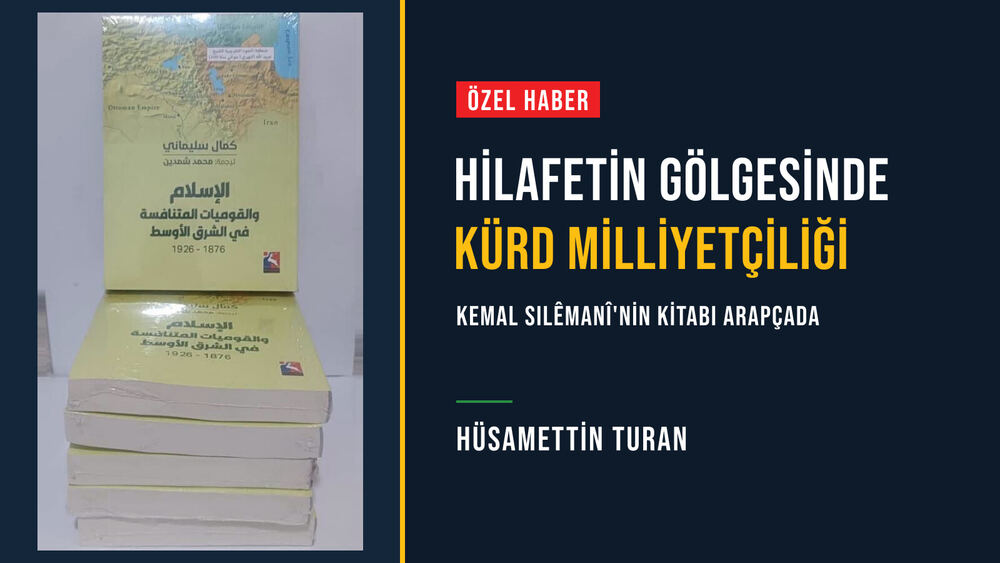
Kurdish Nationalism in the Shadow of the Caliphate: Kemal Silêmanî's Book Now in Arabic
Kurdish historian Kemal Silêmanî's book, which examines the relationship between Islam and nationalism in the last half-century of the Ottoman Empire through Kurdish texts, has been published in Arabic in a translation by Muhammed Şemdîn.
Kurdish historian Kemal Silêmanî's book Islam and Competing Nationalisms in the Middle East, 1876–1926, published by Palgrave Macmillan in 2016, has been translated into Arabic under the title el-İslam ve'l-Kavmiyyat el-Mütenafise fi'ş-Şark el-Evsat. The translation is the work of Muhammed Şemdîn, who had previously rendered one of the author's articles and a chapter of the book into Arabic; in the note announcing the book's publication, Silêmanî thanks the translator, noting that he devoted two years to the task. The translation matters because it brings to Arab readers a study that rereads the relationship between Islam and nationalism in the last half-century of the Ottoman Empire through Kurdish eyes. The book's question targets a distinction long taken for granted in Middle Eastern historiography: are religion and nation, umma and millet opposites, or did they operate intertwined, in the same period and in the hands of the same people?
The Author and the Book's Place
Kemal Silêmanî is a historian who completed his doctorate in Islamic and Middle Eastern history at Columbia University in 2014 and has since taught at Mardin Artuklu University, at Queens College and City College in New York, and at El Colegio de México in Mexico. A native speaker of Soranî, the author can read Kurmancî, Persian, Arabic, Turkish and Ottoman Turkish sources in the original, and this is where the book's real strength lies. The book grew out of the doctoral dissertation the author submitted to Columbia; it is built on texts such as Ottoman archival documents, newspapers of the period, the Persian masnavi and letters of Şêx Ubeydullahê Nehrî, and the pre-exile writings of Said Nursî. In this respect, the study is one of the few academic works that try to read Kurdish political thought not in the language of outside observers or of the state archive, but through the Kurdish actors' own texts.
A Debate in Three Parts
Apart from the introduction and conclusion, the book consists of three parts and seven chapters. The first part addresses the relationship between religious thought and nationalism and the old and new forms of caliphate politics. Here the author challenges theories that assume nationalism pushes religion out of the public sphere, and shows that the caliphate was not a single political order defined in the Qur'an but an institution debated throughout history and redefined according to differing interests. The second part examines Ottoman and Turkish official nationalism and the pan-Islamism of Abdülhamid II; in this part, the longest in the book, the author argues that the notion of "true Islam" defined by the state under Abdülhamid became intertwined with a Turkish-centered claim to identity and civilization. The third part is devoted to Kurdish nationalism and proceeds through three cases: Şêx Ubeydullahê Nehrî, the pre-exile writings of Said Nursî, and the 1925 Şêx Seîd movement that followed the abolition of the caliphate. The book's structure thus follows a deliberate order, setting out first the theoretical ground, then the center's interpretation of Islam, and finally the response the Kurds developed against that interpretation.
Behind this order stands the book's central argument:
In the late Ottoman period, Islam was not a single, shared identity; each nationalism defined its own "true Islam," and the caliphate turned less into a universal office than into an arena of nationalist rivalry.
From Şêx Ubeydullah to Şêx Seîd
For Kurdish readers, the most striking part of the book is the long chapter devoted to Şêx Ubeydullahê Nehrî. The author reads the Naqshbandi sheikh's 1880 movement not as a local tribal uprising but as an undertaking that rejected Ottoman and Qajar rule alike and demanded a separate Kurdish political entity. The best-known basis for this reading is the letter the sheikh wrote at the time to the American missionary physician Joseph Cochran, in which he says that the Kurdish nation is a nation apart, with its own religion, laws and customs, and that it wants to take its affairs into its own hands. According to Silêmanî, Ubeydullah saw the state as an instrument of a Kurdish-centered understanding of Islam; this shows that the Kurds could also use Islam as grounds for separating themselves from the Turks and the Persians. The fact that the cover of the Arabic edition carries a map showing Şêx Ubeydullah's sphere of influence around 1880 also reflects the weight of this chapter in the book.
The Said Nursî chapter paints a more cautious picture. The author relates how, in his writings before and after 1908, Nursî was preoccupied with the backwardness imposed on the Kurds, their low literacy rate and their internal feuds, and how he likened Kurdish national consciousness to the beads of a prayer string whose cord has snapped. Nursî's plan to found a university in Kurdistan is treated as a concrete expression of this concern. The chapter is important for showing that Kurdish nationalism expressed itself not only through uprisings but also through demands for education and language.
The final chapter examines the period that began on 3 March 1924 with the abolition of the caliphate and the founding, on the same day, of the Directorate of Religious Affairs, as well as the 1925 Şêx Seîd movement. The chapter's title, "Fully-fledged Nationalism in Religious Garb", sums up the book's verdict on the movement: Şêx Seîd's religious discourse was not a veil concealing the Kurdish national demand but the expression of that demand in the language of its time. The author further argues that the Kemalist regime used the concept of "irtica" (reaction) to legitimize the Islam it had itself defined and to brand the Kurdish opposition as reactionary, and that this concept was inherited from the Abdülhamid era. In this respect, the book seriously unsettles the official narrative that presents 1925 as a clash between "religious reaction" and the "secular republic."
What the Arabic Translation Means
The significance of the Arabic edition stems from the resonance in the Arab world of the question the book discusses. In Arab historiography and political language, Kurdish nationalism has long been portrayed either as a project of foreign powers or as a deviation that divides the Islamic umma. Silêmanî's book, by contrast, demonstrates with documents that Kurdish national thought was born in the late Ottoman period from within Islam and in the language of Islam; this gives Arab readers the opportunity to see the Kurdistan question not as a cause imposed from outside but as a claim to rights arising from the region's own history. That Muhammed Şemdîn had earlier translated into Arabic the book's chapter on Şêx Seîd and the author's article on a Kurdish Sufi sheikh and his Christian neighbors also shows that this translation is the fruit of long labor.
The book's method may challenge some readers; the theoretical first part contains dense argument, and the chapters devoted to Kurdish history begin only in the second half of the book. Yet the real contribution springs from precisely this patience, for the author takes up the Kurdish case only after showing how Ottoman and Turkish official nationalism used Islam, and thereby positions the Kurdish movements not as a separate exception but as one of the competing nationalisms of the same period. Bringing the book into Turkish and Kurdish without delay would be of particular importance for the debate in Bakur.
Kemal Silêmanî's book tests against Kurdish texts the narrative that sees religion and nation, umma and millet, as opposite poles, and reads the line stretching from Şêx Ubeydullah to Şêx Seîd as the history of a national demand seeking its own voice in the shadow of the caliphate.
Bibliography
- Şemdîn, M. (2025, October 3). Islam and Competing Nationalisms in the Middle East (1876–1926) [Book review]. nlka.net.
- Soleimani, K. (2016). Islam and Competing Nationalisms in the Middle East, 1876–1926. Palgrave Macmillan.
- Soleimani, K. (2026). el-İslam ve'l-Kavmiyyat el-Mütenafise fi'ş-Şark el-Evsat, 1876–1926 (M. Şemdîn, Trans.).