
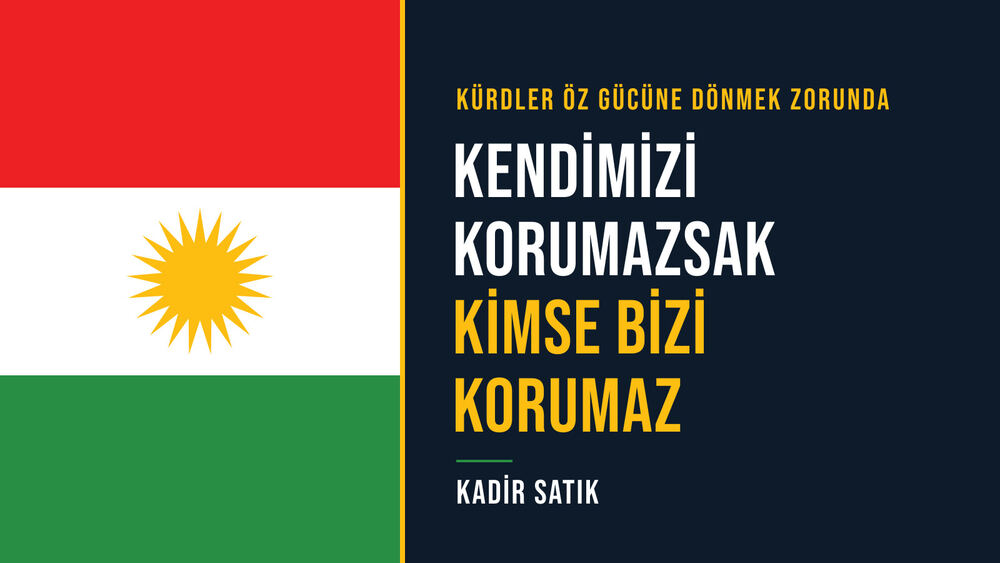
"If We Don't Protect Ourselves, No One Will Protect Us": Kurds Forced to Return to Their Own Strength
Barzani's warning, “if we don’t protect ourselves, no one will protect us,” which emerged from the vacuum left by the U.S. pull‑out from Iraq, is not a lament but a definition of duty for Kurds everywhere.
A Divided Public Opinion
The United States’ completion of its military withdrawal from Iraq on 30 September 2026 and the formal end of the international coalition’s campaign against Daesh in Iraq have split Kurdish public opinion sharply. One camp treats the move as a routine military reshuffle, saying “nothing will happen,” while the other argues that the pull‑out is a bad omen for Kurdistan and that regional powers will quickly fill the emerging void. This split is not new; what is new is the scale of uncertainty and the cost of complacency. After the United States withdrew completely from Syria in April 2026, the disintegration of the Syrian Democratic Forces in August, and the Kurdistan Region becoming the target of more than a thousand unmanned aerial vehicles, rockets and missile attacks in the regional war that erupted at the end of February, the debate has moved from abstract speculation to a daily security concern. In this regard, it must be remembered that periods of vacuum are often the times when the most costly political mistakes are made.
The Same Message from Two Barzanis
The speech delivered by Kurdistan Democratic Party (KDP) Chairman Mesûd Barzanî on 4 October 2026 at the graduation ceremony of his party's cadre institute in Erbil was not a casual observation but a clear warning:
If we don’t protect ourselves, no one will protect us.
Barzanî also said that the coalition’s withdrawal “is not the end of the world,” urging Kurds to unite and rely on their own security, and emphasizing that the Kurdistan Region does not consider Iran, Turkey or any other country an enemy. Kurdistan Region Prime Minister Mesrûr Barzanî stated on 30 September that the Peshmerga and Iraqi security forces have the capacity and readiness to counter any threat that could be interpreted as an opportunity to push for a withdrawal. A few days later he added that the region’s biggest shortfall is air defence, and he asked Baghdad for air‑defence systems. When the two statements are read together, the message becomes clear: foreign support is temporary, alliances dissolve as interests shift; what endures is a nation’s own defence capability and its diplomatic network.
It is no coincidence that this message comes from the Barzani family. After the 1975 Algiers Agreement signed between Iran and Iraq, the sudden withdrawal of US and Iranian support plunged the Kurdish movement into collapse, an experience that has become a lasting mistrust in the political memory of the Masoud Barzani generation. The silence of allies when Kirkuk was seized on October 16 by Hashd al‑Shaabi and the Iraqi army following the 2017 independence referendum can also be seen as a recent repetition of the same lesson. Therefore, the call for “self‑reliance” is not a slogan of bravado but the distilled result of half a century of historical experience.
The Real Purpose of the Provocations
The possibility that the four states surrounding Kurdistan will conduct testing operations through proxies and armed groups, without opening a direct front, must be taken seriously. Major attacks often begin with small provocations: a border violation, an indiscriminate explosion, pressure justified under the name of a “security operation,” or an intervention aimed at disrupting the internal political balance. Drone attacks targeting the U.S. consulate in Erbil demonstrate that this testing policy is already at work. The primary aim of these trials is not always to gain territory; what is truly measured is the opponent’s capacity to respond.
Will the diaspora fall silent, will the will in the region be divided, will the international public again brush it off as an “internal matter”?
If an organized and visible response to the initial moves does not materialize, the experiments grow; as they grow, the individual actions of states can gradually turn into a collective siege policy. Since the 1920s, when Kurdistan was partitioned, the regional states have been able to set aside their deep rivalries over the Kurds and cooperate on security—a pattern that can be read from the 1937 Sadabad Pact to the present.
Sivil Tepki Neden Kritik
Therefore, wherever they are in the world, Kurds must demonstrate an unexpectedly strong, coordinated and civilian response to even the smallest attack on Kurdistan. A rally, a press release, lobbying activity, legal action, media visibility and a minimal common language among political actors—none of these constitute a declaration of war. On the contrary, they are tools that can stop a war before it starts. Considering that the Kurdish diaspora in Europe numbers over a million and consists of voting, tax‑paying, elected citizens, the organized voice of this community can be a resource capable of exerting real influence on the foreign policies of their host countries.
Waiting for the world to “not allow this” does not match the experience of the past decade. The genocide against the Yazidis in Sinjar in 2014 claimed thousands of lives before the international community acted; the occupations of Afrin in 2018 and Serêkaniyê in 2019 were met with reactions that did not go beyond a few condemnatory statements. The world often intervenes not in what it refuses to permit, but in what carries a high price. When the price is invisible, silence itself becomes a policy.
Double Standards and a Silencing World
The same actors who once beheaded and kidnapped Yazidi girls from Sinjar and sold them in markets are now being dealt with at the state level, welcomed in Western capitals; those who fought against them can be abandoned as soon as agreements change. This is one of the starkest examples of double standards. Kurds who gave thousands of martyrs in the fight against ISIS are reduced to bargaining chips once the war ends, showing once again that the international system operates on interests rather than values.
Capitalist interest relations, while gradually pushing humanist discourses aside, have also succeeded in desensitizing societies to distant injustices by drowning them in artificial agendas of their own making. The silence or feebleness of civil‑society organisations in the face of many crises is a clear sign of this desensitisation. Complaining does not change this picture. What changes it are permanent channels that will carry the voice, ongoing bilateral relations, and an undispersed narrative.
A Definition of Duty
Barzani's remark “if we don’t protect ourselves, no one will protect us” is not a threat but a definition of duty and should be read not only as a call to the Kurdistan Region but to Kurds everywhere in the world. Kurds must be ready and organised at all times: militarily on their own lands, politically in their own institutions, and civically across the globe. Dismissing small provocations as “manageable” paves the way for a larger intervention tomorrow.
Relying on one's own power is not isolation; developing bilateral relations is not surrender. Together, they constitute a politics that does not leave matters to the mercy of others.
References
- Kurdistan24. (2026, October 4). President Barzani: "If We Do Not Protect Ourselves, No One Will Protect Us".
- Shafaq News. (2026, September 30). PM Barzani: Peshmerga ready as coalition mission ends.
- Shafaq News. (2026, October 6). Masrour Barzani urges Baghdad to provide Kurdistan with air defenses.
- Gibson, B. R. (2015). Sold Out? US Foreign Policy, Iraq, the Kurds, and the Cold War. New York: Palgrave Macmillan.
- BM Syria Investigation Commission. (2016). "They came to destroy": ISIS Crimes Against the Yazidis (A/HRC/32/CRP.2).