
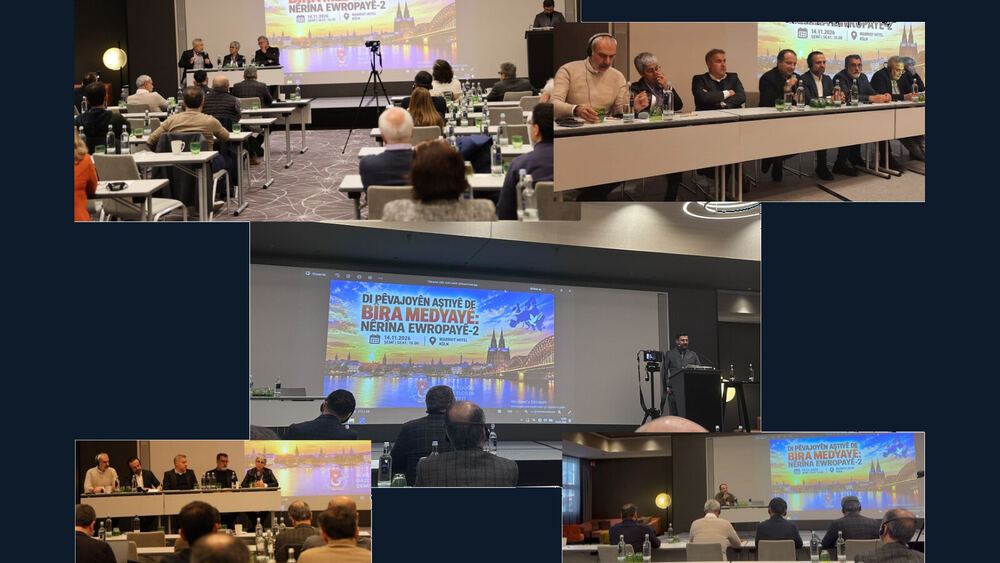
Peace Panel in Cologne: Is It Enough for the Guns to Fall Silent, and What Will Become of the Rights of the Kurds?
At the panel "The Memory of the Press in Peace Processes" held in Cologne, the future of peace, the responsibility of the media and the rights of the Kurdish nation were debated. While participants criticised the lack of transparency in the process and the state's failure to take concrete steps, Ali Ertan Toprak drew attention to the pluralist make-up of the Kurdish nation, and Prof. Dr. Jan İlhan Kızılhan to historical traumas and the recognition of identity.
The panel "The Memory of the Press in Peace Processes: A View from Europe-2", organised by the Southeast Journalists Association (GGC) on 14 November 2026 at the Marriott Hotel in the German city of Cologne, brought together journalists, politicians, academics and civil society representatives from Turkey and Europe.
Speaking at the panel were DEM Party Deputy Co-Chair Tayip Temel, the journalists Bülent Mumay, Hatice Kamer, Nevzat Çiçek, Alişer Delek and Zeki Özmen, as well as Ali Ertan Toprak, Chair of the Kurdish Community of Germany (Kurdische Gemeinde Deutschland), and Prof. Dr. Jan İlhan Kızılhan.
The problem of trust and transparency in the peace process
In the parts of the panel we followed, the criticisms voiced by members of the audience who took the floor centred on concerns that the process was not being conducted transparently and that the state had taken no binding political or legal step on the rights of the Kurdish nation.
While it was acknowledged that the stance of the PKK and Abdullah Öcalan in favour of ending the armed struggle matters for peace, objections were raised to reducing the issue solely to the laying down of arms.
Participants stated that the state's treatment of the process primarily as a matter of weapons and terrorism contradicts the expectation of a settlement encompassing the identity, language, cultural and political rights of the Kurdish nation.
It was emphasised that the fact that young people have not been losing their lives for roughly two years is an important gain, but that the Kurdistan question cannot be considered resolved as long as the policies of denial underlying half a century of conflict remain unchanged.
Tayip Temel: The rights of the Kurds must be secured in law
Speaking at the panel, Tayip Temel said that the identity, language and culture of the Kurds must be placed under legal guarantee. He called for the Anti-Terror Law to be amended, for the practice of appointing trustees in place of elected mayors to be ended, and for the way to be cleared for education in the mother tongue.
Temel stated that a lasting solution can be achieved not through disarmament alone but through democratic and legal reforms.
Ali Ertan Toprak: No party or organisation can represent all Kurds
Speaking in the session "A View from Europe: The Perspective of the Diaspora", Ali Ertan Toprak, Chair of the Kurdish Community of Germany, recalled that the Kurds in Europe hold different political views and beliefs and come from different social backgrounds.
Stating that no political party or organisation can speak on behalf of all Kurds, Toprak stressed the importance of different groups coming together around a shared Kurdish identity and sense of belonging.
Recounting that in his childhood his family had advised him not to reveal his Kurdish and Alevi identity to others, Toprak drew attention to the lasting wounds that pressure on identity leaves in people's lives.
Toprak's remarks added a new dimension to the debate over the need not to confine the peace process to the relationship between the organisation and the state, but to take the different segments of the Kurdish nation into account as well.
Jan İlhan Kızılhan: Without recognition of historical traumas, there can be no trust in society
Prof. Dr. Jan İlhan Kızılhan, for his part, said that the historical traumas experienced by the Kurdish nation are passed down from generation to generation.
Giving examples from the work he carried out after ISIS's attacks on the Yazidis in 2014, Kızılhan explained that wars and massacres are not confined to the period in which they occur but also shape the lives of subsequent generations.
Noting that historical suffering can also be transformed into a strength to resist and endure, Kızılhan pointed out that the current peace process has failed to generate sufficient trust and hope in society.
Emphasising that the identity, demands and rights of the Kurds must be openly recognised, Kızılhan underlined the importance of preserving hope in society with the words: "If hope dies, it has no grave."
A question to Tayip Temel: What guarantees are there that this time will be different?
The question we put to Tayip Temel when we took the floor at the panel concerned the failure of past peace initiatives and the concrete guarantees on which today's process rests.
We recalled that the promises made to the Kurds in the 1920s were abandoned shortly afterwards and that the state was shaped on the basis of a single-nation ideology. We noted that in 1993 and in 2013-2015 the state held far more advanced talks with the Kurdish side, yet after these processes it returned once again to harsh policies of denial and conflict.
Stating that today the state is avoiding even the most humane steps, ones that require no change in the law, we asked the following question:
"In the past, despite far more advanced talks and initiatives that were open to the public, the state backed away from those processes. Today, no concrete and binding steps have been taken. Despite this, the DEM Party and the PKK are trying to convince the Kurdish nation that this time there is a future for peace and that its rights will be won. What makes you so hopeful? What developments or guarantees are there that we do not know about?"
Other participants who took the floor from the audience voiced similar concerns, questioning how a process conducted by the state without taking concrete steps could build trust.
The responsibility of the media: Making criticism visible too
In the sessions of the panel featuring journalists, the way past settlement processes were covered in the media was discussed.
Hatice Kamer drew attention to the distrust created by past experiences, Alişer Delek to the current process's failure to take sufficient root in society, and Bülent Mumay to the difficulty of advancing peace without democratisation. Nevzat Çiçek assessed the regional balances and the need for trust, while Zeki Özmen assessed the German media's approach to the process.
A point that stood out in the discussions was that the press must not content itself with relaying official statements, but must also make visible society's criticisms, expectations and historical memory.
The real question: Will the guns fall silent, or will the Kurdistan question be resolved?
Alongside the need for peace and the support for an end to the armed conflict, the panel in Cologne also revealed the existence of serious distrust regarding the political substance of the process.
Ali Ertan Toprak's emphasis on the pluralist make-up of the Kurdish nation, Jan İlhan Kızılhan's assessments of historical trauma and the recognition of identity, and the audience's demands for concrete guarantees converged on the same fundamental question:
An end to the armed conflict would of course be an important gain. But if the state's policies towards Kurdish identity and rights are not going to change, will the end of half a century of war also mean that the Kurdistan question has been resolved?