
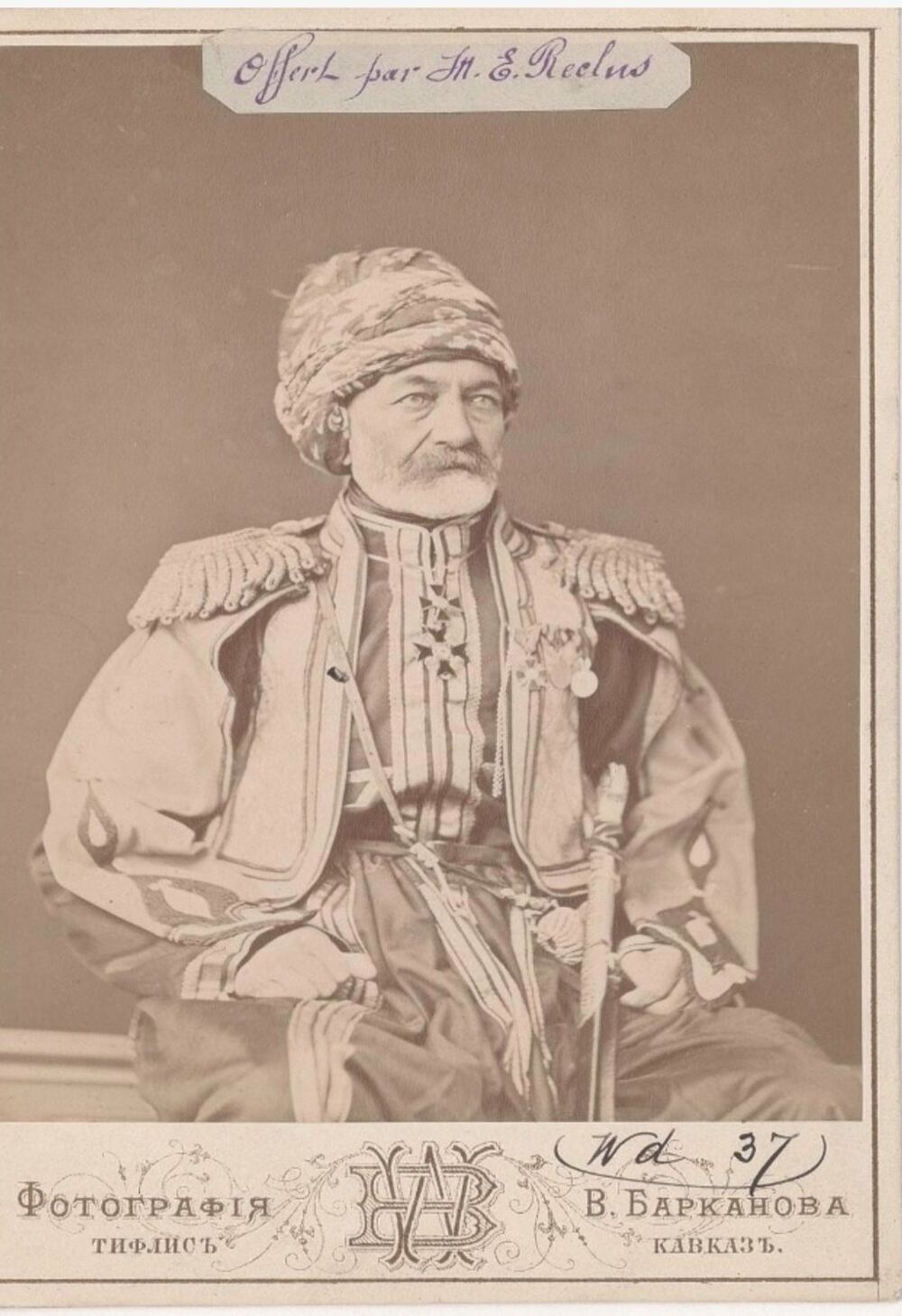
Şemsedînov Kurds of the Redkan Tribe
A Kurdish General Gulî Cafer Ağa in the Russian Army
A Kurdish general in the Russian army.
Gulî Cafer Ağa, son of Çongdeve Huseyîn Ağa, is a Şemsedînov Kurd from the Redkan tribe.
Gulî Cafer Ağa was born in 1806 in Erivan and died on 11 March 1877.
Gulî Cafer Ağa rose to the rank of senior general in the Russian army and belonged to the Redkan tribe.
The Redkan tribe lives in Red Kurdistan and around Yerevan.
In Russian sources they are referred to as the Şemsedînov Kurds.
Şemsedin, son of Gulî Cafer Ağa and father of Çongdeve Huseyîn Ağa, was distinguished for his competence and his military exploits were well known, appearing in travel engravings.
This significant historical episode marks the beginning of Russian‑Kurdish relations, the formation of Kurdish units in the Russian army, and the regional politics of that era, briefly outlined.
Military Career and Achievements
Rise through the ranks: He entered the Russian army in 1853 as a praporshchik (ensign) and distinguished himself in the Crimean War (especially in the Battle of Çengel in 1854), reaching a high rank and attaining the rank of general in 1871.
Command of the Kurdish Regiments: During the Crimean War, he commanded the 1st Kurdish Regiment, which was formed within the Russian army in the region of Kefe and was composed of local Kurdish cavalry.
Cafer Ağa, leading the Erivan troops, fought the Ottoman army near Beyazid on 12 June 1854. The 1st Kurdish Regiment played an important role here and the battle caused the Ottoman forces to retreat, ending the Ottoman cavalry under the command of Behlül Pasha. Behlül Pasha and his companions were captured by a group that also included Kurds. Because of their successes in these battles, three cavalrymen of the 1st Kurdish Regiment — Misto son of Miho, Ehmo son of Resûl, and Yusuf son of Halo — were awarded medals by the commander‑in‑chief.
Imperial Orders: In recognition of his military value, he received the most prestigious Russian Imperial medals: the Order of St. Anna (with Crown), the Four Distinguished Orders of St. Vladimir and St. Stanislaus, in 1856, and as a Kurdish leader he was welcomed in Moscow for a ceremony with Tsar Alexander II.
Bandora Siyasî û Herêmî
Regional administration: Under Russian rule, the Kurds of Red Kurdistan in the Caucasus organized forces loyal to the regional administration and created a substantial authority over the tribes along the Ottoman‑Russian frontier.
After the war of Culî Cafer Ağa, the Kurds of Red Kurdistan in the Caucasus were placed under a regional administration.
After the war, due to the migrations of the Ottoman Empire, the number of Kurds in the Caucasus increased considerably. Despite this demographic growth, the political and military influence of the Kurds, after the death of Gulî Cafer Axa, never returned to its former level.
His son, Elî Eşref Bey, served in the Russian army and also attained his father's political power. His brothers, who succeeded him, could not capture the prestige and authority that Gulî Cafer Axa had held over the Kurds.
There were five sons of Culî Cafer Ağa: Eyüp Paşa, Memed Beg, Mehmûd Beg, Elî Eşref Beg and Ehmed Axa. After the death of Cafer Ağa, his eldest son Eyüp Paşa succeeded him, but after Eyüp Paşa, together with some members of the tribe, aligned with the Ottoman side, his brother Elî Eşref Bey took his place. According to official records, Eşref Bey was born on 20 March 1851. Two months after his father’s death, on 10 May 1877, he entered the service of the Russian army.
This was one of the Russian officers’ attempts to seize the territory that had been handed over by Cafer Ağa and to demonstrate their intention to protect the military‑administrative position they had established with the Kurds. Elî Eşref Bey participated in the Russo‑Ottoman War of 1877‑1878 (the 93rd war) together with his Kurdish troops from Aleksandropol.
After the death of Gulî Cafer Ağa on 11 March 1877, the Russian plans for Bayezid were also abandoned.
The grave of Gulî Cafer Ağa is in a cemetery in the village of Karahacılı, Aralık district of Edirne, within the current borders of Turkey.
It is said that after the death of Cafer Axa, he distributed most of his wealth among the poor, and everyone was deeply saddened by his final journey.
General of the Kurds, Gulî Cafer Axa. The Russian occupation of Southern Qefqasyay and the beginning of Russo‑Kurdish relations. Red Kurdistan.
Kurd of Red Kurdistan
The Kurd, one of the indigenous peoples of Southern Qefqasyay, has lived in the region since ancient times. It is known that the ancestors and clans of the Kurds—Gutî, Mîtanî and Medî—reached as far as the banks of the Kura and Aras rivers.
Not only before their emergence, it is known that after their emergence the Kurds also founded numerous Kurdish states in the 6th century in Red Kurdistan of Qefqasyay. We can name a few: in the year 590 the Mihraani Kurdish Christian state was established, in 900 the Deysemi Kurdish Damil state, the Shirvanshah Kurdish Sunni Muslim state, and in the 10th and 11th centuries the Kurdish states of Shedayi and Revadi were also created.
One can say that Russia first entered the region through exploratory research carried out by European scholars such as S. Pallas and Anton Güldenstädt, who worked at the Imperial Academy of Sciences. These researchers, before the military and political intervention of Russia in the region, conducted extensive studies and collections in fields such as demography, ethnography and history. Later, scholars like V.F. Dittel, P. Berezin, H. Abovyan, P. Lerch and A. Jaba turned their attention to the Kurdish language and history. Research originally Russian on the Caucasus and its peoples, especially those of the Russian Academy of Sciences, directly aimed to make Russian presence in the area more effective and to reshape it anew. In this context, the role of these European scholars in shaping Russian orientalism is of particular significance.
Shamil Teymurov
16.10.2026