
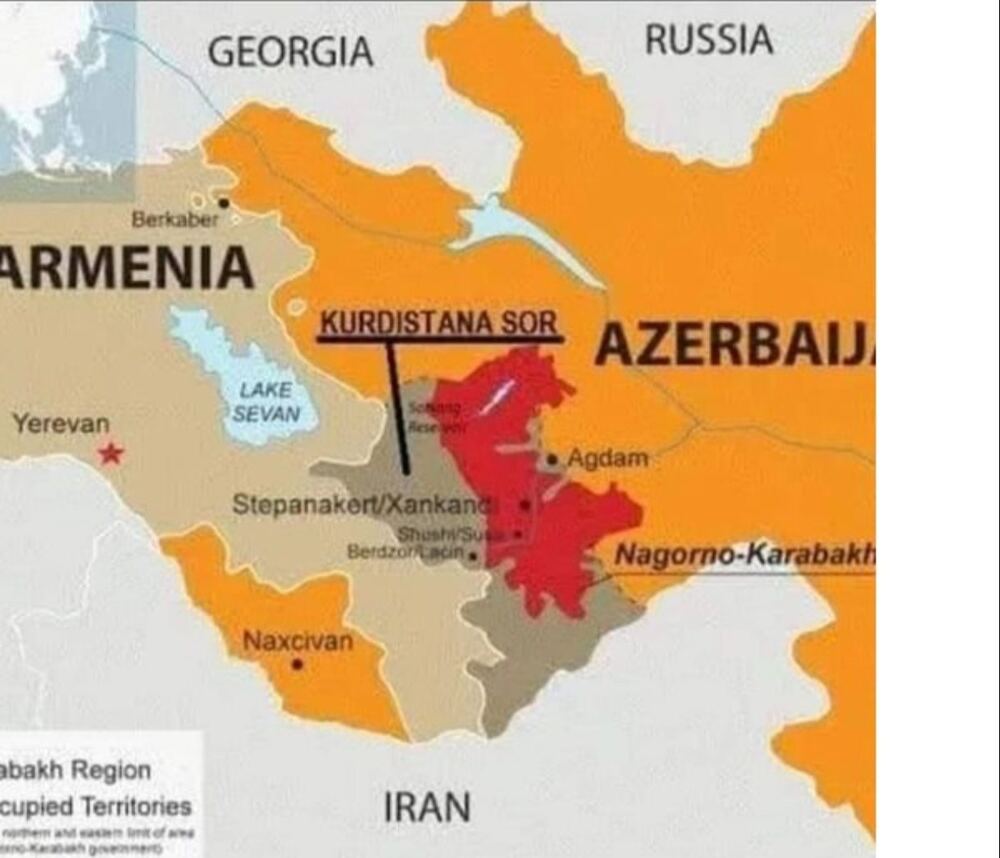
Red Kurdistan, the Ancient Kurd
Its strategic importance for Greater Kurdistan.
Red Kurdistan, the ancient Kurd, existed before recorded history around the 6000s in the valleys of the Aras and Kura rivers.
Red Kurdistan is a part of Greater Kurdistan.
After the Medes state, the Achaemenid state emerged; between 330 and 323 BC Alexander the Great of Macedon conquered Kurdistan and the Achaemenid state fell. At that time, the Kurdish ruler Atropates, with Alexander’s assistance, founded a Kurdish state in 323 BC, which continued for nearly 500 years until around the year 226 AD.
In the year 610, when Islam arose, before Islam in 590 the Christian Kurds established the Mirani state in Red Kurdistan.
In the 8th and 9th centuries, the Deysemi state was founded by Ibrahim ibn Deysem.
Red Kurdistan continued to exist and its capital, now called the city of Berde, persisted.
In 861 the Kurds in Red Kurdistan founded the Shirvanshah state, which lasted until 1538.
The Shirvanshah state was ruled by three dynasties.
Mezyedî 861–1027
Kesranî 1027–1382
Derbendiler 1382–1538
In the year 951, Kurds in Red Kurdistan founded the Shaddadian state, which continued to exist until 1199.
In 955, Kurds in Red Kurdistan established the Revvadian state, which lasted until 1071.
Another Kurdish state, Sadadi, was also founded in eastern Kurdistan, in the region of Urmia.
Between 820 and 822, the Sadadi forces defeated the Ebassian state, liberated Red Kurdistan and incorporated the area into the Sadadi state.
Later, authority over the region passed to the Turks, and Red Kurdistan was separated from Greater Kurdistan, with borders drawn between them.
In 1923, Kurds re‑established Red Kurdistan, which persisted until 1930.
Mustafa Kemal, a friend of the Bolsheviks, together with the Turkish and Russian governments, decided—alongside Stalin—to dismantle Red Kurdistan.
In 1992 Red Kurdistan was re‑created for a second time, but unfortunately the PKK, Armenia and Azerbaijan jointly occupied and destroyed its capital, Lachin. The PKK sold Red Kurdistan for four million dollars and a cheque, committing a major betrayal of the Kurdish people.
Borders and rivers that flow through Red Kurdistan.
They are the Kûr and Arez rivers.
TERTER RIVER – its source is in the Kelbacer province, it flows through the districts of Ağdere, Terter and Bardê and eventually joins the Kur River.
The Terter River, with tributaries Tutku and Lev, has an elevation difference of 3,117 metres between its source and its mouth.
The Serseng spring was formed at the Serseng water source.
Xaçîncay – its source is in the Kelbecar district.
BERGÛŞADÊ STREAM (Bazarçay) – it passes through the provinces of Kelbecer, Kubatlı and Zengîlan, and joins the Araz River. It is a left tributary of the Araz and its length is 164 km.
The small streams Ağa, Bahtiyarlı and Davudlu flow through Kubadlı.
HEKERÎ RIVER – its source is at an altitude of 3,080 m in the Laçîn province, it flows through the districts of Kubadlî and Zengîlan. It is a left tributary of the Araz and its length is 128 km. The elevation difference between its source and its mouth is 2,812 m.
OKÇUÇAY – its source is in the Zengezûr mountains (Kapıcık Mountain) and it flows through the Zengîlan province. It is a left tributary of the Araz and its length is 85 km.
STREAM GARGAR – its source is at Şûşa at an altitude of 2,080 m and it flows through the districts of Xankendî, Xocaly, Kelbecer and Agjabedî. The Gargar River is formed by the confluence of the Zarisli and Halfelî streams.
The elevation difference between the source and the mouth is 2,080 m. Main sections include Ballıca, Bedere, Dağdağan, etc.
Red Kurdistan leads the greater Kurdistan to the Sea of Khazar and the Black Sea; therefore it holds a major strategic importance for Greater Kurdistan.
It is necessary for every Kurd to know that today Kurdistan consists of five parts.
There are five parts of Kurdistan.
As the President of Red Kurdistan, esteemed Wekîl Mustafayev has said, if Red Kurdistan is a dream, then all of Kurdistan is a dream.
A nation's people cannot remain a dream forever.
Shamil Teymurov
17.10.2026