
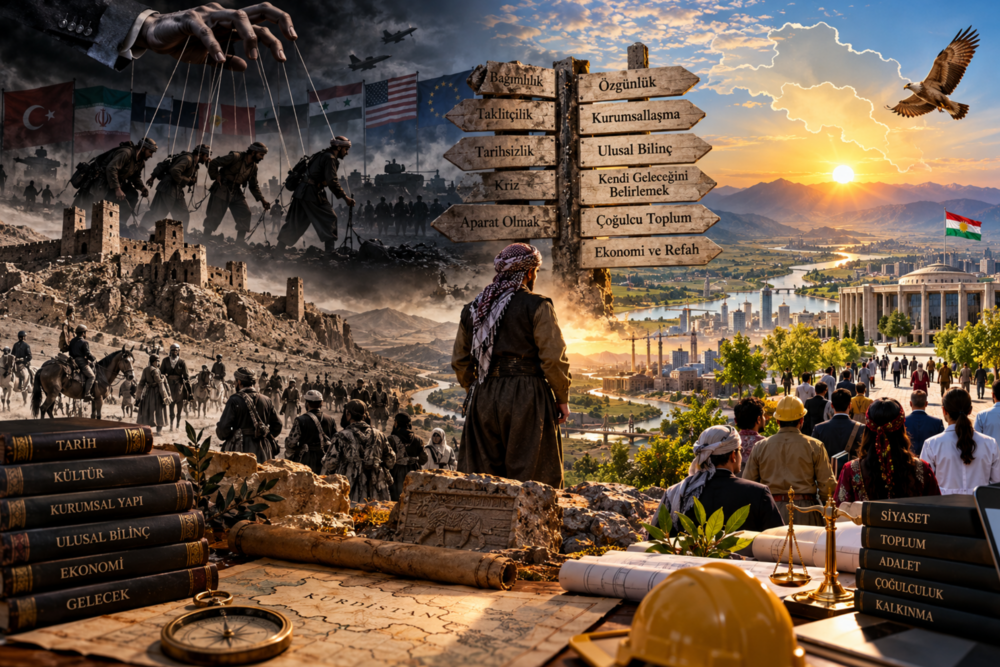
Transformation, Institutionalization, and National Consciousness in Kurdish Political History
The Source of Transformation and the Originality of the “Protected Site”
It is difficult to believe that Kurds possess an original idea concerning transformation and the act of transforming. For, from the Kurdish perspective, the process of transforming or being transformed can be prepared only and exclusively by proceeding from the same “protected site” in which the conditions themselves emerged. Such a process cannot arise through the rigid imitation of other social experiences or their acceptance as they are.
Just as in the realm of thought, the transformation of culture also requires the construction of established political institutions that are not exploitative. Consequently, an idea can be transformed only through another idea that shares the same origin and objective; this constitutes the fundamental backbone of our discussion.
Today, it can be said without the slightest exaggeration that Kurds are increasingly distancing themselves from the idea of independence that history has imposed upon all other nations. For a nation, this situation constitutes a crisis, a chronic predicament that has persisted for a long time. This picture, produced by new movements observed in various spheres in recent years, demonstrates that Kurds are not in a position to evaluate global and regional developments soundly and have fallen far behind political change.
It is precisely here that the great question becomes static: Where do Kurds stand in political history? We must take this question seriously and reflect deeply upon all the historical consequences of the situation into which they have fallen. For even if we cannot change the present condition of Kurds in a single stroke, we assume that changing it is theoretically and practically possible. From Being the Subject of History to Becoming Its Object: The “Sorcerer’s Apprentice” Syndrome
In the context of political history, Kurds appear to consist of a series of entities dependent upon other dominant nations, functioning as instruments of transformation rather than as founding or transformative actors. This means that Kurds are confronted with the instructions and demands of a destructive global or regional power over which they themselves exercise no sovereignty. What is truly disturbing is that this position is becoming normalized and that the masses are following the pessimism that uproots them.
An examination of historical periods clearly reveals that Kurds, “like the sorcerer’s apprentice, have been unable to manage the task with the tool in their hands.” It is evident that Kurds cannot easily free themselves from this submissive pessimism that has permeated their souls. Yet the decisive question that emerges here concerns how Kurds envision the relationship between past and future, because behind this entire picture lies the question of what kind of historical experience Kurds possess.
Of course, the purpose here is neither to romanticize and repeat the past nor to indulge in empty dreams. What must actually be created is a foundation upon which Kurds can govern themselves and acquire the will to decide their own future freely, like the other nations of the modern world.
The Logical Conditions of Historical Transformation and Institutionalization
The search in this regard must be taken as far back as possible, to the roots. For when we place historical transformation at the center of our understanding of past and future, we gain the opportunity to discover the positive and negative factors concerning ourselves. The full weight of this process can be expressed not through temporary and everyday reflexes of governance, but through public and political organization, together with original models of administration directed toward institutionalization.
In this respect, it is essential that two fundamental points be properly understood:
1. The examination of social and moral values through deconstruction within the framework of political and social events.
2. The interpretation of existing and potential developments not as a passive actor, but with an analytical and constitutive capacity.
Interpreting events within this framework is a matter of vital importance. It is precisely here that the fundamental principle by which Kurds can shape their own future emerges. In other words, the logical condition for becoming an independent national society, and the underlying driving force, lie in these principles. From our perspective, becoming a national society does not depend upon accidental causes, but upon the independent organizations and political-economic structures that Kurds are capable of establishing within the framework of their own moral and political values. Today, as in the past, the principal factors shaping political history are the phenomena that encompass these efforts. Progressive Historical Consciousness and the Absence of Statehood
History cannot operate independently of human actions and human rationality; development can occur only by proceeding from a cause or possibility that stimulates it. The historical task of Kurds on this plane is to fill the gap left incomplete with a national consciousness. That is, to sustain an uninterrupted effort toward institutionalization under the motto of “self-realization.” Under all circumstances, Kurds must re-establish their own foundations within the context of the progressive flow of history. For without assigning theoretical and practical meaning to this historical progress, we cannot draw sound conclusions about our relationship with history; even if we do, this makes us merely the objects of history rather than its subjects. It is also worth stating that history, unlike nature, cannot be associated with randomness. The most problematic point here is that stateless nations such as the Kurds are unaware of this historical progression. We do not claim that Kurds have remained without history; nevertheless, it cannot be ignored that an evolution toward “becoming historyless” is taking place without their awareness. The deprivation of Kurds of their history (or their inability to read history as historical subjects) leads them backward rather than forward.
Even if some conjunctural progress can be achieved with a consciousness devoid of history, they cannot sustain their existence in the future without the apparatus of the “state” that grants them the right to sovereignty. Consequently, the participatory and broadly based existence of both economic and political institutions is a fundamental condition not only for political centralization but also for becoming a national society.
Building Inclusive Institutions and Critical Junctures
The relationship that established nations develop with their territory leads to the centralization of political power, just as it ensures the stable centralization of commercial and industrial institutions of various sizes. This process strengthens the capital held by medium-scale merchants and raises the level of social prosperity. At the same time, by opening political power to broad sections of the population, it enables society to exercise a significant influence over its own future. As a result, a pluralistic society is achieved through political centralization, and the obstacles preventing the expansion of social activities are removed.
The ability of Kurds to develop these inclusive political and social institutions depends upon two fundamental factors:
1. Institutional structures in which society participates from the bottom to the top.
2. The formation of a broad and comprehensive social and political coalition.
These two factors provide the foundation for pluralistic political institutions, through which a national political economy can be constructed. The most important step that makes it possible to understand and historicize the reality of the “Kurdish question” within its own context is the aforementioned mechanism of centralized politics. This mechanism both introduces a structural innovation into the relations of Kurds with the outside world and contributes to the creation of a historical process capable of explaining the seemingly endless national question on a rational basis.
Such critical junctures are valuable because it is vitally important to benefit from the production of political and economic institutions in response to gradual developments. Although the ability of Kurds to grasp these matters, to reason within the framework of new values, or to make efforts toward producing politics may require a long process, their realization will produce significant consequences at the macro level.
Beyond this point, the elements that determine the policies being produced—politicians at the center, majorities within society, or approaches toward changing values—bring a series of national demands radically onto the agenda. Foremost among these, undoubtedly, is the reality of self-government.
In other words, institutional differences acquire great importance at critical junctures and naturally bring about greater constitutional transformations. Above all, the institutional structures that initiate this process create social institutions that exert much stronger effects upon the lives of society and individuals.
What is essential here is the establishment of a rational, production-based relationship among these institutions.