
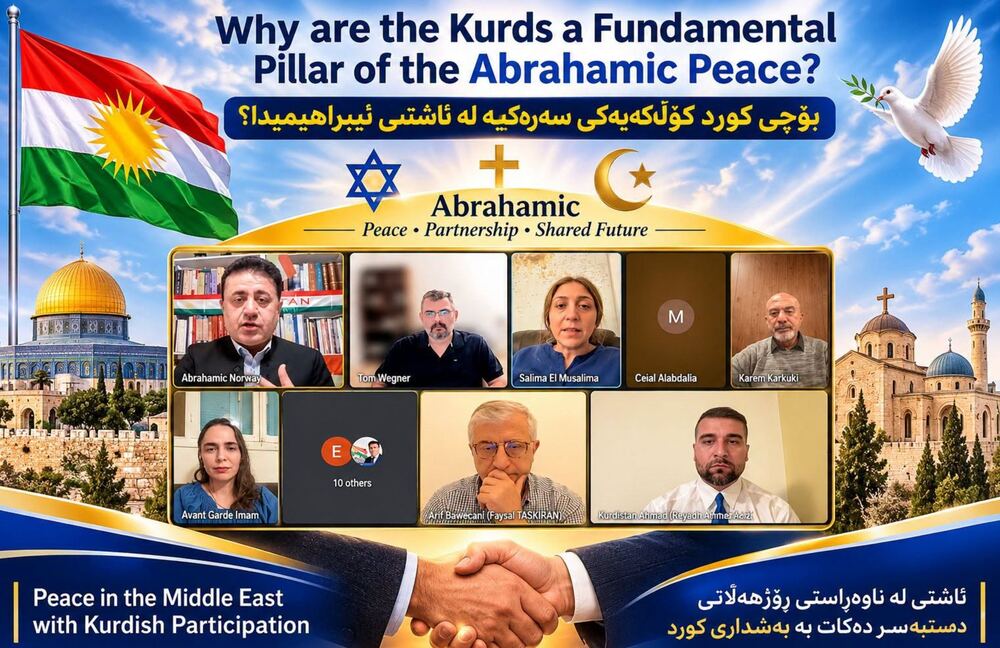
Kurdistan Ahmad: Why are the Kurds a fundamental pillar of the Abrahamic peace?
The organiser of an international seminar held with the leaders of the Abrahamic Movement sets out, in an assessment he authorised Dijital Kurdistan News to publish, why no peace in the Middle East can take root without the Kurdish nation.
An international online seminar titled "The Abrahamic Movement: Peace, Dialogue, Coexistence, and the Role of the Kurds in Abrahamic" was held on 22 November 2026 with senior figures of the Abrahamic Movement. Its organiser, Kurdistan Ahmad, has written up the conclusions he drew from it. The speakers included Tom Wegner, President of the Abrahamic Movement; Salima El Musalima, President of the movement in the Netherlands; and Arif Bawecani, its representative in Norway.
Dijital Kurdistan News publishes Ahmad's assessment in full, with his permission. The Sorani and English originals are the author's; the Turkish, Kurmanji, Persian and Arabic translations are by DKN.
Why are the Kurds a Fundamental Pillar of the Abrahamic Peace?
Throughout most of its chapters in this fire-and-smoke-ridden region of the Middle East, human history appears as a closed, recurring cycle of death, division, and denial of the "other." When we carefully examine the map of wars, the collapse of civilizations, and the consecutive tragedies of the past century, one bitter and undeniable truth imposes itself: the primary problem of this region is not merely a lack of resources, land, or power, but rather a profound crisis in the "mentality of coexistence" and a lack of will to recognize differences.
When societies and authorities allow extremist ideologies and blind nationalism to close doors in the faces of their historical neighbors, they are, in reality, closing the door to the future and civilization upon themselves. It is for this very fundamental reason that today, any initiative attempting to break this ice—such as The Abrahamic Movement—must be evaluated with an open eye, a critical mind, and a strategic reading.
On November 22, 2026, as the organizer and supervisor of a special international seminar held in partnership with senior leaders of the Abrahamic Movement under the title "The Abrahamic Movement: Peace, Dialogue, Coexistence, and the Role of the Kurds in Abrahamic" (organized by Kurdistan Ahmad), it was once again proven to me that the Kurdish nation, despite all the historical injustice and oppression inflicted upon it, still possesses the most vibrant human and cultural energy to reshape the map of peace in the region.
Why Has Politics Alone Failed to Create Peace?
For decades, the capitals of the world and the region have witnessed the signing of dozens of political and security agreements that looked grand and glittering on paper, yet collapsed with the very first shot of fanaticism. The secret behind this continuous failure lies in the fact that those agreements were forged solely among a closed political elite, without the participation of the spirit and conscience of the peoples.
During the in-depth discussions of our seminar, Tom Wegner, President of the Abrahamic Movement, put his finger on this very historical wound. Wegner clearly pointed out that the Abraham Accords are merely a starting point and a political framework; however, if this framework is not filled with human stories, mutual trust among peoples, and a return to that shared history that binds Jews, Muslims, Christians, and all other components of the region together, it will always remain at risk of collapse. This perspective is a vital intellectual turning point, as it calls for history and religion to be transformed from weapons of mutual erasure and hatred into bridges of connection and sources of respect for human dignity.
People’s Diplomacy: Breaking Out of the Cage of Marginalization
One of the greatest tragedies of contemporary history for stateless and marginalized nations like the Kurds has been the monopolization of diplomatic discourse and international relations by centralized states built on the foundation of ethnic and sectarian denial. When a state fails to represent all of its components and suffocates their voices, direct dialogue between communities becomes a historical and moral necessity.
From this perspective, the remarks of Salima El Musalima, President of the Abrahamic Movement in the Netherlands, added another crucial dimension to the discussion. Drawing on her experience working in Europe, El Musalima emphasized that real change occurs when the psychological and cultural walls between different communities are torn down. When women, youth, intellectuals, and civil activists in Kurdistan, Europe, and the Middle East listen directly to one another’s pain and dreams, misleading media and radical ideologies can no longer paint a monstrous image of the "other." For the Kurds, this openness to the world is not merely a public relations activity, but a living strategy to break the intellectual and diplomatic siege imposed upon us for decades.
Kurdistan: The Living Memory of Coexistence in a Sea of Fanaticism
If we ask: while most cities in the Middle East were emptied of their indigenous components over the past century, their markets stripped of economic mindsets and cultural pluralism, and enveloped by the darkness of fascism, what position did Kurdistan hold in this equation?
The answer to this question shone clearly through the remarks of Arif Bawecani (Dana Ahmadi), Representative of the Abrahamic Movement in Norway and Advisor to the Movement's President on the Kurdish issue in Eastern Kurdistan (Rojhelat). Bawecani objectively highlighted the truth that the culture of tolerance and coexistence in Kurdistan is not a temporary political slogan, but rather possesses deep historical and moral roots. At a time when waves of extreme nationalism in the region were expelling and looting Jews and persecuting Christians and other minorities, Kurdistan stood as an island of humanism, opening its arms to all differences. From Zakho and Akre to Erbil, Sulaymaniyah, Koya, Kermanshah, and Sanandaj (Sine); Muslims, Jews, Christians, Yazidis, and Yarsanis lived as one body under one sky.
This pure and glorious history is today the greatest moral capital of the Kurdish nation. It tells us that on the roadmap of the Abrahamic peace, the Kurds are not mere petitioners, but hosts and contributors; because the very model of coexistence that the world is searching for today has been an inseparable part of the culture and daily life of the people of Kurdistan. Without a free, strong, and self-determining Kurdish presence, no peace project in the Middle East can take root or produce lasting stability.
What Is Happening Is the Result of the Absence of Reason; Now Is the Time for Its Return
Today, we are paying the price for that bitter history in which fanaticism replaced reason, and the erasure of the other became the measure of patriotism. The economic, intellectual, and social devastation that has engulfed the Middle East is the natural consequence of the disappearance of pluralism and the marginalization of those nations and communities that believed in life and prosperity.
Yet history does not stand still at a single point. Organizing these dialogues and building bridges of communication between the Kurdish nation and the Abrahamic Movement can mark the beginning of the return of reason and hope to the region. Our duty as Kurdish intellectuals, activists, and elites is to step out of the shell of reaction and passive waiting, and enter international platforms with self-confidence. We must prove to the entire world that the Kurdish nation is not only worthy of a free and dignified life, but is also a key cornerstone in unlocking the doors of peace, prosperity, and civilization in a new Middle East.
Kurdistan Ahmad