
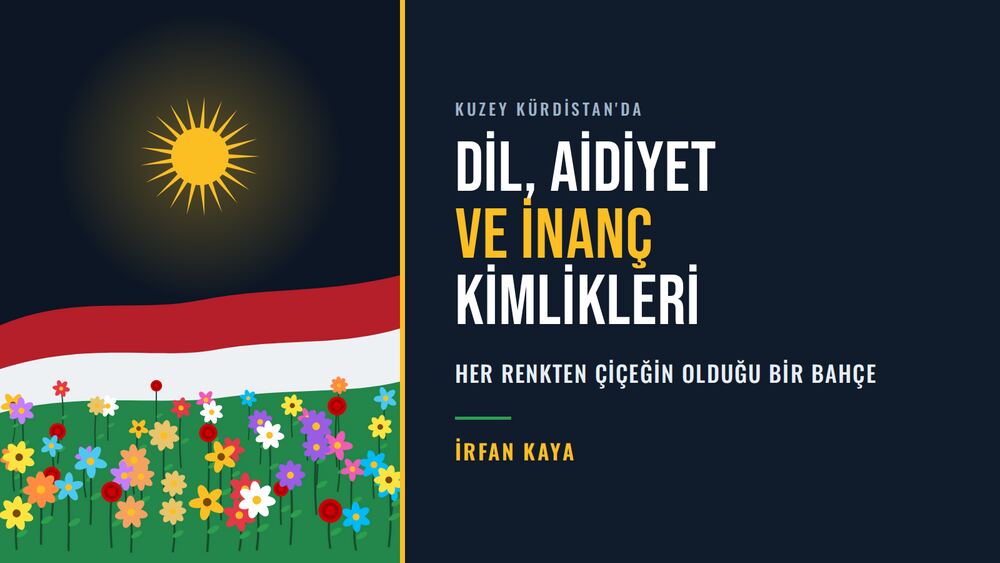
Language, belonging and faith identities in North Kurdistan
The only way to hold Kurdistan's many languages, faiths and identities together is for all of them to live on the basis of equality: a garden with flowers of every colour.
I hope this piece, written with an eye to the lack of empathy between faith communities and other identities within Kurdish society, will be discussed through more objective presentations and serve as a foundation for building the future.
Kurdistan is a land where a great wealth of languages, faiths and identities of belonging live side by side. The only way to hold these identities together is to embrace all of them. By that I mean that every one of them must find life on the basis of equality, in theory and in practice.
Identity of faith
Throughout our history, provocations carried out by central authorities, which played on divisions of faith in Kurdistan, achieved their aim: non-Muslim peoples and communities were subjected to deportation, massacre and genocide.
These policies, driven by a central authority that settled on a single faith identity, surfaced through major provocations in various periods of the Republic's history. Operations resembling the 15 September "lit nights" have been tried on Kurdish Alevis time and again in recent history.
From the early 1970s onwards, first in Maraş and then in Malatya, Çorum and Sivas, every provocation cost dozens of lives, and in some cases hundreds.
The aim of these provocations was to inflame differences of faith within Kurdish and Turkish society and thereby bind the Kurdish Alevi community more tightly to the state. Sadly, by scratching at these differences of ours, the state has managed to kill two birds with one stone every time.
Today, in the Turkish metropolises and in the parts of Kurdistan where Alevis live in large numbers, these policies have taken hold, and an overwhelming majority of the Alevi community has been drawn to the side of the state. Yet even though the state alone was responsible for all these clashes, the common belief in this community is that they stemmed from hostility towards Alevis among Sunnis. The central authority's propaganda has been highly effective on the Alevi community.
After these events, a large part of the Alevi community drifted steadily away from its identity of belonging and chose to hide behind its identity of faith as a way of protecting itself.
Identity of belonging
The second great division in Kurdish society in recent times is the Zaza–Kurmanc split, which has been going on for thirty years and has peaked in the last few years in particular.
I am fully convinced that this is a state-patented policy of division.
My first and second earlier articles on the subject deal with those responsible for this division and the circles that feed them.
The aim is to fragment and weaken the Kurdish national politics that developed after 1970, so as to keep this population under easier control and to stunt the Kurdish national struggle. The Zazas, who until yesterday were counted as Kurds, were suddenly pushed onto the stage as a separate nation. The language used frequently by state officials in recent times, in particular, serves to deepen this division.
So would no one ask: where have you been until now?
Starting from the impressions of a few missionaries in Kurdistan, they have seized, like a man who has stumbled upon treasure, on the claim that Zazaki does not resemble Kurmanji and that the Zazas are therefore a separate nation. They tie the very concept of a nation to linguistic difference.
Yet while the Turks say they descend from the Oghuz, the languages spoken by many communities of the same lineage bear no resemblance to Turkish, and the common language these communities use at the Turkic language congresses they hold every year is Russian, because none of them understands the others. Those communities are called Turkic, while the claim that "the Zazas are not Kurds" is made by pointing to Kurmanji. As if the Kurdish language consisted of Kurmanji alone.
By the account of these circles, the Zazas have a history of three thousand years; if they have only just become aware of their own belonging, they have already lost the quality of being a nation.
It is no coincidence that these ideas were put forward after the mid-1970s, the years when Kurdish national consciousness was rising rapidly. The view the state deliberately advanced, constantly treating the Zazas as separate in its rhetoric, found some support. That this group defends its rights of belonging solely on the basis of language, and that it builds its claim of being denied not against the occupying state but against Kurmanc belonging, holding the Kurmancs responsible, already gives away how the project works. These are circles that see themselves as closer to the Turks than to the Kurds. That they ignore the colonial state and blame the Kurmancs, who suffer the same injustice, shows that these circles are directed from certain centres.
That the leading circles have never defended their own rights of belonging, that is, the rights that come from being a nation, that they have never held the colonial state responsible, and that they point instead to the Kurmanc community, a fellow victim, as the real culprit, is a contradiction in itself.
Another contradiction lies in the programmes of the parties and organisations across the Kurdish political spectrum: programmes that do not embrace every part of Kurdish society, do not meet the needs of today's society and are far removed from concrete realities.
Drawing on a few of the points above, I want to come to the real issue.
What kind of Kurdistan?
Kurdistan is the country of everyone who lives in Kurdistan and regards themselves as Kurdistani. For different identities of faith and belonging, as well as those who share the same belonging yet see themselves as the other, to live freely together is possible only through a social contract that secures it.
For all these identities to live together equally and freely, the question "what kind of Kurdistan?" matters a great deal.
Ask any Kurdish nationalist and they will surely tell you: "I want an independent Kurdistan." The picture in most people's minds is the independent, centralist models of the very states whose colony they are. These models do not meet the needs of our age at all. Such a model restricts the rights and freedoms of broad sections of society, rests on uniformity, and seeks to dissolve many identities within itself through assimilationist policies.
I, on the other hand, want us to have a country like a garden that holds every colour, with flowers of every hue, from the thorny rose to the thornless bloom. I will never accept any identity lording it over another. What I mean is the representation of all differences of faith, language and belonging on the basis of equality.
All Kurdish political parties and organisations must renew their programmes in this direction without delay and come before our peoples with concrete programmes that embrace all these differences.
Beyond the Kurdish parties and organisations, it is essential that civil society organisations also begin work on federal models suited to Kurdistan's needs. For example, apart from cities, towns and a few exceptional villages, the Alevi community lives concentrated in certain regions. The same is true of Zazas and Kurmancs in many areas.
The model best suited to the reality of Kurdistan is autonomous regions within a federal structure, where the communities living in these regions govern themselves and enjoy to the full, without limit, the rights and freedoms that arise from their faith, language and other identities.
For example, in Dersim, Bingöl and Elazığ, where Zazas form the bulk of the population, and in parts of Diyarbakır, in Siverek and elsewhere, Zazaki should be the official language of the Zaza community, with Kurmanji as the second official language. The same should hold in favour of the Kurmancs where they are the majority, with Zazaki made the second official language.
No such arrangement applies to identities of faith. Each faith should be autonomous, its needs met by its own congregation; it is best that they sustain their faith with their economic and social needs provided for by their congregations. Beyond this, there should also be autonomous regions for the Yazidis and other non-Muslim peoples, suited to the same model of faith and belonging.
In my view, this is the only way the communities of a country as many-coloured and many-identitied as Kurdistan can be free. What we must do is to cast out, as the true "other", the harmful attitudes and behaviour that deepen our contradictions by othering one another, denying one another and lording it over one another.