
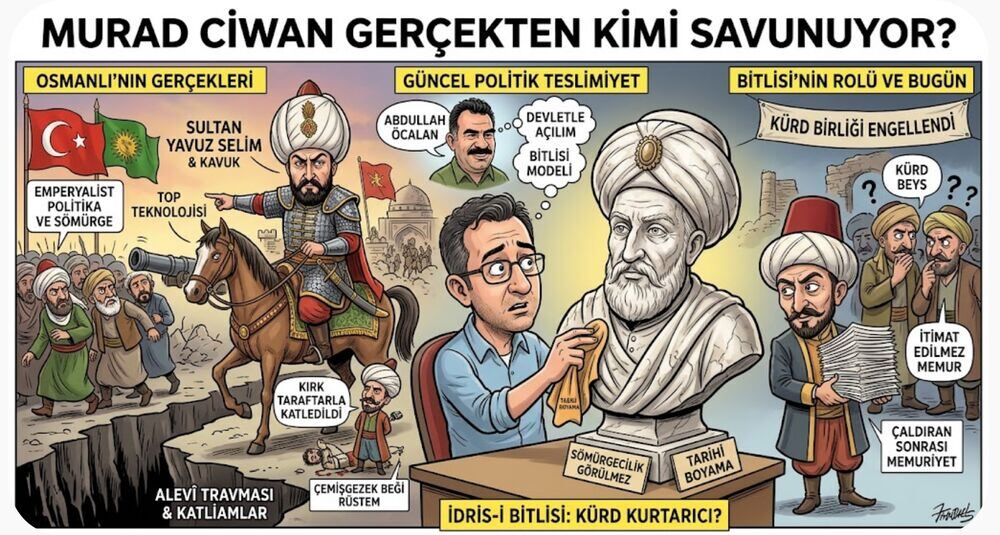
Who Is Murad Ciwan Really Defending?
The narrative that presents İdris‑i Bitlisi as a savior of the Kurds ignores the Ottoman colonial policy and the weight of the Kurds on the Safavid side; seeking legitimacy for today’s submissive politics in history is an injustice to the Kurdish political memory and the trauma of Alevi Kurds.
Murad’s recent articles are almost exclusively about Yavuz‑Bitlisi and Shah Ismail. He criticises Shah Ismail while glorifying the bureaucrat Bitlisi. We understand that. Yet he never mentions any criticism of the Ottoman colonial and imperialist policy. Some Kurdish lineages, either out of compulsion or because they saw an advantage in siding with the stronger power, aligned themselves with the Ottomans. We understand that as well.
The newly‑formed Safavid state was not as experienced as the Greeks. Like every new movement, we can admit that it was not flexible enough at the ideological stage. Flexibility is a disease of entrenched powers that trust themselves. Those still in the founding phase, and therefore not yet beyond the ideological stage, have not acquired the ability to show the necessary pragmatism. However, it should not be concluded that the Safavids lacked any flexibility at all. According to Şerefhan, Emir Şeref, who organised feasts with alcohol, succeeded in obtaining the Bitlis provincial decree with honorary robes. From whom did the Bitlis bey receive the decree? From the Safavids. Thus the Safavids did not have a policy of denying status to Kurdish lineages. Şerefhan also mentions that Muhammad Khan’s army was not supplied with bread and that they faced many other unpleasant situations, but he refrains from detailing them because it would lengthen the story. Clearly, bad things happened that Şerefhan does not wish to recount. In other words, Kurdish lineages are not naïve “spoon‑fed” children.
So what is the real reason Kurdish lineages leaned toward the Ottomans? The judgment that the Ottomans would win the war is hidden in the experience gained by the Kurdish tribes that fought alongside Uzun Hasan. A contemporary Greek writer calls Uzun Hasan the “King of Med”. Uzun Hasan essentially ruled over the Med lands, so we can infer that the majority of those who fought with him were Kurdish. The Ottoman Sultan Fatih won that war thanks to his artillery. That fact should be enough to judge the outcome of a new war. The wavering of Kurdish beys between the Safavid family of Kurdish origin and the Greeks should be examined in this complex context. In the end, some sided with the Ottomans for their own interests. Does this stance constitute a model to be glorified for everyone? Similar situations have recurred many times in history. Why is this episode being highlighted now? Is it a search for common friends and enemies? Who is preventing a brotherhood with some parties?
In that era many Kurdish beys probably felt closer, in belief, to the Safavid order. Hence it is no surprise that Shah Ismail’s sister married Melik Halil Eyyubi, the judge of Hasankeyf and a Kurdish lord. The Bitlis bey also had a kinship link with Karakoyunlu Kara Yusuf, who was on the Ali side. The beys of Bitlis were famous for organising feasts with music and alcohol. So there was no religious fanaticism of the kind we understand today. Moreover, according to David Morgan, the early Safavid order was originally a Sunni‑referenced tariqa. I doubt that many of those who make bold claims about the Safavids and the Kurds are aware of this.
Secondly, Murad Ciwan makes a sweeping generalisation that all Kurds stood with the Ottomans. He glosses over the fact that Çemişgezek bey Rüstem was beheaded together with his forty supporters. If Murad examined the tribes and population that migrated to Khorasan today, he would see how intense Kurdish participation on the Safavid side was and would feel the need to mention it, perhaps even empathise. Not only Shiites stood beside Shah Ismail; Sunnis were present as well. The Shamli tribe, Avşar, İzolu, Reşi, Karaman, Çemişgezek and similar groups were all Kurdish. Let me quote a quatrain attributed to the Khorasan Kurds:
Bi hukma Şah Ebbas je roma qeyser Aware bûye je wê ewlada Heyder Li vir Ce"ferqulî pir bûye muzter Xwanga bu biranê bibîn halê min
What would happen if those beside Shah Ismail were not Kurdish? Why do people, starting from Antalya, turn eastward and want to go to the Shah? Clearly there is a social unrest rooted in Ottoman policies. Were these people wrong? Is obedience the only justified stance? Are social protests illegitimate?
The Ottoman policy of confiscating property and wealth prompted an eastward drift toward Tabriz in Anatolia, beginning in the era of the Akkoyunlu and continuing thereafter. The number of Kurds who stood with Shah Ismail was not negligible. The Dulkadir principality was largely Kurdish, and Yavuz put an end to it; Murad writes about this as if he were pleased. Earlier, the Ottoman state had annexed beyliks such as Menteşe, Kahraman, Germiyan, Candar, Eretna and the Greek‑ruled Empire of Trebizond. First we must accept that the Ottomans were plunderers and annexationists. Murad writes as if there were an early democracy based on consent in the Ottoman realm. Did the Ottomans have a Magna Carta?
Hangi İdris‑i Bitlisi? Rafizi (Alevi) ve Ehli Sünnet (Sünnü) Bitlisi
When we come to Bitlis, it should be noted that Bitlisi was born in Rey, near Tehran, and early in his career was closer to Shiite circles. The same can be said of Şerefhan, who underwent a similar education. Vural Genç’s research shows that in the panegyrics Bitlisi wrote for Shah Ismail he claims to have learned from his grandfather, and later, when the wind changed, he turned to Sultan Selim I. This opportunistic pragmatism of Bitlisi is today marketed by some circles as a conscious rescue move on behalf of the Kurds. In fact, Bitlisi was not even on the battlefield at the Battle of Çaldıran; the massacres pre‑date that. His appointment as an Ottoman official was a routine bureaucratic post‑war assignment. Moreover, even the Kurdish beys under Ottoman direction did not trust Bitlisi nor would they have sent him alone to the palace. The Ottomans never wanted Kurdish beys to unite among themselves. The “white paper” is merely a legend; possessing a piece of paper in a game whose frame is drawn by others never gives the holder the right to become director.
Kurds are not Arabs; they are an Iranian people. What should be questioned here are the foreign interventions in history. Murad Ciwan writes that after Çaldıran the Kurds lived very peacefully, creating the illusion that all major problems began only in the reign of Mahmud II. The Ottoman state was autocratic. Celadet Bedirhan gives a clear date for the colonisation that began with that war. Why does Murad not acknowledge this fact? A vassal‑lord relationship does not change the nature of the object. A territory that was not previously Ottoman was attached to it, and the conflicts we experience today stem from that forced attachment.
We find the bitter outcome of this unwilling relationship again in Şerefhan’s records: when Bitlis lord Şemsettin Han, installed on the throne by the Rozki tribe after being taken from Akdamar Castle, faced the provocations of Ottoman vizier Ibrahim Paşa, he was forced to seek refuge with Shah Tahmasp. Similarly, with the support of Kurdish lineages, Ibrahim Ağa’s brother Sheikh Emir fled and again took shelter among the Qizilbash. These feudal ties trapped between dynasties produced tragic ends full of longing for homeland and displacement.
Bölücülük Meselesi ve Alevi Travması
To be brief: some circles deliberately foreground the name Bitlisi to open deep wounds among Kurds and create division. There are also those within the “Alevi Enlightened” who play along. Presenting the activities of İdris‑i Bitlisi as an Ottoman official as a historical model in order to legitimise the policies and state‑oriented openings of Abdullah Öcalan is, at best, a gross injustice to Kurdish political memory and to the historical trauma of the Alevi community.
Murad Ciwan talks about creating division among Kurds, but that is exactly what he does. He bends history one‑sidedly to get into the eyes of the powerful and to lay the groundwork for a new status‑quo with the state. İdris‑i Bitlisi is a bureaucrat whose authority did not extend beyond Ottoman civil service and whom even Kurdish lineages did not trust. The real danger is not his bureaucratic rank but what he symbolizes today. Glorifying this bureaucrat as a saviour‑genius amounts to white‑washing the massive, blood‑stained Ottoman apparatus that carried out the Alevi massacres under Sultan Selim I. Sacrificing the historical wounds and current legitimate sensitivities of Alevi Kurds for the sake of building a new reconciliation table with the centre is unacceptable. The true division is the submissive mindset that erases a religious component of the Kurdish nation while marketing the oppressors’ officials as visionary.
Today there are no tribes, no lineages. What remains is a leadership that smiles at every direction except the Kurdish nation itself. The artificial debates conducted through Bitlisi serve only to mask contemporary political submissiveness. Our reference point is not the interests of imperial officials but universal human rights and the Kurdish nation’s struggle for freedom.
Shafi‑Alevi relations can never be reduced to Bitlisi’s shallow pragmatism. Historically, in the Iranian arena, Shiites, Alevis and Sunnis/Shafi‘is forged many alliances and kinships because political interests, not religious fanaticism, were paramount.
If justice and truth matter, we must stay alert to such historical manipulations. Our gaze is not on power; rather, we have a duty to critique powers and those who seek alliances with them. The false historical route drawn by those who want to cooperate with the powerful may bring not freedom but a new form of obedience to the Kurdish nation.