
Musa Anter's death 34 years ago: status debate back on the agenda
Kurdish intellectual, writer and journalist Musa Anter is commemorated on the 34th anniversary of his killing in Diyarbakır on September 20, 1992. Hüsamettin Turan's assessment places Anter's life and death at the centre of the Kurdish nation's political status debate.
Kurdish intellectual, writer and journalist Musa Anter is remembered again on the 34th anniversary of his death, and discussions about the political status of the Kurdish nation have also resurfaced, based on his life and killing.
In an assessment written by Hüsamettin Turan, Anter's death on 20 September 1992 in Diyarbakır as a result of an armed attack is examined within the long‑standing debate over the Kurdish nation's political status.
According to Turan, a nation's existence is not only cultural and social; having its own political status is also a decisive factor in safeguarding its history, values and pioneering figures. This approach argues that Musa Anter's life and death should be evaluated not merely as an individual intellectual murder but also in terms of the Kurdish nation's political and historical memory.
"A painful sign of statelessness"
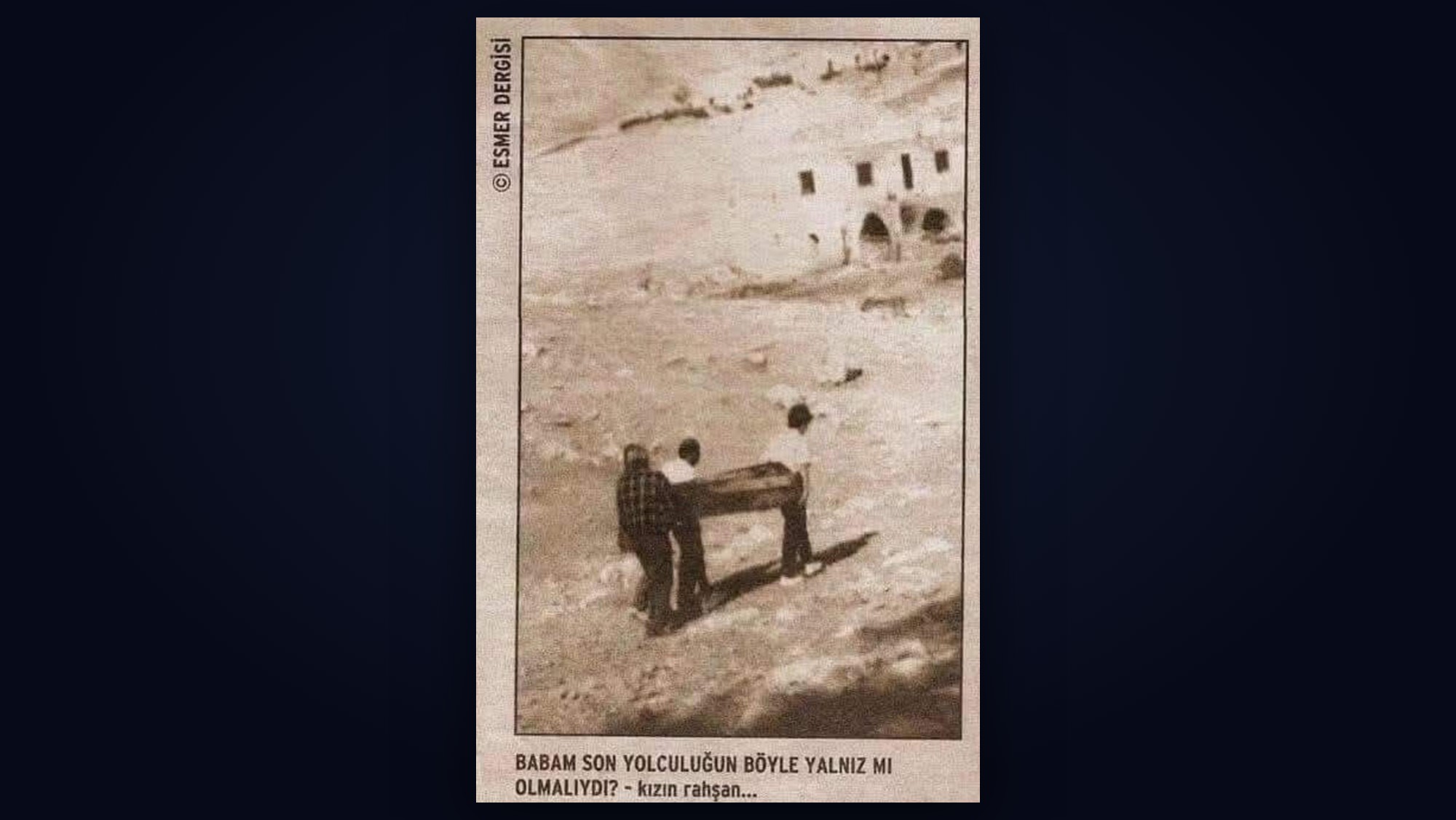
One of the striking parts of the assessment is the claim that “only four people attended” Musa Anter's funeral. Turan interprets this picture as a “painful sign of the Kurdish nation's lack of political status.”
The basis of this narrative is the image published in Esmer Magazine and also featured in our report: a few people carrying the coffin on a bare slope. The caption beneath the photo belongs to Anter’s daughter Rahşan: “Should my father’s final journey have been so lonely?” Our newspaper could not independently verify the claim about the number of people who attended the funeral.
The debate here is not limited to how many people attended a funeral. The real question hinges on how far a nation can uphold its historical figures, intellectuals and cultural heritage.
Musa Anter’s life also carries symbolic meaning in this respect. Because of his writings, journalism and studies on Kurdish identity, Anter holds an important place in Kurdish media and political history, and years after his death he continues to be a core subject of debate in the Kurdish issue.
“We don’t need the state” debate
In Turan's assessment, the “We do not need the state” approach is also examined from a critical perspective. The article, which argues that the state is not merely a mechanism of daily administration, emphasizes the importance of political status in enabling a nation to uphold its history, cultural memory, and pioneering figures.
This view addresses the “status” debate in the Kurdish issue not only in terms of a form of political governance but also through collective memory and national identity.
However, another dimension of the debate includes differing approaches that argue a nation's defense of its history and cultural heritage cannot be solely explained by possessing a state. Consequently, the discussion centered on Musa Anter's legacy also raises the question of how to define the relationship between the state, the nation, political status and cultural memory.
Anter's legacy is still debated today
Musa Anter, who was killed in Diyarbakır on 20 September 1992, continues to be an important figure in Kurdish press and political history despite the passing years. His murder is regarded as a historical turning point concerning the safety of Kurdish intellectuals, freedom of expression, and the political dimensions of the Kurdish issue.
His reappearance in the public eye on the anniversary of his death does not merely mean recalling a past killing. It also brings back into view the ongoing debate about the political status of the Kurdish nation, its claim to its own historical identity, and how it constructs its collective memory.
Musa Anter’s life and death thus remain at the centre of a discussion that stretches from the past to the present.
File: murder and trial
Born in 1920, Musa Anter was shot on 20 September 1992 in Diyarbakır while attending a culture and arts festival, and died at the age of 72. Writer Orhan Miroğlu was also seriously injured in the same attack.
The European Court of Human Rights, in its 2006 ruling, held Turkey responsible for Anter’s killing. In 2013, a trial was opened in Diyarbakır against four individuals, including Mahmut Yıldırım, known by the code name “Yeşil,” and Abdülkadir Aygan.