
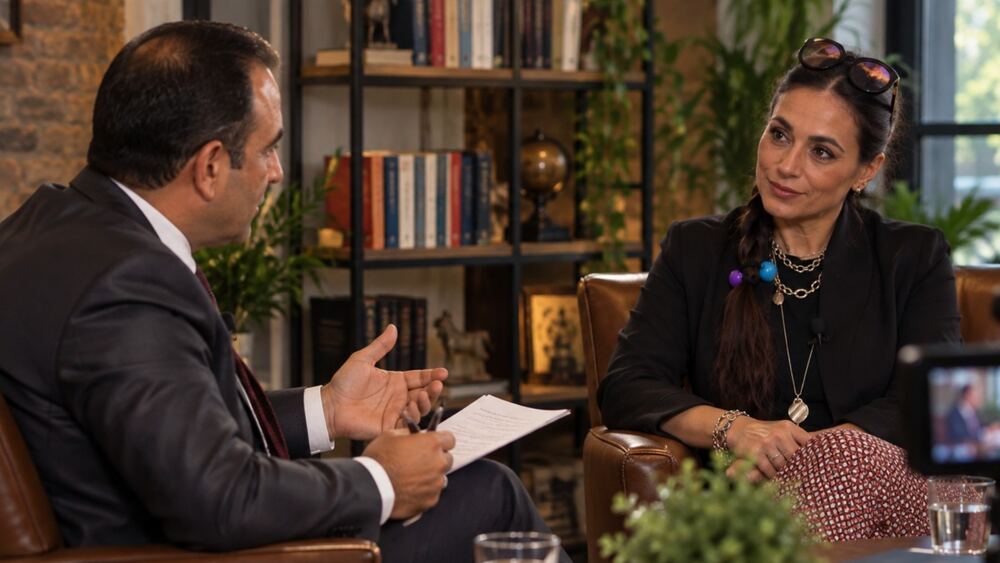
Nurgül Çokgezici: "They Can Take Away My Power to Speak, but Not My Thoughts"
Nurgül Çokgezici, a psychologist and linguistic mediator who came from North Kurdistan to Italy at the age of nine: "The Turkish government banned my language, but it could not stop us from speaking it secretly at home."
Nurgül Çokgezici, a human rights defender, linguistic and cultural mediator, and psychologist working in the field of ethnopsychology, says that none of the work she does was a choice; it is a call to duty, to help those like her, the last and the forgotten. When she came from Turkey to Italy through family reunification in the 1990s, at the age of nine, together with her illiterate mother and her brother, she understood that education was the only way out for her. Today she shares the same conviction with her three daughters and hopes they will live in a more inclusive, more understanding society. We spoke about homeland, migration, difference and freedom with Çokgezici, who works in Milan with migrant children, asylum seekers and women who are victims of violence.
Hüsamettin Turan: You came to Italy from North Kurdistan. Is Italy your homeland today?
Nurgül Çokgezici: I came to Italy when I was nine. I see Italy as my adoptive country. When you are part of a stateless nation like Kurdistan, a country like Italy becomes your adoptive homeland. I feel Italian, but my first homeland is Kurdistan; my heart lives in the Kurdish mountains. You can tell from these words that, even though I have found a second home in Italy, I have never forgotten my roots. I am a specialist in linguistic and cultural mediation, and I have devoted myself to keeping alive the millennia-old traditions and knowledge of my nation. I would not want my roots to be erased. Customs, culture, knowledge and belongings that have existed for thousands of years cannot be erased.
We are not only Kurds, we are also Italians. This duality is often misunderstood. The remark we migrants so often hear, "But you are Italian now," feels like a kind of violence; I feel as if there were a colonization, an attack on my origins. That is why I am both Kurdish and Italian, and I build a bond of belonging with Italy. I call this not integration but interaction. Integration is a harsher concept that often implies the loss of cultural roots or submission to one culture. Interaction, on the other hand, is a mutual process in which no culture is destroyed, in which the two coexist and add value to each other.
Hüsamettin Turan: Do you still feel like a migrant?
Nurgül Çokgezici: Yes, I still feel like a migrant. I am a migrant, and my daughters are second-generation children of migrants. This is not a deficiency; it should not be a stigma. Very often a person is proud of who they are, but this does not always come from genuine pride; it comes from having no other option but to accept and embrace who they are. It is a defense against those who try to belittle us. Being an Italian migrant of Kurdish origin is an inseparable part of my identity, one I embrace strongly and resolutely.
Hüsamettin Turan: You say, "Access to education made me a more aware person and gave me the tools to be the protagonist of my own life." How did your life change when you came to Italy?
Nurgül Çokgezici: My life changed not so much when I came to Italy, but above all in my adolescence. I was living between two completely different cultures and could not fully live either of them. I felt vulnerable and confused. I did not know whether it was I who could not interact, or whether it was my exclusion as a Kurd without social status in Turkey that made me this way.
When I came to Italy, I was considered dangerous because I was different, and I was subjected to bullying and exclusion. This identity crisis pushed me to study intensely. I began with linguistic mediation, then studied the dynamics of migration from an anthropological and sociological perspective. In the end, I began to find the answers I had been searching for for years. I understood that I was not the one who was wrong; the hardships of migration were far too complex for a child and a young woman like me. Education was an enlightenment for me, and it gave me the tools to help people going through similar hardships. Now I can explain to them the processes they are living through, reassure them and ease their fears. Thanks to my own experience and knowledge, I can offer them the understanding and support that I, too, would have wanted to receive.
Hüsamettin Turan: Which people do you come into contact with most in your work?
Nurgül Çokgezici: As a linguistic mediator, I work with Kurds, most of them asylum seekers fleeing the harsh conditions in Turkey. I have also worked a great deal with Afghans and felt a special closeness to them. I have worked with Ukrainians as well. As a pedagogue and socio-pedagogical educator, I work with second-generation children of migrants. Unfortunately, these children do not have the chance to be closely followed, as many of their Italian peers are. On television we often see news of young people who face discrimination, with no one knowing their background or the hardships they have faced. Their families often live unemployed, without social recognition, in deep depression.
As a psychologist, I collaborate with an anti-violence association that supports not only women but also children and men of different origins. I work with Moroccan and South American women trapped in violent marriages and relationships. Many of these women hesitate to file a complaint because they fear their children will be taken from them and given to other families. Abandoned women are subjected not only to physical but also to economic violence, and because they have nowhere to go, they wait a long time to reach the municipalities' assistance services. Bureaucracy is a huge obstacle. For example, just to obtain a certificate of their economic situation, they have to wait years to be separated from their husband's family registration. When they become homeless, getting the help they need becomes almost impossible.
Hüsamettin Turan: You often quote the Algerian-born French sociologist Abdelmalek Sayad: "Migrants live a double absence: they no longer belong to the place they came from, and in the place they go to they are not allowed to belong." Does this constant search for identity, however demanding it may be, also offer new possibilities?
Nurgül Çokgezici: Absolutely, yes; forced migration can also offer a new opportunity. We psychologists working in the intercultural field know well that forced migration is traumatic. Adapting to a new country takes two or three times more energy than it does for someone born in a privileged country. Getting lost is far easier than finding oneself; that is why, in the country of arrival, "cultural islands" are built where people still feel at home. This is the expression of an instinct for survival and salvation born of pain. Fortunately, this instinct also opens the door to new opportunities.
Hüsamettin Turan: You have three daughters, and they belong to the second generation of migrants. Do you think young people in Italy today are more open-minded and free of prejudice because they are growing up in a multicultural society?
Nurgül Çokgezici: My three daughters are second generation, children of migrants. Young people today are more open and welcoming; I see this in my daughters' Italian friends as well. As the generations pass, prejudices will diminish, but they will not disappear entirely. Because among migrants, too, there is a kind of sense of superiority toward newcomers: newcomers will always suffer, and those who came before will feel their suffering. Those with a good heart will accept them, but those who come from families where they were taught to fear what is different will always carry prejudice.
My greatest fear is the political propaganda against migrants, especially by right-wing parties. Always building election campaigns around an enemy can, if one is not careful, lead to divisions and radicalization. A person is born with prejudices handed down from their ancestors; these prejudices can sometimes even help survival. But if they are fed with ill intent by a part of society, they cause great harm. My hope is that future generations, through education and tolerance, will overcome these barriers and build a more inclusive and understanding society.
Hüsamettin Turan: Considering that governments in Europe are shifting increasingly to the right and placing the fight against illegal migration at the center of their programs, will the hardships for migrants and refugees who want to come to Europe grow in the coming years?
Nurgül Çokgezici: I think migration is a phenomenon that rich countries also feed. The West needs migrants: Westerners are having fewer children, and migrants increase national income and make life easier all over Europe. But the rate of legal migration is very low. Most people reach the West through dangerous journeys, by illegal routes. Many drown in the Mediterranean or suffocate inside trucks. Humanitarian corridors give me hope, but I fear they will never be enough. I came to Italy in the 1990s; more than thirty years have passed, and people are still coming by illegal routes.
For thirty years I have been hearing news of people dying in the Mediterranean, and it breaks my heart. It is not fair to die at sea while trying to reach the hope of a better and more dignified life. My greatest concern is the manufacturing of hatred and the political games played over these people who pay the price for having been born in the wrong place in the world. Migration must be managed with humanity and respect; it must stop being an instrument of desperation, division and political manipulation.
Hüsamettin Turan: What has being "different" given you in life?
Nurgül Çokgezici: Being different has given me both positive and negative experiences. I have experienced exclusion, marginalization, being looked at with a critical eye. Very often they tried to strip me of my dignity with words like "poor thing" or "you bring disease." Fighting within my own community was not easy either; there I was seen as too outgoing and too Western. People say I carried out a revolution on my own against the molds imposed from inside and outside. Interaction goes both ways: just as migrants must adapt to the new society, the host society must also be more welcoming.
The positive side of being different was discovering the strength of my resilience. I was not aware of it until one day my therapist told me, "In forty years of practice I have met many people, but I have never seen anyone so resilient, able to turn pain into such a great transformation." This awareness allowed me to face hardships with renewed strength and turn them into opportunities for growth. Although difference brought hardships, it revealed my true strength and showed me how resilient a human being can be.
Hüsamettin Turan: What is freedom for you?
Nurgül Çokgezici: Freedom is both an inner and a universal quest. It is a complex, multifaceted concept; it varies from person to person and from society to society, and it is shaped by the traditions and rules of each culture. In Kurdish there is a saying: prohibition creates its own rebel. Freedom is being able to remain free in mind in spite of prohibitions, aware of how absurd they are. They can take away my power to speak, but they cannot take away my thoughts; that is freedom.
The Turkish government banned my language, but it could not stop us from speaking it secretly at home. That is freedom. The greatest freedom lies in knowledge and wisdom; knowledge sets us free. When someone tries to hold you back with their own frustration and you realize they are doing it out of ignorance, you become free. Freedom is being able to smile in the face of a racist. True freedom is an inner strength; it is being able to preserve your own integrity and identity regardless of outside pressures, to see beyond the limits imposed on you and find your own way.