
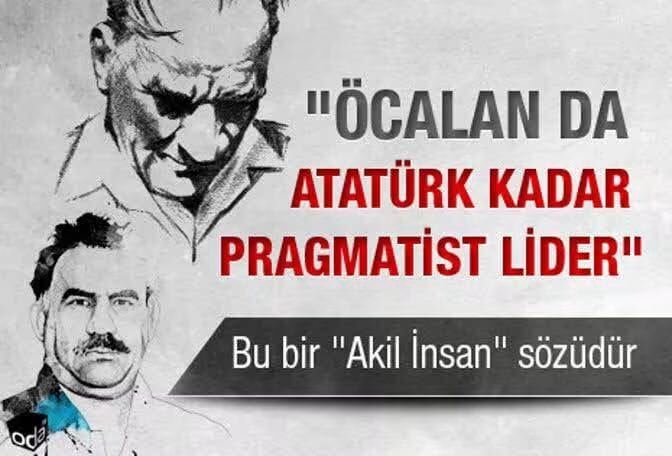
Which of Öcalan’s Historical Narratives Is Correct?
The “Thousand-Year Turkish-Kurdish Brotherhood” or the “Turkish-Jewish Alliance”?
Let us recall the debates of recent months concerning Yavuz Sultan Selim and İdris-i Bitlisî (Îdrîsê Bedlîsî). Today, in Öcalan’s discourse, this period is presented as one of the most important historical foundations of the so-called “thousand-year Turkish-Kurdish brotherhood.”
Yet during the years he spent in Syria, Öcalan interpreted the same period in a diametrically opposite way. He regarded the era of Yavuz Sultan Selim not as the beginning of a brotherhood, but as the beginning of the decline and the historical catastrophes of the Kurdish and Arab nations. Moreover, he associated Ottoman politics with the Jews and explained this era, as it were, through a “Turkish-Jewish alliance.”
Today, however, it is claimed that Öcalan rejects even a Kurdish state for the sake of protecting the Republic of Turkey and fighting against Israel, and that his only aim is to “democratize” the existing Republic.
There is a serious contradiction here: how can Öcalan, who once accused the Republic of Turkey of playing a decisive role in the founding of Israel and of serving Zionism, today place the protection and “democratization” of that very Republic at the centre of his political project? Having once portrayed the era of Yavuz Sultan Selim as a process of decline and domination for the Kurds and the Arabs, how is it that today the same historical legacy becomes the basis of the “thousand-year brotherhood” discourse?
In short, which of Öcalan’s historical narratives is correct? His critique of the Ottomans and the Republic from his years in Syria, or today’s discourse of a “common Republic” and “democratic integration”?
The problem is not merely a change of views. The views of political actors can, of course, change. The real problem is that these two diametrically opposed historical narratives are presented as the “immutable truths” of the same leader, without any serious self-criticism or historical reckoning.
The following text contains the grave claims Öcalan made during his years in Syria about Ottoman history, Atatürk, Freemasonry and the founding of Israel. These statements are reproduced not as verified historical facts, but in order to expose the contradictions between Öcalan’s past and present political discourse.
Abdullah Öcalan's Words
“When we look at the history of Kurdistan, we see that the era of Yavuz Sultan Selim (Sultan Selim I) constitutes an important stage in this history. It is also an important period in the history of the Arabs. The stagnation and decline of Kurdish and Arab societies are linked to this period. Indeed, these societies remain bound to one another under today’s conditions as well.
Yavuz Sultan Selim entered Kurdistan with the Battle of Çaldıran (1514), Syria with the Battle of Marj Dabiq (1516) and Egypt with the Battle of Ridaniya (1517).
At that time the Ottoman sultans had fallen behind in terms of colonialism. Outwardly they were Muslims, but inwardly they harboured other ideas. Jews fleeing from Spain and the Khazar lands gradually began to establish themselves in the circles around the Ottoman sultans. Some of the Turks also embraced Judaism and converted to that religion.
There are signs and documents indicating that Yavuz Sultan Selim’s mother was Jewish. At that time Jews had established themselves in the Ottoman palaces. These people, who hid their own ideas behind a false mask of Islam, surrounded the Ottoman sultans. For this reason, the wars that the Ottoman sultans waged against the Shiites in Iran and against the Arabs were in reality the wars of the Jews.
The role of the Jews is clearly visible even in the founding period of the Ottoman Empire. Jews fleeing from Spain had taken refuge with the Ottoman sultans. They held economic affairs in their hands in the Ottoman palace and ran the affairs of state. In this way, a segment of the Jews managed all the affairs of the empire.
In Turkey there are large Islamic orders and groups that do not know Islam at all. These groups have approached Islam in an extremely superficial way and have naturally remained ignorant of its essence. They have become a scourge upon Islam. The Prophet of Islam, too, spoke of such groups as the people of Gog and Magog.
Now let us look at what befell the Arab regions that remained under Ottoman rule and domination for four hundred years. The Arabs, who undoubtedly had a civilization and way of life of their own, were turned into desert Bedouins. These four hundred years brought the Arabs no benefit whatsoever. This is not a matter to be underestimated. Even removing the dust from the problems accumulated over several centuries is difficult.
In addition, the attacks of Zionism intensified further after 1900. At the Ottoman Congress held in 1886, it was decided that the world’s Jews would be moved to Palestine through the Jews of Turkey. Through Sultan Abdulhamid II, the Jews were gradually settled in Palestine.
It is said that Sultan Abdulhamid II was opposed to Zionism. However, such a claim is far from the truth, because he gave the Jews great assistance and sold them many parts of Palestine for money.
Most of the Jews who gathered in Salonica became Turkified after a while. Masonic lodges multiplied, and they founded a party under the name of Union and Progress. The Committee of Union and Progress was a party of a Masonic character that was active before Israel was founded. Mustafa Kemal Atatürk was also one of these Masons.
So what did they do? They opened the lands of Palestine to the Jews for certain groups. In this way, the Republic of Turkey, too, played its part in the founding of the State of Israel.
Mustafa Kemal Atatürk’s membership number in the Masonic organization was 33. He, too, was one of those who played the Israelis’ role. They deliberately drove Islam towards fragmentation. Atatürk was, in reality, opposed to Islam and to its essence.
There are even documents bearing his own signature which show that he was fully aware of the consequences of the policies he pursued. He launched a comprehensive attack on all fronts in order to support Zionism.
The founding of the Republic of Turkey weakened Islam in two respects. Islam lost even more strength than it had in the Ottoman period. And when Turkey passed into the Republican era, Islam entered a stage of death throes and extinction.
We can lay the greatest betrayal ever committed against Islam at Turkey’s door. The State of Israel, too, was founded in this way. Israel is an extremely effective instrument of pressure in the region.
Many states were founded in the Middle East with the help of the Turks. Outwardly these states are Islamic states, but in reality they serve the ideologies of Zionism, Ottomanism and Kemalism. European and American imperialism, too, has been supporting these states for nearly two hundred years.”
Source
Abdullah Öcalan, “Önderlik ve Halk” (“Leadership and the People”; رهبریت و خلق), interview with Nebil el-Melhem (Nabil al-Mulhim), p. 45 ff. Translated into Turkish from the Persian text.
Translation Note
In the Persian text that was shared, the dates of the battles of Marj Dabiq and Ridaniya are given as 1571. In the translation, the historically correct years are given in parentheses: Çaldıran (1514), Marj Dabiq (1516) and Ridaniya (1517).
The claims made in the excerpt concerning the Jews, Freemasonry, Ottoman history and the founding of Israel belong to Öcalan and have no historical value. The translation was prepared on the basis of the Persian text and has not been compared with the original edition of the book.