
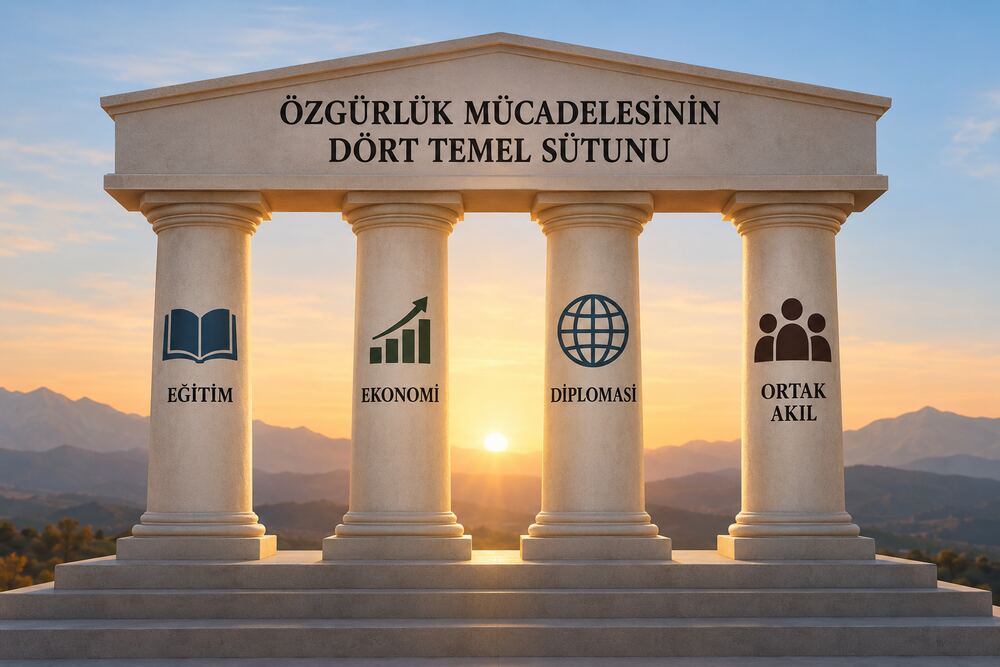
THE FOUR FUNDAMENTAL PILLARS OF THE STRUGGLE FOR FREEDOM
For any nation's struggle for freedom and national liberation to continue and achieve success, a level of strategic planning is required that leaves nothing to chance.
For any nation's struggle for freedom and national liberation to continue and achieve success, a level of strategic planning is required that leaves nothing to chance.
The theoretical, practical, and organizational foundations of this struggle must be built upon four fundamental pillars.
These four pillars that strengthen the struggle are: Education, Economy, Diplomacy, and Collective Reason.
1. EDUCATION
For Conscious Generations, an Intellectual Foundation, National Memory, and Language Education is one of the strongest and most enduring foundations of the struggle for freedom.
According to divine and universal principles, generations who have confidence in their culture, language, and values must be able to use their mother tongue freely in everyday life. They must also know the history and collective memory of their society, be at peace with their roots, and regard differences as a form of richness. They must be educated accordingly.
Undoubtedly, preserving language, culture, and historical memory and transmitting them to future generations is of fundamental importance for strengthening identity consciousness, protecting social unity, and establishing a strong defensive barrier against policies of assimilation. Organizational and Technical Competence Ideological and political consciousness alone must not be considered sufficient. In addition to morality and faith, knowledgeable, specialized, and competent cadres must be trained on the basis of merit and with a sense of responsibility in various fields, including basic sciences, technology, social sciences, law, economics, education, health, the environment, communications, and public administration.
This brings together human resources, competencies, experiences, and different perspectives. It must strengthen the capacity for research, production, planning, and organization.
The accumulation of knowledge and technical and organizational experience, together with the principles of justice, transparency, accountability, and democratic participation, must become the foundation for building a strong, free, just, and democratic society of the future. Transformation of Mentality The most fundamental way to overcome social unconsciousness, fragmentation, and social backwardness is to transform the ways of thinking, learning, and assuming responsibility among individuals and within society.
A modern understanding of education that takes divine, universal, and scientific principles together as its foundation must promote critical thinking, free will, a culture of research and inquiry, moral responsibility, and collective consciousness.
Undoubtedly, this understanding regards differences as a form of social richness and a source of shared development. It must provide individuals with opportunities to develop their abilities. Society itself must develop solutions to its common problems in the future.
Education must be regarded not merely as a field for transmitting knowledge, but as a strategic force for developing conscious individuals, competent human resources, strong institutions, and a responsible society.
This transformation of mentality will become one of the most important forces behind social development, the struggle for freedom, and the construction of a sustainable future.
2. ECONOMY
Sustainable Strength and Financial Independence Local Production and Employment Undoubtedly, if a movement for political freedom lacks its own economic foundation and an independent, self-sufficient productive capacity, it cannot achieve success.
For this reason, sustainable models that mobilize local resources and encourage production and entrepreneurship must be developed in order to create economic value.
Policies that reduce external dependence must strengthen local capital, create employment and entrepreneurial opportunities for young people and women, protect skilled human resources, and reduce economic inequalities.
In this way, productive capacity, employment, prosperity, and economic independence must be strengthened together, establishing a sustainable foundation for social and political freedom. Management of Diaspora Capital The financial resources and capital available in the diaspora must be brought together and must not remain limited solely to charitable activities.
These resources must be directed toward sustainable, strategic, and value-creating investments in Kurdistan in fields such as education, agriculture, industry, technology, and tourism. Areas of Financial Freedom For the struggle to continue sustainably and independently, a transparent and sustainable financial ecosystem must be established, one that creates its own economic resources and networks of cooperation and support.
3. DIPLOMACY
Diplomacy Must Be Conducted According to the Circumstances of the Time From the past to the present, all material, spiritual, cultural, economic, and social values created by human beings need protection so that their rights may be recognized, their existence in the social sphere may continue, and their preservation may be guaranteed.
One of the most important means of ensuring this protection is strong and principled diplomacy.
Diplomacy must not be limited solely to relations between states. It must be regarded as a strategic instrument that promotes understanding, trust, cooperation, and common interests among peoples, societies, institutions, and various actors.
According to this understanding, diplomatic relations must serve to strengthen rights, justice, freedom, equality, and social peace, to safeguard achievements, and to transmit them to future generations. Diplomacy According to the Circumstances of the Time: A Realistic and Flexible Strategy Instead of adhering to fixed dogmas and unchanging patterns, a dynamic and realistic strategy must be developed that takes the fundamental principles of the divine call as its basis.
This strategy must be capable of accurately analyzing the balance of global and regional powers, evaluating changing geopolitical conditions and emerging opportunities at the appropriate time, and adapting rapidly and flexibly to new developments.
It must be based on continuous consultation and deliberation, collective reason, the evaluation of different perspectives, the determination of realistic objectives, and the protection of long-term interests.
Diplomacy must be conducted on the basis of collective reason: a form of reasoning capable of renewing itself according to changing circumstances, promoting dialogue instead of confrontation, cooperation instead of isolation, and result-oriented policies instead of dogmatic approaches. International Law and the Defense of Rights The struggle for freedom and the rights of the peoples of Kurdistan must be explained to international public opinion through democratic and peaceful methods, on the basis of international law, human rights, equality among peoples, justice, and universal legal principles.
Within this framework, diplomatic relations must be strengthened, and effective relationships must be established with international institutions, human rights organizations, and political parties.
Historical and contemporary rights must also be documented and brought to international attention.
The struggle must be supported not only by political statements but also by legal, academic, diplomatic, and social documents and evidence, so that legitimate demands may be properly understood and accepted in the international arena. Effective Lobbying and Strategic Partnerships Lobbying must not be limited solely to countries where the diaspora resides. Systematic and long-term relations must be developed with international parliaments, governments, decision-making mechanisms, political parties, academic circles, research and intellectual centers, the media, and global civil society networks.
The objective must be to communicate the demands for the rights and freedom of the people of Kurdistan accurately and effectively, and to establish strategic partnerships and alliances based on shared values and interests.
Within this framework, by establishing a professional, transparent, and organized diplomatic and lobbying network, international public awareness, support, and political legitimacy must be strengthened.
4. FROM FRAGMENTATION TOWARD COLLECTIVE REASON
Overcoming Fragmented Organizations Political, diplomatic, economic, cultural, and social activities are extremely important.
If these activities are carried out by organizations that exclude one another, compete against one another, or operate separately and in a fragmented manner, collective strength is weakened, resulting in the loss of resources.
For this reason, a strong and comprehensive foundation for cooperation must be established, enabling different organizations, movements, circles, and sections of society to act in a coordinated and harmonious manner around common objectives without losing their independent identities and distinctive characteristics.
Human resources, knowledge, experience, financial opportunities, and diplomatic relations must be brought together within the framework of shared strategic planning.
Complementarity must be prioritized over competition, coordination over fragmentation, and collective reason over individual interests.
In this way, existing potential must become a coordinated and effective force in pursuit of common objectives, without being absorbed into a single centralized organization. Agreement on Common Principles Different political, intellectual, religious, and social perspectives must be accepted as a form of richness.
Differences must be evaluated not as causes of conflict and division, but as opportunities that strengthen collective reason.
At the same time, strong agreement must be established on common principles such as freedom and fundamental rights, justice, equality, democratic values, social peace, and national interests.
The preservation of differences while simultaneously uniting around common objectives, the development of a shared strategy based on mutual respect and consultation, and the prioritization of higher national interests over individual, organizational, or ideological interests must become fundamental principles. Building Collective Strength The foundation for building sustainable and effective strength is the ability of different organizations, movements, circles, and sections of society to act in a coordinated manner around common objectives.
A spirit of unity must be developed that creates organizational synergy and is supported by transparent, responsible, accountable, and participatory governance.
This spirit of unity must preserve differences while simultaneously strengthening the consciousness of collective reason and shared responsibility.
Human resources, knowledge, experience, economic resources, and diplomatic opportunities must be utilized according to a shared strategic vision.
The collective strength built upon this understanding will become one of the most important elements ensuring the continuity of the struggle for freedom and a fundamental key to achieving common objectives.
CONCLUSION The four fundamental pillars of a people's struggle for freedom and democratic rights cannot be evaluated separately from one another: 1. Consciousness and Education: A society that knows itself and has confidence in itself. 2. Economic Strength: A society capable of sustaining its existence, producing, and supporting itself through its own economic strength. 3. Politics and Diplomacy: A society that correctly understands the conditions of its time, carefully evaluates opportunities and risks, and can express itself effectively in the international arena. 4. Unity and Collective Reason: A society capable of bringing dispersed and fragmented forces together around common objectives and transforming them into a collective force. If any one of these four pillars is missing or weak, the struggle itself becomes weaker, and its continuity is placed at risk.
However, if these four pillars are strengthened together, social consciousness, economic capacity, democratic political strength, and organizational cooperation can act together in accordance with a shared vision and common objectives.
A free and democratic future cannot be built through wishes and demands alone. It becomes possible through the development of a conscious and responsible society, a strong and sustainable economic foundation, a realistic and practical political understanding, effective diplomacy, and a strong common organizational structure built upon collective reason.
These elements must not be regarded as separate fields, but as complementary components within the framework of an integrated strategy.
Only in this way can society make productive use of its human resources, knowledge, economic resources, political capacity, and diplomatic relations, and establish a sustainable foundation for freedom, justice, prosperity, and democracy.