
The Unification of Peshmerga Forces and the Changing Geopolitics of the Middle East
The Institutionalization of the Peshmerga in the Iraqi Kurdistan Region, the 2026 War and the Reshaping of Regional Balances of Power
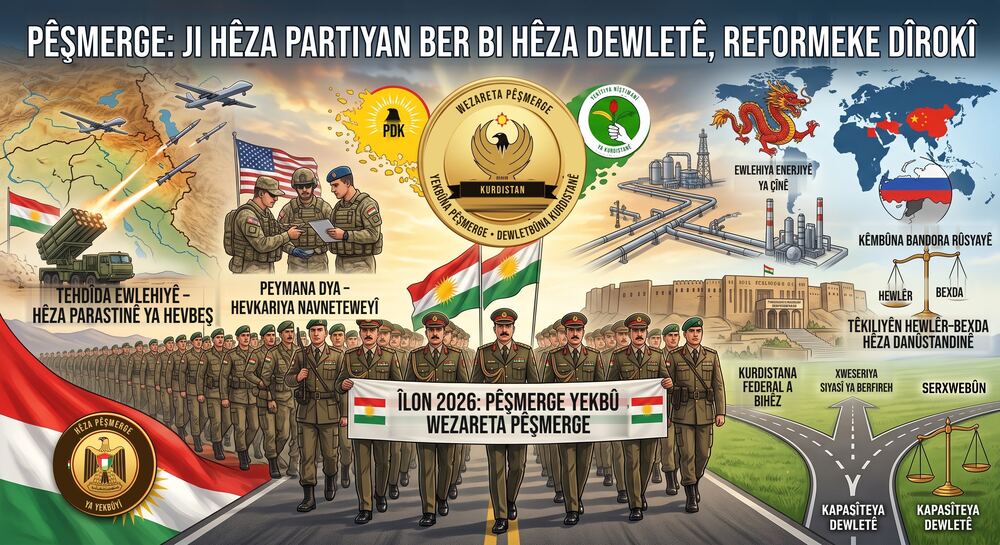
The announcement by the Ministry of Peshmerga Affairs in September 2026 that Unit 70, affiliated with the Patriotic Union of Kurdistan (PUK), and Unit 80, affiliated with the Kurdistan Democratic Party (KDP), had been fully unified under the Ministry's umbrella constitutes a historic threshold, indicating that a reform on the agenda in the Iraqi Kurdistan Region for more than a decade has been completed at the institutional level. The fact that this announcement came in the very month in which the memorandum of understanding signed with the United States, a long-standing supporter of Peshmerga reform, is due to expire, and that it coincided with a period in which the Kurdistan Region has for months been the target of drone and missile attacks, lends the timing of the development additional significance.
However, this development is not a matter that can be assessed solely in terms of the Kurdistan Region's internal political balances. The process should be addressed as part of a broad geopolitical framework extending from Iraq's security architecture to Iran's regional influence, from US policies in the Middle East to the Russia-Ukraine war, and from China's energy security to the future political status of the Kurdistan Region.
The fact that the Peshmerga forces were historically shaped along the KDP-PUK axis has meant that the Kurdistan Region's security structure long retained a party-centered character. For this reason, the unification of the Peshmerga does not simply mean bringing military units under the same roof. The real issue is removing armed force from the direct control of political parties and transforming it into an institutional security structure.
The September 2026 announcement is the product of a long process. The formation of joint brigades, the reorganization of personnel records and the centralization of financial structures constituted different stages of this process. According to the implementation report published by the Kurdistan Regional Government at the end of 2025, the 88,900 personnel within the Ministry of Peshmerga Affairs had been organized into 34 unified brigades, 7 divisions and 2 mechanized divisions. In mid-2026 it was announced that the former Units 70 and 80 had been incorporated into two regional commands through a thorough restructuring and that the number of unified divisions within the Ministry had reached 11; the process culminated in the announcement of full unification in September. These data indicate that the process has moved beyond a mere political intention and acquired the character of a concrete institutional transformation.
Nevertheless, viewing the unification of the Peshmerga solely as the outcome of a political settlement between Hewlêr and Silêmanî would be an incomplete assessment. For many years the military and political rivalry between the KDP and the PUK was one of the most important obstacles to unification, and both parties preserved their own security and intelligence mechanisms. That this rivalry can today be drawn into an institutional framework is related not only to the will of the two parties but also to the shift in regional balances of power.
The fundamental problem that emerges here is the question of to whom military power belongs. Even if a Peshmerga unit appears legally subordinate to the Kurdistan Regional Government, if in practice it remains within the command and sphere of influence of a particular political party, it retains the character of a party security organization rather than that of a public security institution. Accordingly, the real meaning of Peshmerga reform lies not so much in changing the names or numbers of units as in removing the command, budget, personnel, logistics and intelligence mechanisms from political party control. Indeed, in the months preceding the announcement of full unification, a former secretary general of the Ministry of Peshmerga Affairs warned that the unification achieved up to that point had remained "only organizational" and had not evolved into a common military identity; it was also pointed out that, despite official statements, party-affiliated units continued to exist in practice. The strategic significance of the September 2026 announcement and of recent developments can only be understood from this perspective.
The regional environment facing the Kurdistan Region has also changed considerably compared with earlier periods. The spheres of influence that Iran built through Iraq, Syria, Lebanon and other actors in the region have come under serious pressure in recent years, and this change in the capacity of regional proxy networks has also affected the security balances in Iraq. One of the most important consequences of this change for the Kurdistan Region is that it has made it necessary to reassess the external support mechanisms and the regional room for maneuver that the PUK has historically enjoyed. It would not be realistic to claim that Iran's influence has disappeared entirely; the more accurate approach is to acknowledge that the regional freedom of action Iran possessed in the past is no longer at the same level, and that this situation has become a factor capable of altering the calculations of political actors in Iraqi Kurdistan.
This change also directly affects the future of the relationship between the KDP and the PUK. In the past, the relations that the PUK established with Iran, and those that the KDP established at various times with Turkey and Western countries, formed the external dimension of the military divide between the two parties. For this reason, the unification of the Peshmerga can be read not only as an internal political settlement but also as the reflection, in the Kurdistan Region, of the shift in regional balances of power.
The harshest manifestation of this change was seen in the regional war that began at the end of February 2026 with US and Israeli strikes on Iran. In the first four weeks of the war alone, more than 450 drones and missiles were directed at the Kurdistan Region, 354 of them targeting Hewlêr and 90 targeting Silêmanî, and the attacks were attributed to Iran and to Iraqi militia groups close to it. Tehran's characterization of the Kurdistan Region in May 2026, within the framework of its security doctrine, as an area hosting "enemy bases", despite the Kurdistan Regional Government's declaration of neutrality, showed that the region had become one of the direct targets of the conflict. This picture carries a particular meaning for the PUK: in Silêmanî, the headquarters of the party that has historically maintained the closest relationship with Iran, a PUK-affiliated Peshmerga base was also among the targets of the attacks, and in a city lacking an air defense system, Unit 70 tried to shoot down drones with machine guns mounted on pickup trucks. This vulnerability of a fragmented and party-centered security structure in the face of aerial threats exposed the need for joint command, joint air defense and international coordination with a clarity that no political rhetoric could provide.
The role of the United States in this transformation is also of particular importance. The United States and the countries of the international coalition have long supported the professionalization of the Peshmerga, the creation of a unified command structure and the removal of party influence. The concrete framework for this support was the memorandum of understanding signed in 2016 and renewed in 2022, which tied US financial assistance to the Peshmerga to the unification process. The reason for this is not solely the security of the Kurdistan Region; the military cooperation established between the Peshmerga and the international coalition during the fight against ISIS clearly demonstrated the need for a centralized and predictable security partner.
However, it is not methodologically possible to establish from this, as a definite fact, a direct causal relationship of the kind "the US ordered the PUK to hand the Peshmerga over to the KDP"; proving such a claim would require the production of direct diplomatic or military documents. The assessment that can be made within the broader geopolitical framework is rather the following: from the US perspective, a professional and predictable security force subordinate to the Kurdistan Regional Government and possessing a centralized chain of command appears to be more functional than a party-centered and fragmented Peshmerga structure. Accordingly, US support for Peshmerga reform coincides with the strengthening of institutional state capacity in the Kurdistan Region. The expiration of the memorandum at the end of September 2026 and the absence of any direct funding for the Kurdistan Region in the US 2027 budget request, however, indicate that this external incentive is weakening and that the durability of the reform will increasingly depend on the Kurdistan Region's own institutional will.
This development also has important consequences for Iran and Baghdad. One of the principal instruments of Iran's influence in Iraq is its political and security networks within the central government. Although it would be inaccurate to place all components of Hashd al-Shaabi within the same political line, the close ties of some of its groups with Iran are well known. This polycentric character of Iraq's security structure complicates relations between Hewlêr and Baghdad, and also makes the balance of power that may emerge between the Peshmerga and Hashd al-Shaabi one of the determining elements of Hewlêr-Baghdad relations. In this respect, the emergence of a unified Peshmerga structure may affect not only the internal security of the Kurdistan Region but also its bargaining capacity in its relations with Baghdad.
The fragmentation of a security force increases the vulnerability of political actors to external interference; by contrast, centralized command, a common budget, common training, a standardized personnel system and institutional logistical capacity strengthen the state capacity of a political entity. It is here that the real strategic importance of Peshmerga unification emerges. For the future of the Kurdistan Region, military capacity and state capacity are two inseparable elements; however, for military capacity to be converted into state capacity, the armed forces must be made independent of political parties. For this reason, Peshmerga reform is also part of the Kurdistan Region's process of institutional state-building.
Nor is it sufficient to read regional developments solely through the lens of Iran. The economic, military and diplomatic pressures Russia has faced because of the war in Ukraine have narrowed Moscow's room for maneuver in the Middle East. Russia's traditional strategic objectives in the region included access to the Mediterranean and the preservation of its regional influence through Syria; the shift in Syria's political balances and Moscow's concentration of its military capacity on the Ukrainian front have rendered the future of this strategy uncertain. Damascus's announcement in August 2026 that it had reached an understanding with Moscow on converting the Russian bases at Hmeimim and Tartus into joint training and capacity-building centers also indicates that Russia's military presence in the Mediterranean has been drawn into a new and more limited framework. When the narrowing of Russia's regional room for maneuver, the change in Iran's capacity and US security policies along the Iraq-Syria line are assessed together, it can be seen that the strategic weight of the geography in which the Kurdistan Region is located has increased.
For China, energy security is one of the decisive factors. China's economic growth and energy needs make the oil and natural gas resources of the Middle East strategic for Beijing. Although Russia is an important energy supplier for China, assessing the relationship between the two countries solely as a "partnership against the West" overlooks the structural elements of rivalry between them. Despite significant strategic rapprochement, the interests of the two states do not converge in every area, and historically serious tensions have arisen over issues such as borders, security, economic competition and influence over Central Asia. The asymmetry between Russia's sparsely populated Far Eastern and Siberian territories and China's demographic and economic capacity is also a factor that cannot be ignored in Moscow's long-term strategic calculations. Nevertheless, Russia's focus on the European security system because of the war in Ukraine is widening the United States' strategic room for maneuver in the Middle East to a certain extent and, when assessed together with the change in Iran's regional influence, suggests that a new balance of power is taking shape in the region.
The energy question lies at the center of this transformation. The importance of Middle Eastern oil to the world economy does not stem solely from production volumes; the routes along which oil is transported, which countries control those routes, the security of sea lanes and the access of major consumer countries to energy resources are among the fundamental elements of the global balance of power. The severe disruption of maritime traffic in the Strait of Hormuz during the 2026 war clearly demonstrated that this issue is not an abstract geopolitical debate. For this reason, energy producers such as the Gulf states, Iraq, Iran and Venezuela need to be assessed within the same global energy system. However, explaining all the developments in these countries as parts of a single US plan oversimplifies a multi-actor international system. It is more illuminating to treat US energy security, China's energy dependence, Russia's energy export capacity and oil flows in the Middle East as mutually influencing elements.
In this context, the Kurdistan Region's oil and natural gas resources increase not only the economic but also the geopolitical value of the region. There is also an indirect link between Peshmerga unification and the security of energy resources: a Kurdistan Region with high security capacity, a centralized command structure and the ability to coordinate with international partners becomes a more predictable actor in terms of operating its energy resources and delivering them to foreign markets. The damage inflicted on Kurdistan's oil fields by drone attacks during the same war, and the fact that some operators were forced to suspend their activities, showed how concrete this link between security capacity and energy revenues is. In this respect, security reform and economic capacity should be seen as two mutually reinforcing processes.
One of the most important developments for the future of the Kurdistan Region is the gradual drawing of the military dimension of the KDP-PUK rivalry into an institutional framework. Here the question of why the PUK has begun to reduce its traditional control over the Peshmerga gains importance. It is not possible to give a single answer to this question; however, when the change in Iran's regional capacity, the security gap made visible when Silêmanî too was targeted in the 2026 war, US security policy, the Kurdistan Regional Government's institutionalization efforts, economic pressures and the political balances between the two parties are assessed together, it can be seen that maintaining the old party-centered security model has become increasingly costly for the PUK. Accordingly, Peshmerga unification should not be interpreted as the PUK "voluntarily handing over its military power to the KDP". A more accurate formulation is that the military capacity held by the two parties is gradually being transferred to the institutional security structure of the Kurdistan Region.
This distinction is important, because a unified Peshmerga belonging to the KDP and one belonging to the Kurdistan Regional Government produce two entirely different political outcomes. In the first case, the KDP's military superiority becomes institutionalized; in the second, a public security institution separate from both parties emerges above the military power of the KDP and the PUK. It is the second model that is strategic for the long-term future of the Kurdistan Region. For this reason, the criterion for assessing the reform is as follows:
The success of Peshmerga reform should be measured not merely by the unification of units, but by whether these units genuinely become independent of political parties.
The emergence of a unified and professional Peshmerga may increase the Kurdistan Region's bargaining power in the security sphere. However, there is an important point that must be borne in mind here: a strong Peshmerga does not in itself mean an independent Kurdistan. Independence requires that, in addition to military capacity, numerous factors such as economic sustainability, political unity, control of borders, international diplomatic support and the stance of neighboring countries become favorable at the same time. Nevertheless, there is an important relationship between independence and state capacity: the greater the institutional capacity a political entity possesses, the greater the bargaining power it gains regarding its future status. For this reason, Peshmerga unification should be seen not as independence itself, but as the strengthening of the state capacity that the Kurdistan Region can draw upon with regard to its future status.
In this framework, the basic options before the Kurdistan Region may develop in three different directions: a stronger and more institutionalized federal structure within Iraq; a higher degree of de facto political autonomy; or, should regional and international conditions become favorable, a new political process toward independence. It is not possible to say with certainty today which of these options will materialize. However, when the shift in regional balances of power, the security vulnerabilities exposed by the 2026 war, the institutionalization of the Peshmerga, the transformation of Iran's regional capacity, the narrowing of Russia's room for maneuver, the global energy balances in which China is also among the decisive actors, and the role of the United States in the Iraq-Kurdistan security architecture are assessed together, it can be argued that the Kurdistan Region's capacity to act in the coming period not merely as a federal region of Iraq but as an actor carrying greater weight in the regional balance of power has increased. Peshmerga unification is one of the most visible indicators of this transformation.
The real historical issue, however, is far greater than the unification of the armed forces held by the KDP and the PUK. The question that must be asked is this:
Can the armed capacity of the Kurdish political movement, historically organized along party lines, be transformed into an institutional and centralized public force?
If this transformation is successfully completed, the Kurdistan Region will possess not only a stronger security structure but also a stronger budget, a more centralized administration, a more effective foreign policy and a greater international bargaining capacity. For this reason, Peshmerga unification is far more than a military reform and should be regarded as one of the fundamental stages of the transition from an armed party structure to an institutional state structure; in this respect, the announcement of full unification in September 2026 should also be read as a beginning rather than a point of arrival. Yet what will ultimately determine the meaning of this transition lies beyond the way the units are organized:
The long-term outcome of this transformation, which is emerging at a time when the regional system is being reshaped, will be determined not only by how the Peshmerga is organized, but by the political goal toward which the Kurdistan Region directs this new state capacity.
References
Al Jazeera. (2026, August 9). Syria says it reached deal with Moscow on future of Russian bases.
Frantzman, S. (2026). Kurdistan Region concerned over US support amid Iran's continued attacks.
Knights, M. (2025). Leveraging Iran's Defeat to Strengthen U.S.-Iraq Security Relations.
Kurdistan Regional Government. (2025). Implementation Status of the Kurdistan Regional Government Ninth Cabinet's Agenda.
Nagraj, A. (2026). Iraqi Kurdistan resumes oil production of up to 230,000 bpd after drone attacks.
Qadi, A. (2026). Kurdistan Region To Complete Unified 11-Division Peshmerga Force by September.
Rudaw. (2026, March 25). Kurdistan hit by over 450 drones, missiles since start of regional conflict, 14 killed.
Shafaq News. (2026, May 8). Peshmerga unified 'only in form,' former Kurdish military official warns.
The New Region. (2026, March 9). Renewed drone attacks on the Kurdistan Region thwarted.
The New Region. (2026, July 17). Erbil, Sulaimani targeted in renewed drone attacks.
van Wilgenburg, W. (2026). Beyond the MoU: The Future of U.S.-Peshmerga Relations.