
Ramazan Ergin to Read Girê Mirazan Through the Êzidî Belief in Creation
Amed-based researcher Ramazan Ergin will present a paper explaining the cosmology of Girê Mirazan through the Êzidî belief in creation at the 15th International Göbeklitepe Scientific Studies Congress in Riha on 28 November.
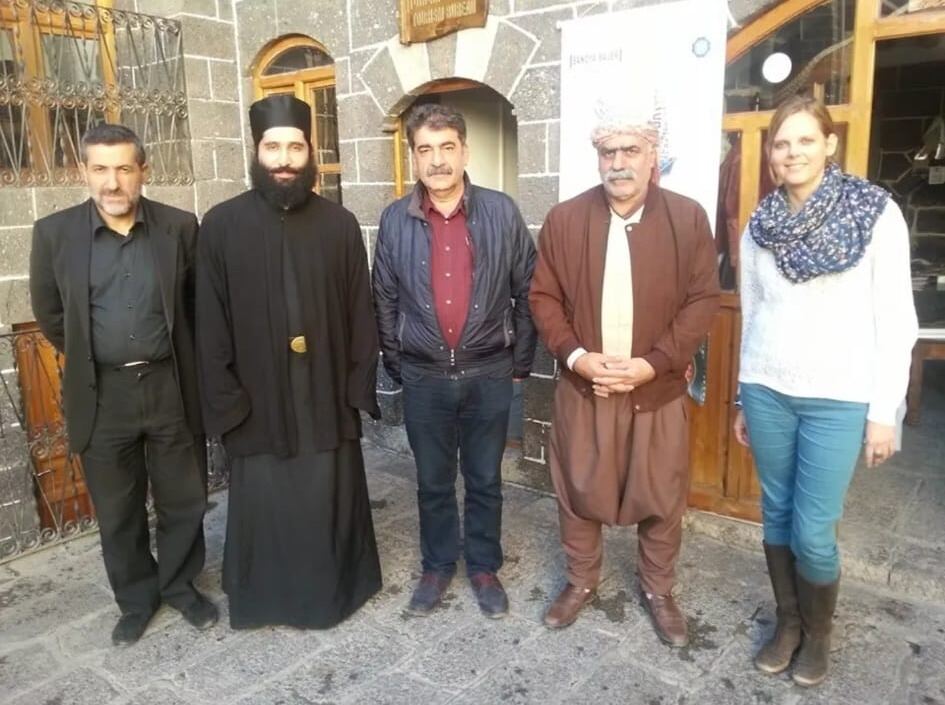
Photo: Mala Dengbêjan (the Dengbêj House) in Amed, 2013. From left to right: Yusuf Akbulut, priest of the Virgin Mary Syriac Orthodox Church in Amed; Meday Muhammad, a Christian monk of Êzidî origin; Ramazan Ergin; Hilmi Akyol, head of Mala Dengbêjan and a writer who has collected hundreds of folk tales; a Dutch academic who has written on the Kurdish lament (lawij) in Syriac historiography. That year Ergin presented at an international symposium on the first Kurdish Christian hymns written in the Syriac alphabet (Garshuni).
Ramazan Ergin, a writer and independent researcher from Amed, will present a paper at the 15th International Göbeklitepe Scientific Studies Congress, to be held in Riha on 28-29 November 2026, explaining the cosmology of Girê Mirazan, the Kurdish name of Göbeklitepe, through the Êzidî belief in creation.
Organised by ISARC, the congress brings together participants from Türkiye as well as Algeria, Azerbaijan, Bangladesh, Belarus, Georgia, India, Indonesia, Iran, Jordan, Morocco, Nigeria, Pakistan, Romania, Tanzania and Uganda. Ergin's paper is part of the in-person session to be held at the Vera Otel in Riha on the first day of the congress, Saturday 28 November, from 14:00 to 16:00. The session will be chaired by Assoc. Prof. Dr. Sevcan Yıldız. The congress sessions can also be followed via Zoom.
The paper's Turkish title translates as Explaining the Cosmology of Göbekli Tepe (Girê Miraza) from Yezidi Cosmogony, while its English title in the programme is An Explication of the Cosmology of Göbeklitepe (Girê Mirazan) through Yezidi Cosmogony. Girê Mirazan means "hill of wishes". Ergin refers to the excavation site by this Kurdish form of its name, and for Karahantepe he likewise uses Nevala Çori, the name used locally.
Reading the site through its own faith
Ergin's starting point is this: the oldest known temple structures, uncovered in the excavations at Göbeklitepe and its surroundings, force a rethinking of the accepted narratives about the history of human belief, and these finds still await explanation. According to Ergin, that explanation must be sought in the region's own faith. The paper therefore examines the sacred texts of the Êzidîs, Mishefa Reş (the Black Book) and Kitêba Cilwe (the Book of Revelation), the Êzidî creation narrative, sacred-site rituals and local place names from the perspectives of anthropology, linguistics and theology.
At the centre of the paper stands Tawûsî Melek. In the Êzidî creation narrative, this great angel, depicted as a celestial bird, is the intermediary between God and the universe. Ergin reads the name as "Tav û Sî", that is, sun and shadow. He discusses how the label "devil worshippers", which Orientalists and Western students of the East have attached to the Êzidîs for centuries, has also shaped the interpretation of the excavation finds. The bird sculptures and reliefs that Klaus Schmidt brought to light in the Göbeklitepe excavations are compared in the paper with the Êzidî tradition of sacred peacock standards.
According to Êzidî belief, the universe was created first, then place, and humankind last. Taking this order as his point of departure, Ergin sets alongside the Göbeklitepe finds, with reference to the original texts, the circle of divine protection drawn around the sacred site, the account in Mishefa Reş of Adam eating the forbidden wheat, the fish that are not eaten at Balıklıgöl (the Pool of Abraham) in Riha and similar lakes, and the Êzidî prohibitions on lettuce and hare.
The paper also draws attention to the similarity between the Göbeklitepe finds and the wish tree (Dara Mirada) and wish stone (Kevirê Mirada) rites that the Êzidîs still observe today at their temples in Laleş (Lalish) and Şengal (Sinjar). Alongside written sources, Ergin also draws on the hymns, the qewls, handed down orally by Êzidî pîrs. For centuries these texts were kept hidden from outsiders, and even within the community they were recited orally only by the pîrs. Ergin studies these hymns through video and written records of their oral transmitters, and offers a comparative assessment of tomb and temple architecture, icons, and old and new temple sites.
Kurdish names in Riha
Göbeklitepe has been on the UNESCO World Heritage List since 2018. Until now the site has mostly been discussed within the framework of Neolithic archaeology. The faith and language of the people of the land where the excavations take place, however, have found little room in these discussions. Ergin's paper proposes that Göbeklitepe be discussed at an international congress together with its Kurdish name and the Êzidî faith.
We will share Ramazan Ergin's paper with our readers once it is published. We wish our dear friend every success with his presentation in Riha.
Programme details
- Event: 15th International Göbeklitepe Scientific Studies Congress (ISARC)
- Paper: An Explication of the Cosmology of Göbeklitepe (Girê Mirazan) through Yezidi Cosmogony, Ramazan Ergin
- Date and time: Saturday 28 November 2026, 14:00-16:00 (in-person session)
- Venue: Vera Otel, Riha (Şanlıurfa)
- Session chair: Assoc. Prof. Dr. Sevcan Yıldız
- Online: Congress sessions can be followed via Zoom (www.isarconference.org)