
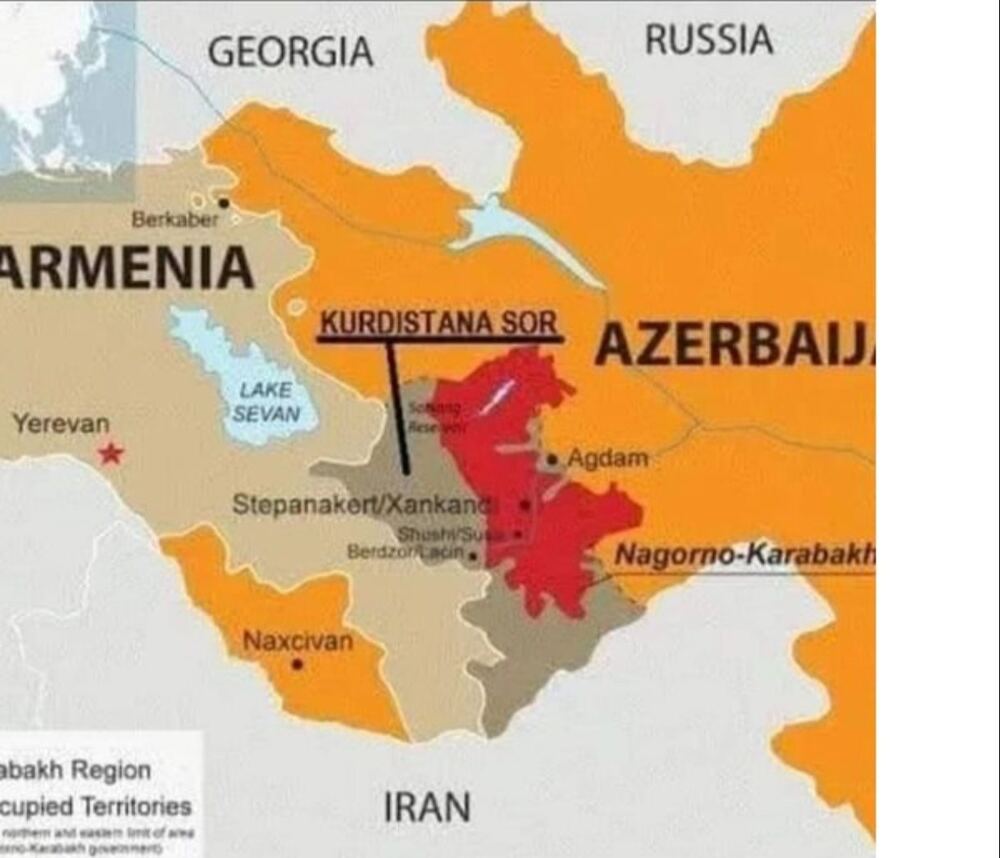
Russia Views an Independent Kurdistan as a Geopolitical Threat
Russia's Southern Policy and Kurdish Resistance.
Moscow's perception of an independent Kurdistan as a geopolitical threat.
Russia's Southern Policy and Kurdish Resistance: The Unseen Actor of Strategic Balance
Why the Statehood of the Kurds Frightens Russia?
Kurds and Russia's Southern Policy: Strategic Resistance and Geopolitical Balance between the 17th and 20th Centuries.
In Russia’s historical geopolitics, the ideal of “reaching warm seas” has shaped the main direction of foreign policy for more than four centuries. The desire to reach the Black Sea, the Caspian Sea and the Mediterranean is driven by both commercial and military motives. Yet, in pursuing this goal, Russia has confronted not only the Ottoman and Persian states but also the strong and independent Kurdish communities that lay between these two empires.
The geographic position of the Kurds—strategic mountain ranges stretching from the Caucasus to Mesopotamia—has formed a natural barrier that has impeded Russian south‑ward expansion plans for centuries.
I. 17th Century: Mukri Resistances
In the 17th century, the Russian Empire, while attempting to advance southward through Safavid lands, faced strong resistance from the Kurdish emirates inhabiting the present‑day Urmia, Mahabad, and Sinjar corridor.
In particular, the Mukri and Ardalan emirates established an active defensive line that blocked the Russians from moving from the Caspian coast into the interior.
The Kurdish beys’ aim was not only to preserve regional sovereignty but also to defend Kurdish and Kurdistan lands against Slav raids coming from the Caucasus. This period is regarded as the first time the Kurds directly halted Russian expansion.
Second half of the 18th century: Peter the Great’s Caspian Expedition and the Role of the Kurds
Peter the Great (Peter I), in 1722, aimed to move south after seizing the shores of the Caspian Sea.
After the Russian forces captured Derbent and Baku, they advanced toward Erbil, Urmia, and Tabriz.
However, the Mukri, Hewraman, and Soran Kurds living in these areas, together with local militia forces, halted the Russian advance.
Peter’s army was forced to retreat due to both Kurdish resistance and the region’s harsh terrain.
This incident entered history as the first major failure of Russia’s “crossing the Caspian to reach Baghdad” plan.
III. 19th Century: Red Kurdistan and the Caucasus Wars
The 19th century was a critical period in which Russia occupied the Caucasus and approached the Ottoman‑Iranian border.
However, Russia’s push southward met fierce resistance in Red Kurdistan.
At the heart of that resistance were Kurds living along the Lachin, Kelbajar, Kubatly and Zangilan lines.
Two leaders emerged prominently during this period:
Seyid Teymur Shemsedinov,
Hüseyin Ağa Shemsedinov
These leaders organized local militias against the Russian army, protecting both the Red Kurdistan and the passes into Iran.
The Russian army attempted to move through the area several times, but each time it was met by Kurdish resistance.
Consequently, Russia was forced to abandon a direct southern advance and instead develop a permanent “buffer zone” strategy in the Caucasus.
IV. Bedirxan Bey and the Position of the Kurds in the Ottoman‑Russian Wars
In the mid‑19th century, Bedirxan Bey, the leader of the Botan Emirate, played a direct role in the wars between the Ottoman Empire and Russia.
The military organization established by Bedirxan Bey in the 1840s delayed Russian advances along the eastern frontier where the Ottoman army was weak.
Although the Bedirxan uprising was eventually suppressed by the Ottomans, Kurdish resistance kept the Russians from penetrating the region for a long time.
This is another reason why Russia could not reach Mesopotamia directly.
Early 20th Century: Soviets and the Red Kurdistan Republic (1923–1929)
After the Bolshevik Revolution, the Soviets redrew borders in Transcaucasia.
The Red Kurdistan Republic was established in the Laçin, Kubatlı and Kelbecer areas where Kurds lived.
Although it appeared to be under Soviet control officially, local Kurdish officials did not fully obey Moscow.
Commanders linked to the Şemsedinov family and local intellectuals opposed Russia's use of the “Kurdish region as a military base.” Thus the Kurds once again thwarted Russia's plans to move south.
For this reason, the Soviet administration, citing its friendship with Mustafa Kemal and taking his request into account, dissolved Red Kurdistan in 1929.
The Turkish Republic, under Mustafa Kemal, strongly opposed a Kurdish state established in Red Kurdistan.
Conclusion
From the 17th to the 20th century, the Kurds were a strategic force that halted Russia's policy of advancing to the warm seas at least six times.
This resistance was not only military but also carried a geopolitical character.
Russia never managed to establish a lasting dominance in the mountainous regions inhabited by the Kurds; each time it withdrew due to the Kurds' local organization, tribal systems, and geographic defensive advantages.
As a result, the Kurds became an unseen yet highly effective actor in Russia's four‑century‑long southern policy.
Geopolitical Background of Russia's Stance Against a Kurdish State
Behind Russia's historically negative attitude toward the Kurds establishing an independent state lie not only ideological but also geopolitical reasons.
The regions inhabited by the Kurds — the Caucasus, Mesopotamia, and the Iranian plateau — have long been at the heart of Russia's “advancement to the warm seas” strategy.
A strong and independent Kurdish state established in these regions would weaken Russia’s line of influence over both the South Caucasus and the Middle East.
This stance has not changed even during the Soviet Union era in the 20th century.
The Red Kurdistan Republic, founded in 1923, was shortly thereafter dissolved by Moscow.
Because an independent or semi‑independent Kurdish state would weaken Soviet control in Transcaucasia and also disrupt the balance politics over Iran and Turkey.
Therefore, although Kurdish identity was recognized at a cultural level within the Soviet system, political autonomy was constantly blocked.
As a result, the basis of Russia’s distant approach to a Kurdish state lies in historical memory and strategic concerns.
Russian policy thinking has long viewed Kurds throughout history as a “geopolitical actor that could upset regional balance,” and thus has regarded the idea of a Kurdish state as a threat to its sphere of influence.
Even today, the cautious stance of Moscow toward the Kurdish issue is underpinned by this centuries‑old geopolitical fear.
Shamîl Teymurov
18.10.2026