
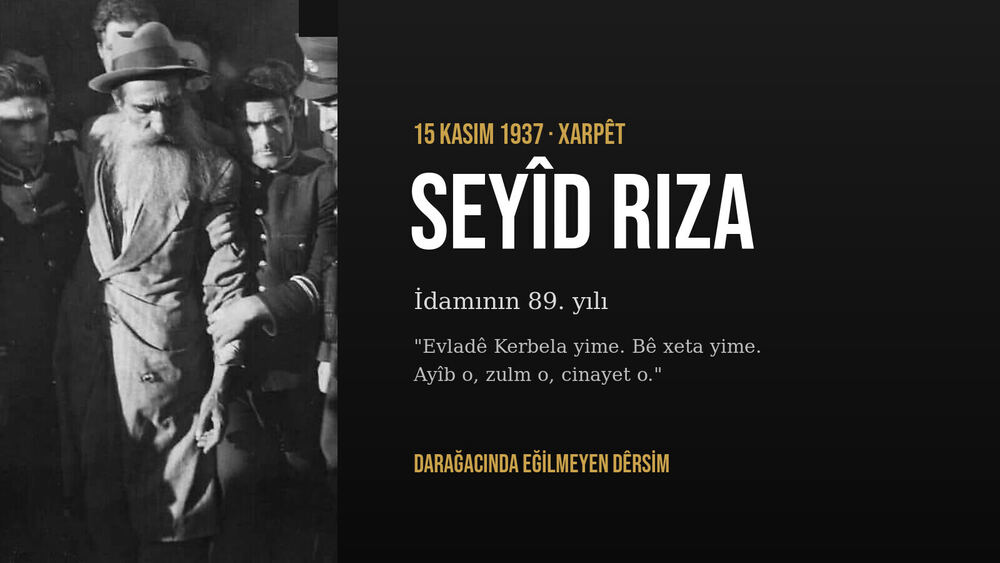
89th Anniversary of Seyid Riza's Execution: Dersim, Unbowed on the Gallows
Dersim's leader Seyid Riza and six of his companions were executed in Kharpert's Wheat Square on the night of 15 November 1937. In the 89 years since, their honour has not been restored, and the location of Seyid Riza's grave is still kept secret.
Eighty-nine years have passed since Dersim's leader Seyid Riza and six of his companions were executed in Kharpert's Wheat Square. On the gallows erected on the night of 15 November 1937, the seventy-five-year-old Seyid Riza was hanged together with his sixteen-year-old son Resik Huseyin and the leaders of Dersim's tribes.
Those executed that night were: Seyid Riza; his son Resik Huseyin; Seyid Huseyin, chief of the Şêxan tribe; Fındık, son of Kamer, chief of the Yusufan tribe; Hesen, son of Cebrail, chief of the Demenan tribe; Hesen, son of Ulkiye, of the Kureyşan tribe; and Elî Gule, son of Mirza Elî.
The trial was held in Elazığ before a court set up under the special provisions of the Tunceli Law, enacted in 1935. The defendants were denied the right of appeal. Because the penal code prohibited the execution of anyone under eighteen or over sixty-five, Seyid Riza's age was lowered in the records and his son's age was raised. The executions were carried out in haste so that they would be completed before Mustafa Kemal Atatürk arrived in the region on 17 November.
According to the memoirs of İhsan Sabri Çağlayangil, the state official who oversaw the executions, Seyid Riza spoke these words before the gallows in the Zazaki dialect of Kurdish: "Evladê Kerbela yime. Bê xeta yime. Ayîb o, zulm o, cinayet o." That is: "We are the children of Karbala. We are innocent. This is a disgrace, this is oppression, this is murder."
What was truly defeated on Seyid Riza's gallows was the law of those who hanged him.
The executions marked the beginning of the great massacre of 1938. Villages were burned, inhabitants who had taken refuge in caves were killed, the mountains of Dersim were bombed, and the survivors were deported to the west. In 2011, Recep Tayyip Erdoğan, then Prime Minister, citing state documents, announced that 13,806 people had been killed and 11,683 deported, and described what had happened as a "massacre." Yet these words were never turned into any concrete step. The archives have not been fully opened, the honour of Seyid Riza and his companions has not been restored, and the location of Seyid Riza's grave has remained undisclosed for 89 years.
On 11 November 2026, lawyer Cihan Söylemez applied to the Ministry of Justice, through the Tunceli Chief Public Prosecutor's Office, for the death sentences to be quashed by "annulment in the interest of the law." The application states that the sentences were handed down without the right of appeal, in violation of the constitution and penal laws of the time.
A genuine reckoning with what happened in Dersim must go even further. The name of Wheat Square, where Seyid Riza and his companions were hanged, must be changed to Dersim Square. Today there is no statue of Hitler in any square in Israel. For a state that acknowledges a massacre to go on keeping statues of that era's rulers in the very region of the massacre is a shameful contradiction. The Atatürk statues in Dersim must be removed, and the mosque policy imposed on Alevi Dersim after 1938 as a tool of assimilation must be brought to an end. For centuries Dersim governed itself. Dersim was autonomous, and its right to live autonomously remains valid today.
If President Recep Tayyip Erdoğan, who acknowledged the Dersim massacre, wishes to lessen the weight of this crime against humanity, he must stand by his own words. To acknowledge a massacre while continuing to honour those who committed it is to take back the apology.
Every 15 November, Kurds commemorate Seyid Riza because he refused to surrender and spoke his last words before the gallows in his own language. Eighty-nine years on, Dersim is still asking the same question: Where is Seyid Riza's grave?