
How the Youth Movement Changed Power in Serbia
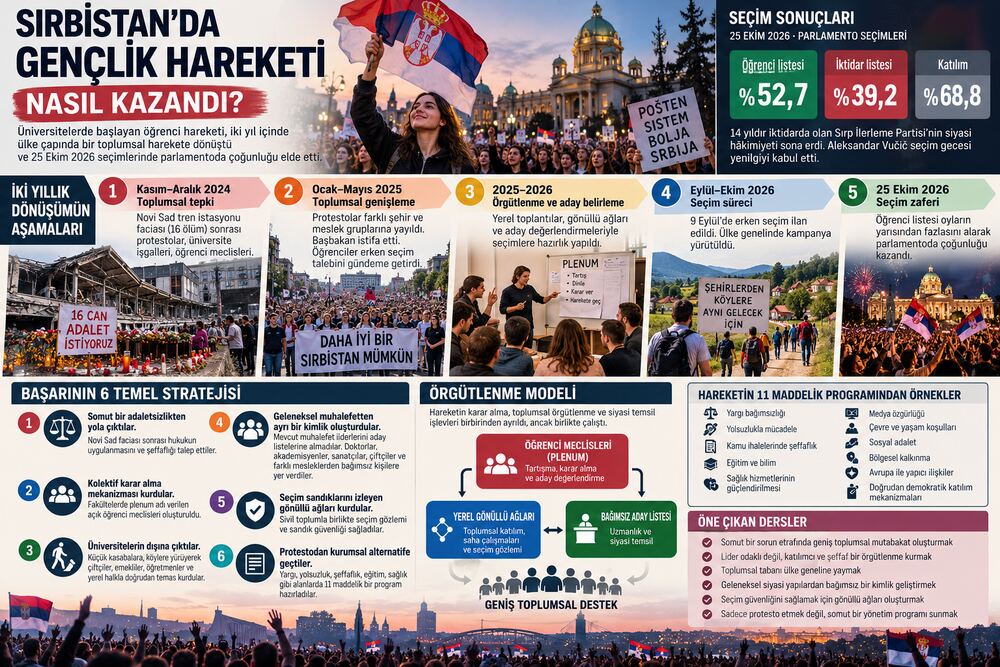
The student movement that emerged from the tragedy in Novi Sad won 141 of the 250 seats in the October 25 elections, ending the Serbian Progressive Party’s 14‑year rule. Six key factors lie behind this victory.
A student movement that began two years ago at a train station in Serbia secured an outright majority in parliament in the October 25, 2026 elections. Assemblies formed in university amphitheaters evolved into a nationwide social organization and delivered a change of power through the ballot box.
First, let's look at the results, then at the organizational model behind them.
1. What exactly happened in Serbia?
In the early parliamentary election, the Student List captured 52.7 % of the vote. The “Aleksandar Vučić – United Serbia” list, led by Aleksandar Vučić of the Serbian Progressive Party (SNS), fell to 39.2 %. Voter turnout was 68.8 %, roughly a ten‑point increase compared with the 2023 election.
According to the initial data from the Republic Election Commission (RIK), the Student List won 140 seats in the 250‑seat parliament. After overseas votes were counted on October 28, this number rose to 141; the ruling list fell to 103 seats. The threshold needed to form a government is 126 seats. In other words, the students are in a position to form a government without coalition partners. Apart from minority lists, no list surpassed the 3 % threshold.
Thus, the political dominance of the SNS, which had been in power since 2012 – 14 years – came to an end. On election night, Vučić admitted defeat in a brief televised statement: “It is clear that we lost these elections; the Student List won.”
The figures are rounded values of the preliminary results announced between 26 and 28 October; the final results may show slight differences.
2. Six Core Factors Behind Their Success
They Started from a Concrete Injustice
On November 1, 2024, at the Novi Sad train station, the concrete slab of a newly renovated building collapsed, killing 16 people. Students demanded that those responsible be held accountable, that documents related to the renovation be disclosed, and that the law be enforced. The movement began not with abstract ideological debates but with concrete demands that anyone could understand and that no one could openly oppose.
These demands quickly spread nationwide. According to the Meetings Archive, more than 325,000 people took part in a protest held in Belgrade on March 15, 2025. In January 2025, Prime Minister Miloš Vučević announced his resignation.
They Established a Collective Decision‑Making Mechanism Instead of a Single Leader
They set up open student assemblies called plenums in faculties. Decisions were debated and voted on in these assemblies. The political side of the movement did not rely on the authority of a single individual; even when heading to the polls, students openly stated that their lists had no leader.
This structure made it difficult for the government to delegitimize the movement by targeting a single face. There is also an example that shows how seriously plenaries are taken: Belgrade University rector Vladan Đokić was excluded from the candidate list in faculty assemblies in September 2026 by a vote of 42 to 43.
They Went Beyond Universities
They walked to small towns and villages, and traveled by bicycle. They made direct contact with farmers, retirees, teachers and various communities. Through an initiative called “One Student per Village,” they set up booths in marketplaces, neighborhoods and villages, going door‑to‑door. In this way they also reached voters who never attended rallies.
Their face‑to‑face communication with people in areas where pro‑government media are dominant proved especially decisive. According to experts from the Atlantic Council, the list’s support did not remain confined to Belgrade and the major cities; it also spread to rural areas that the traditional opposition has not reached for a long time. A student summed up the pre‑election strategy: “We now have a name on the ballot, but our approach on the ground stays the same.”
They Created a Political Identity Separate from the Traditional Opposition
They did not include the leaders of existing opposition parties on their candidate list. They set six criteria for candidacy: being a Serbian citizen and of legal age, adhering to the programme, not being a student, never having been a member of the SNS, not holding a leadership position in an opposition party, and not having been convicted of a serious crime.
Instead, they gave slots to doctors, academics, artists, athletes, farmers and independent individuals from various professions. The 250‑person candidate list was distributed among five state universities in proportion to their size and was compiled with the assessments of student councils. Each council had the right to veto any candidate. At the top of the list was cardiologist Prof. Dr. Ilija Srdanović from the University of Novi Sad Faculty of Medicine.
This split also affected opposition parties. Parties such as the Democratic Party, the Green‑Left Front and the Serbian Renewal Movement chose to support the students rather than run with their own lists.
They Established Volunteer Networks to Monitor the Polling Stations
They worked with civil society organizations on election monitoring and ballot security. According to the independent monitoring group CRTA, the network of observers largely prevented systematic manipulation at the polls.
The election environment was far from equal. Throughout the campaign, intimidation attempts and unbalanced media coverage were recorded. On election day, armored vehicles blocked the entrances of several key buildings and hooded groups gathered under police protection in central Belgrade. These groups dispersed only after Vučić conceded defeat.
From Protest to Institutional Political Alternative
They did not stop at demanding the government's resignation. They drafted an eleven‑point program, dubbed the “Student Plan,” organized under three headings.
- "Serbia or the mafia?": a special prosecutor's office to dismiss officials linked to organized crime, a law to seize unlawfully acquired assets, full transparency and independent oversight in public tenders and state projects, the liberation of the media including public broadcaster RTS, and an end to partisan hiring in the public sector.
- "Information is power": modern curricula and free textbooks in primary and secondary education, a knowledge economy that supports entrepreneurs and farmers.
- "Serbia grows with us": reducing the length of temporary employment contracts from 24 months to 12 months, food security, affordable housing for young couples, cheap medicines and a doctor in every village.
3. Key lessons
The Serbian experience shows how a protest movement can turn into an electoral‑winning political force:
- Build broad societal consensus around a concrete issue.
- Create a participatory and transparent organization, not leader‑centric.
- Organize the social base not only in big cities but in every corner of the country.
- Develop a trustworthy identity independent of traditional political structures.
- Set up volunteer networks for election security.
- Offer a concrete governing program rather than merely protesting.
What Comes Next?
The real test begins now. The movement, which has deliberately avoided hierarchy until now, must now transform into a government with ministers, a prime minister and a parliamentary group. The Student List has not yet announced a prime‑ministerial candidate. Its pledges to fight corruption and uphold the rule of law will meet resistance from entrenched interest networks that have been in place for years.
On the European Union side, the door appears open. Following the result, EU Commissioner for Enlargement Marta Kos said, “A new page could be opened for Serbia. The EU’s door is open.” The students, however, oppose sanctions against Russia and have faced criticism for their nationalist rhetoric on Kosovo.
Sources: data from the Republic Election Commission of Serbia (RIK) (via the Serbian Government and Balkan Insight), European Policy Centre, Atlantic Council, Euronews, CNN, AP, Manila Times (via N1), Wikipedia.