
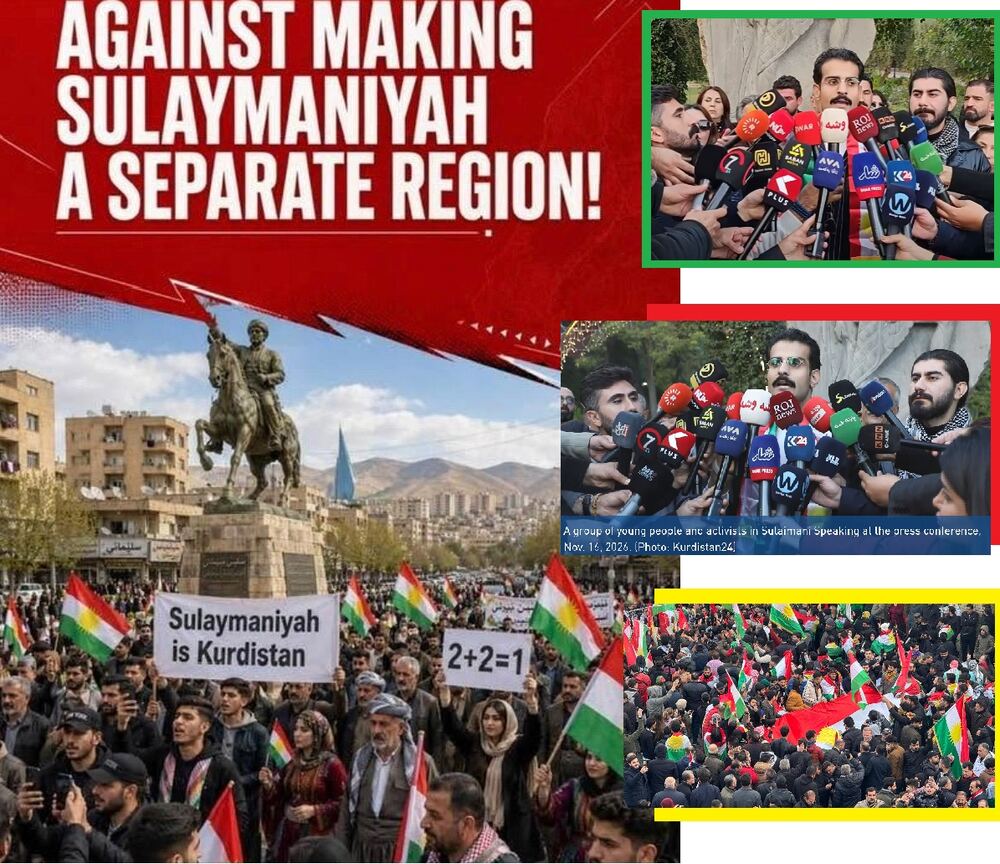
Mass rally in Süleymaniye “Süleymaniye is Kurdistan”: Broad participation against separation
The crowd that took to the streets against the attempt to make Süleymaniye a separate region, with their placards, showed that the gap between the Kurdish people and Kurdish politics has widened.
Today in Süleymaniye, a rally held under the slogan “Süleymaniye is Kurdistan” attracted a large turnout. The placards carried by participants indicated that the divide between the Kurdish people and Kurdish politics has further widened.
Kurdish politics is expected to take into account the stance and sensitivities of the Kurdish nation.
Gençler ve aktivistlerden basın açıklaması
Before the rally, youths and civil activists gathered in the city and issued a press statement on 16 November. Speaking into the microphones of dozens of local and regional channels, the activists said they oppose any attempt to detach Süleymaniye from the Kurdistan Region and turn it into a separate entity, and they stand for the integrity of Kurdistan.
Participants in the rally marched with Kurdistan flags. The placards read “Süleymaniye is Kurdistan”; another placard emphasizing unity simply said “2+2=1”. The common message of the participants was that the cost of the infighting among parties should not be paid by Kurdistan’s land and its unity.
Ayrılık tartışması nereden çıktı?
The dispute stems from a deepening crisis between the Kurdistan Democratic Party (KDP) and the Kurdistan Patriotic Union (KYB). Since the October 20, 2024 elections, a new government has not been formed. On November 4, the Kurdistan Parliament reconvened in a session attended by 52 deputies, without the participation of the KYB and the New Generation Movement, and elected a new presidential council. The KYB and New Generation are contesting the legitimacy of that session. The KYB announced on November 6 that it was withdrawing from the government.
Following that, a petition was launched in Sulaymaniyah demanding that the city become a separate federal region within the framework of the Iraqi constitution. Mahmud Hoşnav, a senior KYB official, said, “Whatever the KDP does, we will do the same in Sulaymaniyah,” heightening fears that two separate administrations could return. KYB Chairman Bafil Talabani, however, said that talk of two governments was “premature” and rejected any violence.
Is it legally possible?
Article 117 of Iraq’s constitution recognises the Kurdistan Region as an existing federal entity. Article 119 sets out the procedure for one or more governorates to create a new region; however, neither the constitution nor the 2008 law on establishing regions explicitly provides for a governorate to break away from an already existing region. Legal scholars say such an initiative would be contested in the courts and that, without federal recognition, secession could turn Sulaymaniyah and Halabja into ordinary governorate administrations with far fewer powers than they currently enjoy.
On 15 November, Iraq’s Federal Supreme Court rejected requests for interim measures concerning a parliamentary session; the substantive cases are still ongoing. The Baghdad government also stated that demands to separate governorate budgets will be evaluated within the framework of the constitution and laws, rather than as political disputes.
Intellectuals and officials also oppose secession
The street protest is not an isolated incident. On November 15, eighty academics, writers, lawyers and civil‑society representatives published a statement titled “Call to Preserve the Unity of the Kurdistan Region.” The signatories stressed that governance problems should be addressed through reform rather than new borders, and that a signature campaign alone cannot represent the will of the people of Süleymaniye.
Süleymaniye Governor Haval Ebubekir, speaking on the city’s anniversary, warned that the pride felt for Süleymaniye should not be confused with a desire to detach the city from the motherland: “No one is in favour of splitting the region. We stand for a strong region in which everyone sees themselves.” The governor said he supports granting local authorities greater administrative and financial powers, but he is opposed to any move toward secession.
Makas açılıyor
The crowd in the streets of Süleymaniye was a public response to the “separate region” card that parties use at the bargaining table. The painful memory of the 1994‑1998 civil war and the two successive administrations that lasted until 2006 remains fresh. The message of those attending the rally was clear: the Kurdish people stand for unity, not division, and for a single Kurdistan rather than a dual administration. Now all eyes are on Kurdish politics, wondering whether it will heed this voice.