
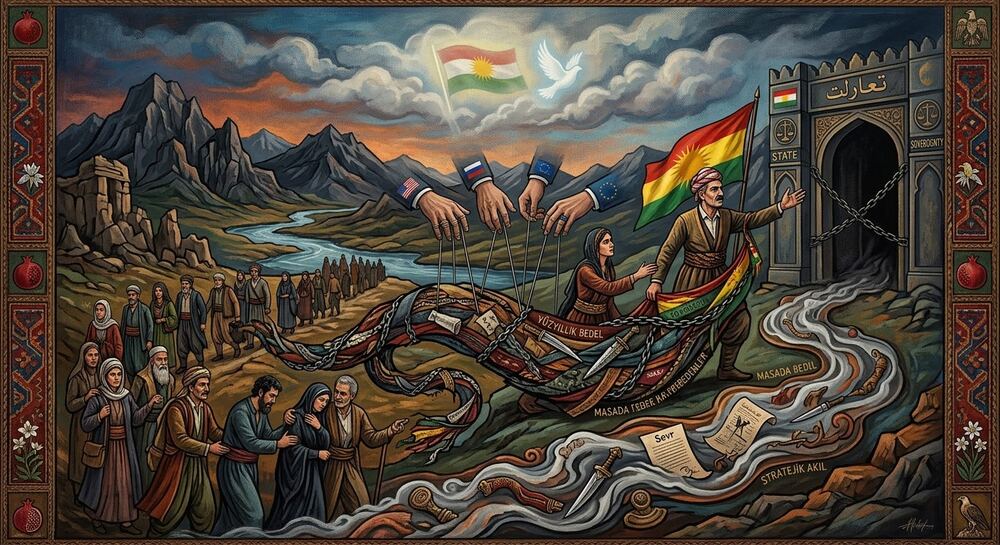
Paying the Price at History’s Tail: The Tragic Balance of Kurdish Diplomacy and Politics
In the Kurdish nation’s centuries‑long struggle, the real tragedy is not the heavy costs paid, but the repeated loss of every historic gain due to diplomacy lacking strategic sense and misguided alliances.
Just as in individual lives, the pursuit of great goals in the destinies of societies and nations can sometimes bring irreparable destruction and heavy costs. The “sacrifice everything” logic offered by modern systems or ambitions creates a tragic cycle in the fate of nations, just as it does for individuals.
The Kurdish people, who have been seeking justice for a century, paying the heaviest tolls, yet constantly retreating at the very point where they seemed to have finally arrived, represent one of the most painful examples of this tragic balance in social and political history.
The struggle of the Kurds—among the oldest peoples of Mesopotamia, living in a geography split into four parts—is a record of how sincere resistance and endless sacrifices have been squandered by diplomatic choices lacking strategic insight and by imperialist acquiescence.
Just as an individual may identify himself solely with the goals he produces or achieves, the Kurdish political movement has, throughout its history, turned the act of “resisting and paying the price” into an end in itself.
The heavy costs paid over a century—loss of lives, burned villages and forced exiles—have forged a deep culture of resistance in the collective memory of the people.
Yet when that resistance is not crowned by a rational politics, the suffering itself becomes sanctified and turns into the backbone of politics.
Just as a climber feels a fleeting satisfaction upon reaching a summit only to confront an ensuing void, the Kurdish people have repeatedly ascended a high point of hope with each uprising or wave of resistance, only to become trapped in the same cycle of emptiness and exhaustion brought on by the subsequent devastation.
The energy of younger generations, the region’s potential, and social peace have been sacrificed on this endless climb.
No matter how heroically a people’s struggle for existence is waged on the ground, diplomacy that is not properly crafted at the negotiating table is doomed to reset everything. The historical breaking points of Kurdish diplomacy are the clearest evidence of this weakness:
Throughout history, steps taken on the basis of the temporary interests of extra‑regional imperial powers (Britain, France, the United States, the Soviets, etc.) or regional actors (including the late Ottoman period and the early years of nation‑states) have reduced the Kurds to a perpetual “pawn” status.
When the imperial powers’ agenda at the table shifted, the Kurds were left alone with whatever gains they had, and often eliminated.
Instead of an independent diplomatic reasoning based on its own strength and the universal balance of international law, unconditional submission to the “conscience or interests of great powers” has led to the loss of hard‑won rights at the table. Diplomacy is conducted not by emotional demands but by real‑politics, balance of interests and lasting alliances.
The lack of this mechanism has caused centuries‑long efforts to be wasted.
International politics is a chessboard; one must calculate ten moves ahead, read the intentions of the other players on the board and know the limits of one’s own pieces before making a move.
Deprived of strategic foresight, steps taken on momentary emotion or mere reactive reflexes have paved the way for regional powers with statecraft (Turkey, Iran, Iraq, Syria) to waste those moves using their asymmetric capabilities.
The geographic and political fragmentation caused by being split into four parts has prevented the emergence of a common strategic mind. The inability of the fragments to integrate has made it easy for each part to be spent separately.
In my next article I may discuss a state structure where the four parts are independent, perhaps differing even in minor flag details.
A structure that cannot move in harmony with its own pieces on the chessboard remains vulnerable to every move of the opponent.
Success is meaningful only when it is achieved without alienating a person or a nation from its own nature, borders and values. After a century of this honorable yet equally tragic struggle, if what remains is merely a “list of historic wounds” and “unwon victories,” then this is nothing more than an embellished form of tragic defeat.
Leaving emotional and reactionary politics aside and building a cold, rational and professional diplomatic mindset, Forming lasting, mutually beneficial alliances instead of temporary promises tied to the interests of imperial powers, Making moves on the chessboard not with fleeting excitement but with long‑term strategic plans, is essential.
Otherwise, every historic threshold that has been reached “to the very end” will continue to become the beginning of a new devastation and endless costs.
Stay safe, stay Kurdish...!!!